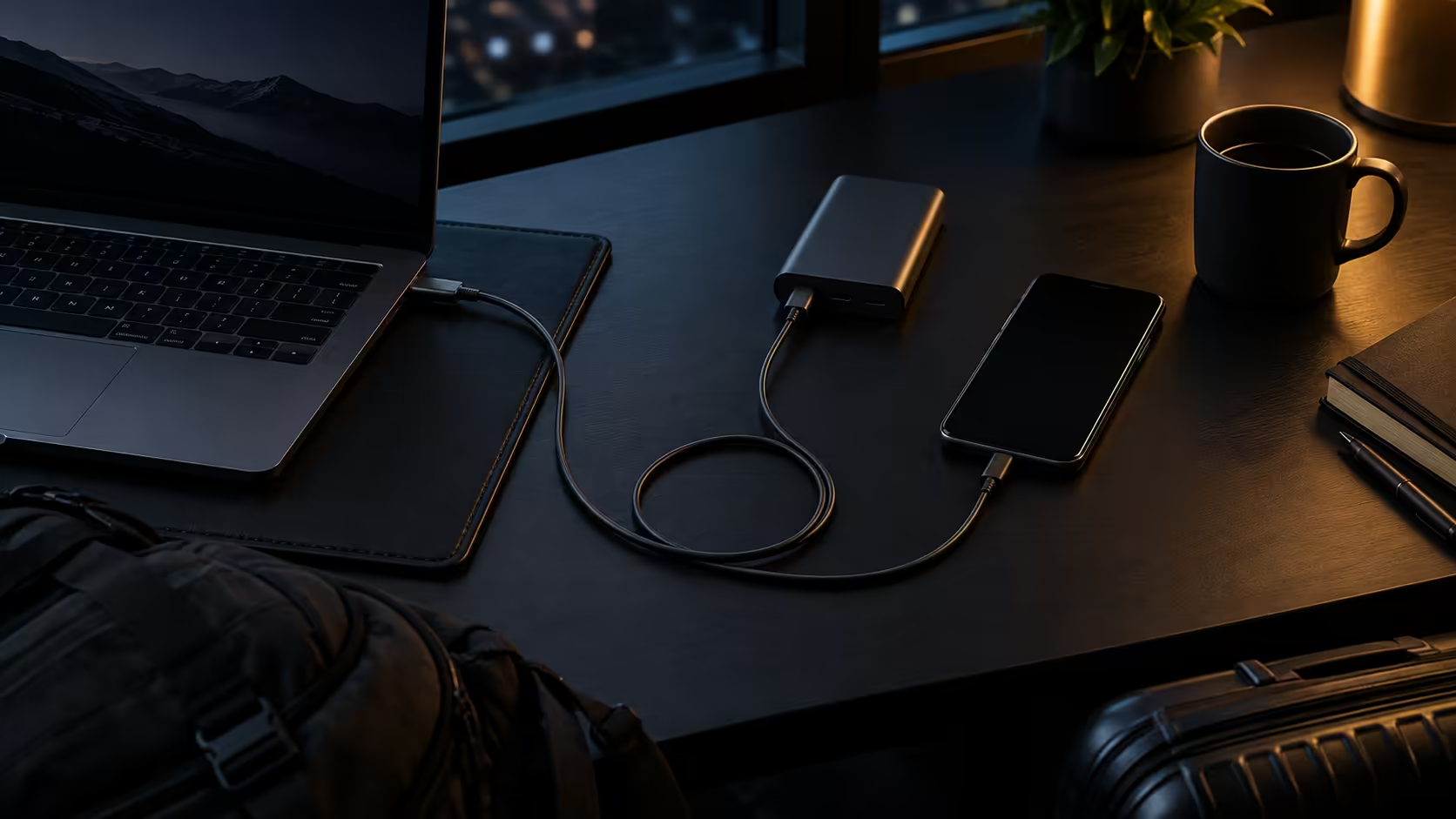
Whether high-wattage USB-C cables are worth it for South African work and travel setups depends less on the wattage number itself and more on how often a setup actually moves between a desk, a bag and somewhere else entirely.
Quick Answer
For a setup that moves between a home office and a bag, a high-wattage cable is the part that stops being a variable. The R399 Anker 544, from the comprehensive cable range, runs a laptop at full rate at the desk, survives a commute on its 30,000-bend braid, and carries local warranty cover.
📊 Why the calculation changes once travel enters the picture
A USB-C cable that only ever sees a single desk is judged almost entirely on its charging speed, since durability barely enters the equation for something that never moves. The moment a setup starts genuinely travelling, whether daily between rooms or weekly between cities, that same cable is suddenly being asked two separate questions at once, and a high-wattage cable that ignores the second one, its own physical durability under repeated handling, is only half the answer a mobile setup actually needs.
💼 The hybrid-work case for buying high-wattage
A laptop split between a home office desk and an office docking station needs a cable capable of its full charging speed at both ends, since a lower-rated cable stationed at either spot quietly throttles the laptop below whatever its own charger was actually built to supply. Buying a genuine 5A, high-wattage cable once removes this as something to think about regardless of which desk the laptop lands at on a given day.
🧳 The travel case: durability matters as much as wattage
A cable packed into a laptop backpack for a work trip faces daily coiling and uncoiling that a desk-bound cable never experiences, and that repeated handling is precisely what a published bend rating exists to forecast. A high-wattage cable that also carries a strong bend rating, such as the Anker 544's 30,000 cycles, answers both the charging speed question and the durability question a genuinely travelling setup actually needs answered together.
🔄 What actually breaks first on a moving setup
Ask anyone who has replaced a USB-C charging cable more than once why the previous one failed, and the answer is almost never "it stopped carrying enough power." It is nearly always a frayed connector or an intermittent connection, the exact failure mode a bend rating is designed to predict rather than the wattage figure printed on the box. This is worth remembering when a high-wattage cable looks expensive next to a basic one: the extra cost is very often paying for the part that was going to fail first anyway.
🏠 When the extra spend genuinely is not worth it
A laptop that never leaves a single desk, paired with a charger already at or below 60W, gets nothing from a high-wattage cable beyond unused headroom. This is a genuinely reasonable situation to stick with a standard cable, since neither the speed nor the durability argument applies to a setup that stays fixed and undemanding.
🗺️ A realistic week for a hybrid worker
Monday and Tuesday at a home desk, Wednesday through Friday at a co-working space, with the laptop and its USB-C cable making that trip in a bag each time: this is an increasingly ordinary week for South African professionals, and it is precisely the pattern that turns a cable's rating and durability into genuinely practical concerns rather than theoretical ones. A cable that only performs well in one of those two locations, or that cannot survive the daily transit between them, fails the actual test this lifestyle sets.
🛒 Buying for a setup that genuinely moves
Where work and travel both feature in the same setup, a single high-wattage, well-rated cable such as the Anker 544 at R399 covers the charging requirement at every location it lands and survives the handling that comes with actually being carried between them. A local warranty means any fault gets sorted with a nearby courier rather than a wait for something to travel overseas and back.
Frequently Asked Questions
Does a high-wattage cable actually charge faster at every location, or just some?
It charges at full speed wherever the charger and device at that location also support the higher wattage, so the cable itself is never the limiting factor across different setups.
Is durability or wattage the more important factor for a travelling setup?
Both matter for this specific use case, since a travelling cable needs to survive daily handling as much as it needs to carry the wattage a work laptop demands.
Would two separate cables work better than moving one back and forth?
Budget permitting, dedicating one cable to travel and a second to the desk avoids the daily swap entirely, though a single well-rated cable handles both roles perfectly well if that suits your setup better.
Does a docking station need the same wattage cable as a direct charger connection?
Yes, the docking station simply passes the charging connection through, so the same rating requirement applies as it would connecting the laptop directly to a wall charger.
Is it worth carrying a backup cable specifically for work travel?
Yes, given how disruptive a failed cable is during a work trip, a low-cost spare rated to the same standard is cheap insurance against losing charging capability at the wrong moment.
Does a rented workspace or hotel desk change what cable length is needed?
It can, since these locations vary widely in where sockets sit relative to the desk, which is another reason a slightly longer 1.8m cable travels better than the shortest option available on a shelf.
Should a freelancer working from several client sites think about this differently from an employee?
Not fundamentally, though a freelancer moving between more varied locations each week benefits even more from a single high-wattage, durable cable that removes one more thing to think about at each new site they visit.
Does the number of chargers owned matter as much as the number of cables?
Somewhat, since a genuinely capable charger at each fixed location, paired with one durable cable that travels between them, is usually more practical than carrying a heavy charger back and forth every day too.
Ready to decide if a high-wattage cable suits your own setup?
Buy it if your laptop moves between locations, skip it if it never leaves one desk.