


PCIe 5.0 vs PCIe 4.0 for Video editing in 4k in SA
PCIe 5.0 vs PCIe 4.0 for video editing in 4k is mainly about fit, features, compatibility, cost, and upgrade path, not one automatic winner. SA buyers should match the choice to the setup.
Read morePremium arcade parts can justify more than R3,000 only when their exact hardware, fit and serviceability meet needs that cheaper options miss. The C2 does not occupy that band: it costs R1,799 with Sanwa Denshi parts, placing the product R1,201 below the title figure.
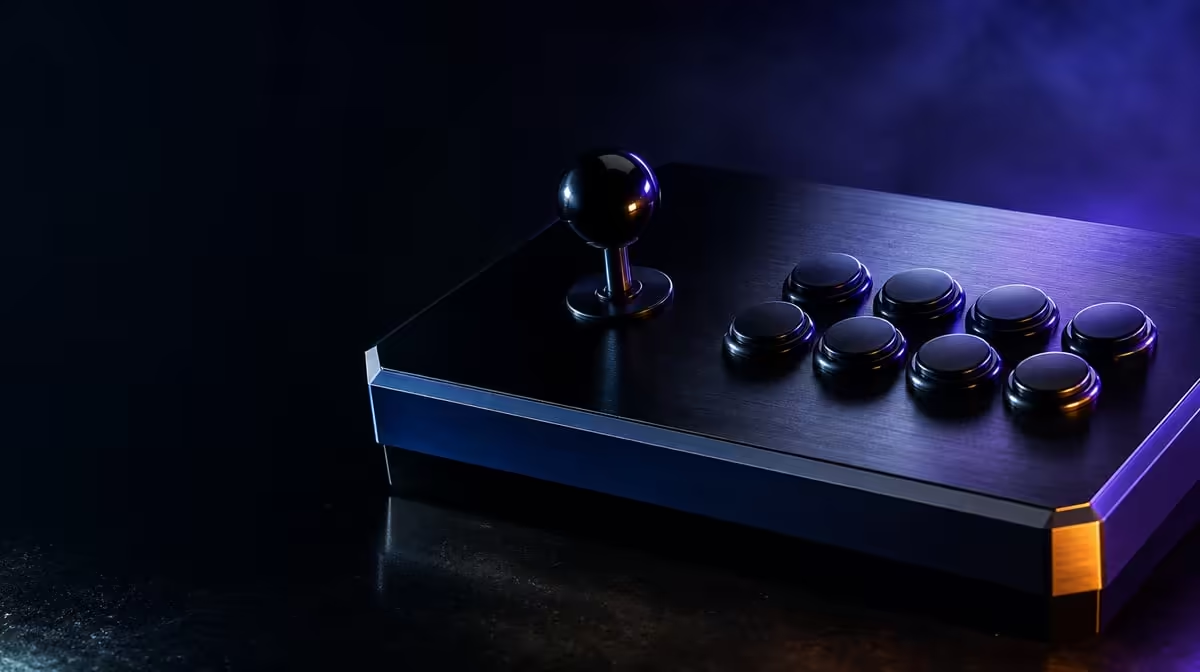
Expensive arcade hardware can be worthwhile, but a four-figure label cannot stand in for fit, serviceability or performance you can actually use. In this comparison, arcade parts above R3,000 must justify needs that a less costly complete fightstick leaves unresolved.
Arcade hardware over R3,000 is worth considering only when its exact components, supported platforms, enclosure and maintenance options solve a defined requirement. The GameSir C2 is not in that band: at R1,799 with Sanwa Denshi controls, it sits R1,201 below R3,000 and provides a useful lower-cost benchmark.
The C2 should not be described as a R3,000 product. Its reference price is R1,799. That distinction matters because the title's higher figure is a decision threshold, not the product's cost. Any premium alternative would need to earn at least R1,201 of additional value for the individual buyer.
Value is not calculated by subtracting two prices and declaring the cheaper item the winner. Begin with a list of unmet needs: a different supported platform, a precisely identified component, a particular enclosure fit or easier service access. If the C2 already serves the required consoles and layout, a higher figure needs a clearer reason.
Use Evetech's gaming controller range to compare complete devices and current availability. Keep the R1,799 baseline visible so feature claims do not blur the size of the premium.
Sanwa Denshi controls make the C2 easier to assess than a fightstick whose arcade hardware is entirely unspecified. The name establishes a component family, not every internal model, switch force, gate shape or mounting detail. Those specifics still require direct evidence.
Test consistency rather than reputation. Press each button individually, alternate pairs, hold every cardinal direction and trace diagonals at a controlled pace. Record missed and unintended inputs. Repeat the exercise after the initial excitement has faded.
A more expensive stick can earn a premium if it provides the exact component configuration a player wants and that difference produces reliable comfort or easier maintenance. It does not earn it merely by making the same broad "arcade grade" claim at a higher price.
The C2 names PS4 and Xbox One support. For a player using both, one familiar control surface across those systems has real value. Other hosts, including PC routes, should be confirmed instead of folded into the score without evidence.
Its directional toggle supports mode configuration, and the Key Lock protects selected functions from stray activation. The customisable faceplate offers visual flexibility. These included features deserve weight only where they affect the buyer's games, event routine or ownership experience.
An option above R3,000 could justify its difference through broader confirmed support or a specific layout improvement. The comparison must remain like for like: named host against named host, observed comfort against observed comfort, documented part against documented part.
Event use adds another filter. A feature that matters only on an unplanned platform should not dominate the purchase, while reliable setup on the actual tournament host may deserve substantial weight. Keep future possibilities in a separate column from needs already on the calendar.
Serviceability can matter to players who expect years of heavy use, but it has to be demonstrated. Ask whether the exact internal parts are identified, whether suitable replacements exist for the mounting and connectors, and whether opening procedures are documented. Do not infer easy upgrades from the Sanwa badge alone.
The C2's artwork-ready faceplate is a confirmed custom feature, though dimensions and removal steps still need the correct guidance. Cosmetic access is different from proof that every button or joystick can be swapped casually.
Evetech's gaming accessory selection may reveal transport or desk needs around the controller. Add those costs to both options fairly instead of burdening only one side of the comparison.
Create a premium ledger. In the left column, place every benefit of the higher-priced option. In the right, describe how often you will use it and what evidence supports it. Remove vague status, future-proof language and features outside your systems. What remains is the case for paying above the C2 benchmark.
For a competitive player, a better physical fit used every evening could be worth more than decorative extras. For a casual player on PS4 or Xbox One, the C2's Sanwa layout and match controls may already cover the important ground. The answer can differ without either buyer being wrong.
Check Evetech's popular accessories collection for current availability around the complete setup, then protect the decision from impulse. A premium is defensible when the need, component and result are all specific.
Put comfort evidence beside the ledger. Use the same practice sequence on both layouts, preferably across more than one day, and record unwanted directions, missed buttons and physical strain. A premium that removes a persistent problem carries more meaning than one that merely feels different for five minutes.
Maintenance planning can also earn money, but only when the exact pathway is understood. Clear access, identified parts and appropriate instructions reduce ownership friction. An expensive enclosure with uncertain internals should not receive an automatic serviceability score.
The final question is frequency. A small improvement used for hundreds of sessions can justify a large gap, while a dramatic feature used once cannot. Translate every claimed advantage into a weekly action before approving the extra R1,201.
Test both price levels on ordinary tasks, not only their most impressive feature. Establish recognition, complete the same input drill and play through a normal session. A premium option should retain its advantage when novelty is removed and the player is simply trying to execute familiar commands.
Include the cost of learning and configuration. Moving to another layout may require new muscle memory, different maps and new transport habits. Those are not reasons to avoid a better fit, but they belong beside the hardware difference when comparing total usefulness.
Set a review date before purchasing. After several weeks, return to the reasons written in the premium ledger and mark which benefits actually appeared. A higher price can remain justified when the evidence survives ownership; if the claimed gains never enter play, the decision record will make that clear without relying on brand status or hindsight.
No. The C2 costs R1,799, placing it R1,201 below the comparison threshold.
It uses Sanwa Denshi controls. Identify the exact button, joystick and gate models before buying replacement parts.
It can make sense when confirmed platform coverage, exact components, physical fit or service access solve needs the lower-priced choice does not.
Price cannot replace timing, practice or comfort. Judge whether the hardware produces a repeatable benefit in the player's real games.
Only if visual customisation carries substantial personal value and the complete hardware comparison is already sound. The C2 already confirms an artwork-ready faceplate.
It should deliver specific, evidenced usefulness that the buyer will actually use, not a broad prestige claim.
Ready to make a premium prove its purpose? Compare Evetech's gaming controllers against the R1,799 C2 baseline and pay more only for confirmed differences that improve your own setup.
No. The C2 costs R1,799, placing it R1,201 below the comparison threshold.
It uses Sanwa Denshi controls. Identify the exact button, joystick and gate models before buying replacement parts.
It can make sense when confirmed platform coverage, exact components, physical fit or service access solve needs the lower-priced choice does not.
Price cannot replace timing, practice or comfort. Judge whether the hardware produces a repeatable benefit in the player's real games.
Only if visual customisation carries substantial personal value and the complete hardware comparison is already sound. The C2 already confirms an artwork-ready faceplate.
It should deliver specific, evidenced usefulness that the buyer will actually use, not a broad prestige claim.
PCIe 5.0 vs PCIe 4.0 for video editing in 4k is mainly about fit, features, compatibility, cost, and upgrade path, not one automatic winner. SA buyers should match the choice to the setup.
Read more
Wi-Fi 7 vs Wi-Fi 6e for competitive esports comes down to router support, latency goals, device compatibility, and coverage. SA buyers should match the choice to the real network setup.
Read more
ATX 3.1 vs ATX 3.0 for mMO and live-service games buyers - what changes is mostly about compatibility, budget, upgrade path, and setup fit. SA buyers should check device support and real needs before expecting a clear win from either option.
Read more
LGA 1851 vs LGA 1700 can affect Twitch and YouTube streaming when gaming and encoding share CPU resources. For SA creators, the real-world difference depends on encoder choice, memory support, motherboard cost, thermals, and upgrade plans.
Read more
X870E vs X670E for aaa single-player gaming is mainly about fit, features, compatibility, cost, and upgrade path, not one automatic winner. SA buyers should match the choice to the setup.
Read more
Hall Effect switches vs Mechanical switches for mMO and live-service games is mostly about compatibility, budget, upgrade path, and setup fit. SA buyers should check device support and real needs before expecting a clear win from either option.
Read more
A fake 113GB GTA VI ISO reportedly used empty padding around a small malware payload. SA gamers should delete unofficial builds, keep Windows security active and wait for official channels.

Wi-Fi 6E vs Wi-Fi 6 matters for 4K video editing when files move across a network. The real-world difference between Wi-Fi 6E and Wi-Fi 6 for video editing in 4K depends on NAS access, cloud uploads, router range, and SA creator workflows.

The difference between PCIe 5.0 and PCIe 4.0 for SA gamers is mostly bandwidth headroom. Compare GPU slot needs, NVMe speed, motherboard support, and upgrade timing before paying extra for a newer platform.

Gaming PC stuck pixel checks in South Africa should confirm the monitor fault first. Use colour tests, screenshot comparison, cable swaps, display menu checks, and clear photos before deciding on support.

Shokz OpenFit Air 2 earbuds weigh 7.2g each and use a redesigned dual-driver open-ear layout. SA buyers should choose them for comfort and awareness, not maximum isolation.

AMD's current driver now lists a Radeon RX 9050 4GB, while product coverage details a narrowed memory system. SA buyers should weigh the low VRAM ceiling against current local Radeon options.

Samsung Display has demonstrated a 16-inch 2.5K OLED laptop panel running at 300Hz. SA buyers should wait for a named notebook, full panel specifications and a local price before planning an upgrade.

Microsoft says some Windows 11 game crashes after recent updates are linked to RGB-related drivers. Affected SA gamers should confirm the update and driver before using the published registry workaround.

Minisforum's M2 Pro pairs Core Ultra X7, Arc B390 graphics and 32GB onboard memory in 1.8 litres. SA buyers should weigh its fixed memory and $1,439 launch offer against local mini PCs.

Smart monitors can add apps and convenience, but they also add privacy settings and unwanted-software risk. SA buyers should audit the operating system before paying for extras.

Lenovo says Legion Go failures linked to BIOS N3CN42WW are not user error. Affected SA owners should stop retrying the update, preserve proof and open a support case.
The ROG Gjallar gaming soundbar is now listed in the US at $599.99. SA buyers should compare its 2.1.2 audio, wireless bass and built-in chat controls with simpler local options.