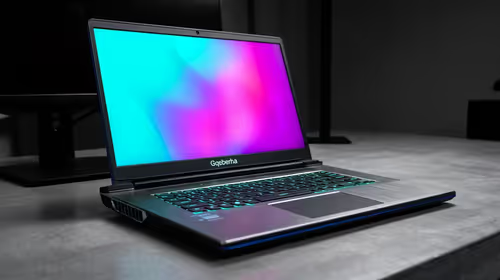
Ever scrolled through Evetech and wondered why one ASUS Vivobook costs R9,000 while another, almost identical-looking model, is R19,000? You're not alone. This isn't a pricing error; it's by design. The big ASUS Vivobook price difference comes down to the powerful components packed inside that sleek chassis. Understanding what's under the hood is the key to choosing the right machine for your needs… and your wallet. Let's break it down.
Cracking the Code: What Drives Vivobook Prices?
At its core, the Vivobook series is a versatile family of laptops, not a single product. ASUS creates dozens of configurations to serve everyone from students on a tight budget to creative professionals who need serious power. The price tag you see is a direct reflection of the performance you get.
The primary factors influencing the ASUS Vivobook price are the processor (CPU), graphics (GPU), RAM, storage, and, crucially, the screen quality. A small bump in any of these specs can add thousands of Rands to the final cost, so knowing what you actually need is everything.
The Engine Room: CPU and GPU Variations ⚙️
The biggest chunk of a laptop's cost is almost always its processor and graphics hardware. This is where the most significant performance gains… and price jumps… happen.
CPU: The Brain of the Operation
The Central Processing Unit (CPU) handles all the thinking. The model you get determines how fast your laptop feels for everyday tasks, multitasking, and demanding applications.
- Intel Core i3 / AMD Ryzen 3: Perfect for browsing, streaming, and document editing. These entry-level chips keep the price down.
- Intel Core i5 / AMD Ryzen 5: The sweet spot for most people. They offer excellent performance for general productivity, light photo editing, and even some casual gaming. For a reliable daily driver, you'll find powerful options in our range of ASUS Intel laptops.
- Intel Core i7 / AMD Ryzen 7: Aimed at power users. If you're into video editing, coding, or running complex software, these high-end CPUs are worth the investment. You can often find ASUS Ryzen laptop deals that offer incredible multi-core performance for less.
GPU: The Visual Powerhouse
The Graphics Processing Unit (GPU) renders everything you see on screen. For most Vivobooks, the GPU is "integrated" into the CPU, which is fine for video and basic tasks. However, some higher-end models include a "dedicated" graphics card, causing a major price increase. This is a must-have for anyone serious about gaming or creative work.
Beyond the Core: RAM, Storage, and Display Quality
While the CPU and GPU are the headliners, these other components play a massive role in both performance and the final ASUS Vivobook price difference.
RAM and Storage
- RAM (Memory): Think of RAM as your laptop's short-term workspace. 8GB is the minimum today, but 16GB is the new standard for smooth multitasking. More RAM means a higher price.
- Storage (SSD): Modern Vivobooks use speedy Solid-State Drives (SSDs). The price variation here comes from capacity. A 256GB SSD is budget-friendly, while a 1TB SSD offers ample space for games and large files but costs significantly more.
The Display: Your Window to the World ✨
This is the secret ingredient behind many of the price variations you see. Two Vivobooks might have the same CPU, but one could have a basic screen while the other boasts a stunning OLED panel.
- Standard IPS: Offers good viewing angles and decent colour.
- OLED: Provides perfect blacks, incredible contrast, and vibrant, professional-grade colour accuracy. For photographers, video editors, or anyone who values a breathtaking visual experience, the extra cost for an OLED screen is absolutely worth it.
Screen Spec Pro Tip ⚡
When comparing models, don't just look at the resolution (e.g., Full HD). Check the brightness, measured in 'nits' (300+ is good), and the colour gamut, like '100% sRGB' or '100% DCI-P3'. A brighter, more colourful screen makes a huge difference and is a key reason why some Vivobook models cost more.
Finding Your Perfect Match 🚀
So, why do ASUS Vivobook models vary in price so much? Because they're built for different people.
- For the Student: A Ryzen 3/Core i3 model with 8GB RAM and a 256GB SSD is a budget-friendly hero for assignments and Netflix.
- For the Young Professional: A Ryzen 5/Core i5 with 16GB RAM, a 512GB SSD, and an optional OLED screen is the perfect all-rounder.
- For the Creator: A Ryzen 7/Core i7, 16GB+ RAM, a 1TB SSD, and a mandatory OLED display provide the power needed for demanding creative workflows.
The key is to pay for the performance you'll actually use. Keep an eye on our ASUS laptops on special to snag a high-spec model at a great price. Ultimately, exploring the full range of ASUS Vivobook laptops is the best way to see these differences for yourself.
Ready to Find Your Perfect Vivobook?
Now that you understand what drives the ASUS Vivobook price difference, you're ready to make a smart choice. Match the specs to your needs and budget. Explore our massive range of laptop specials and find the perfect Vivobook to power your projects and passions.