


80+ Gold vs 80+ Platinum for Couch co-op gaming in SA
80+ Gold vs 80+ Platinum for couch co-op gaming is about PSU efficiency, heat, fan behaviour, quality, and wattage headroom, not direct FPS. SA buyers should compare the whole build.
Read moreStruggling with backlight strobing motion blur settings? We tested various strobe lengths to reveal the critical tradeoffs between motion clarity and screen brightness. Discover the sweet spot for competitive gaming and find out if the sacrifice in brightness is worth the crystal-clear visuals. Get ready to eliminate ghosting for good! 🎮✨
Ever tracked a fast-moving enemy in Valorant only for them to become a blurry mess? That frustrating ghosting is motion blur, the nemesis of competitive play. Many gaming monitors offer a secret weapon: backlight strobing. This tech promises crystal-clear motion by sacrificing some brightness, creating a sharp image that feels instantaneous. But how do you balance the trade-off between motion clarity and a vibrant picture? Let's dive into the settings that matter.
At its core, backlight strobing motion blur reduction is a clever trick. Your monitor's backlight flashes on and off at an incredibly high speed, in sync with its refresh rate. Each flash is followed by a brief period of blackness. This process, known as black frame insertion, prevents your eyes from perceiving the motion blur that occurs as pixels change colour.
It mimics the way old CRT monitors worked, which is why they were famous for their superb motion clarity. Today, it’s a core feature in many modern PC monitors designed for speed. ⚡
The magic of backlight strobing lies in a single setting, often called "Pulse Width," "Overdrive," or simply a numbered level in your monitor's on-screen display (OSD). This setting controls how long the backlight stays on for each strobe. This is where the crucial balance between length and brightness comes into play.
A shorter pulse means the backlight is on for a briefer period.
This setting is a non-negotiable for esports pros who value clarity above all else, and you can often find it on the best PC monitor deals if you know what to look for.
A longer pulse keeps the backlight on for a greater portion of each refresh cycle.
This is an excellent compromise for immersive, story-driven games where you want stunning visuals without sacrificing too much responsiveness. It's particularly fantastic for sinking into the vibrant worlds on curved monitors.
So, how do you find the perfect balance for your own setup? It's all about testing.
tuning your settings, look for a "double image" or ghosting effect, especially at the top or bottom of the screen. This is called strobe crosstalk. Some monitors let you adjust the "Pulse Phase" or "Timing" to move this artefact to the edge of the screen where it's less noticeable. A good setup with the right [monitor accessories](https: www.evetech.co.za PC-Components buy-monitor-accessories-368) like an adjustable arm can also help you find the perfect viewing angle to minimise it.
Ultimately, the choice is yours. For competitive gamers in South Africa, the motion clarity offered by backlight strobing motion blur reduction is a powerful advantage. However, it often comes at the cost of brightness and usually can't be used at the same time as variable refresh rate (G-SYNC or FreeSync).
For casual players, the trade-off might not be worth it. But for anyone chasing that extra edge, it's a fantastic tool. The technology is constantly improving, and it's even making its way into high-refresh-rate portable monitors for LANs. Knowing how to tune it gives you another way to optimise your rig for victory. ✨
Ready to Banish Motion Blur for Good? The backlight strobing debate comes down to personal preference, but the clarity it offers is undeniable. Explore our massive range of all gaming monitors and find the perfect display to give you the competitive edge.
Backlight strobing, also known as motion blur reduction, rapidly turns the monitor's backlight on and off to eliminate motion blur, creating CRT-like clarity for fast-moving objects.
It makes the screen dimmer because the backlight is off for a portion of each refresh cycle. A shorter strobe length means less 'on' time, resulting in a clearer but darker image.
Backlight strobing crosstalk, or strobe crosstalk, appears as a double-image artifact. It is caused by imperfect timing between the pixel transitions and the backlight strobing.
Yes, for many competitive gamers, the significant reduction in motion blur is worth it. It can make tracking fast-moving targets much easier, providing a clear competitive edge.
Generally, no. Most monitors require you to disable Variable Refresh Rate (VRR) technologies like G-Sync or FreeSync to enable their motion blur reduction feature.
No, backlight strobing does not typically affect input lag. Its primary function is to improve motion clarity by reducing pixel persistence, not to speed up signal processing.
ULMB (Ultra Low Motion Blur) is NVIDIA's strobing tech, while DyAc (Dynamic Accuracy) is ZOWIE's version. Both aim to reduce motion blur, but implementation and performance vary.
80+ Gold vs 80+ Platinum for couch co-op gaming is about PSU efficiency, heat, fan behaviour, quality, and wattage headroom, not direct FPS. SA buyers should compare the whole build.
Read more
80+ Platinum or 80+ Titanium for competitive should be shortlisted around the job it must do. South African buyers should compare fit, performance, compatibility, and upgrade room, warranty path, and upgrade room before treating any pick as best.
Read more
The real world difference between IPS and OLED for AAA single-player gaming is immersion versus versatility. OLED lifts contrast and dark scenes, while IPS can suit bright rooms, mixed PC use, and SA buyers watching total setup cost.
Read more
HDMI 2.1 vs HDMI 2.0 for SA MMO needs a workload-first comparison. For SA buyers, judge real performance, platform fit, warranty path, power needs, and upgrade timing before choosing either side.
Read more
USB4 and Thunderbolt 4 differ for competitive esports through dock, display, and capture consistency. Use this real world difference between usb4 and thunderbolt 4 for competitive guide to keep SA tournament desks tidy without assuming better ping.
Read more
Magnetic switches vs Mechanical switches depends on Competitive esports needs, platform limits, and budget fit. Compare compatibility, latency, upgrade path, and real setup constraints before choosing for an SA build.
Read more
B850 motherboard FPS drops needs a methodical troubleshooting pass. Review drivers, thermals, power settings, background apps, cables and game settings before replacing parts in an SA gaming setup.

Gaming PC FPS drops in South Africa often come from drivers, thermals, background apps, power plans, or in-game settings. Check one change at a time and use the same scene before buying upgrades for your local setup.

Difference between PCIe 5.0 and PCIe 4.0 explained for PC builders starts with bandwidth, lanes, and support. SA builders should match the motherboard, GPU, NVMe drive, and budget before choosing a platform.
Windows 11 mechanical keyboard setups rarely cause display banding directly. Fix color banding by checking HDR, colour depth, GPU range, monitor profiles, and any new RGB utility conflicts.

Steam Big Art Mode enlarges library artwork in Big Picture Mode and on Steam Deck, while the same beta adds configurable screensavers. Both features are optional and currently require the Steam beta client.
Diablo 4 HDR settings work best after Windows and the display are calibrated, then the game's black point, brightness and white point are adjusted in that order. Use visible shadow detail and controlled highlights, not copied values from another screen.
The best HOTAS for Elite Dangerous is a separate stick-and-throttle set with enough analogue axes for pitch, roll, yaw and thrust, plus local support. Evetech's captured flight-simulation sample lists the complete Logitech X56 at R4,999.
Nintendo Switch 2 docked VRR arrives with system version 23.0.0 and also requires a dock update. The connected TV or monitor and the running software must support VRR before the output can follow changing frame rates.

NVIDIA lists 550W required system power for the RTX 5060 reference specification, based on a high-end test system. A quality 550W unit can be enough, but CPU draw, transient load, connectors and ageing decide real headroom.
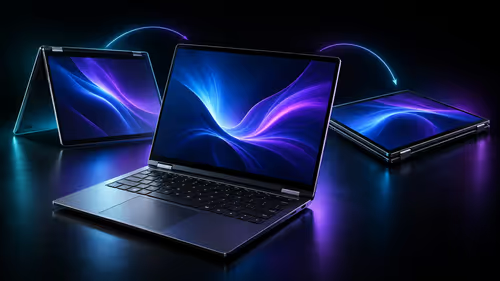
The VAIO T combines a 13.3-inch display with a multi-flip mechanism for laptop, tablet and outward-facing viewing modes. Orders begin in Japan on 18 September; South African availability is unconfirmed.

OpenRGB's master branch now carries changes labelled for 1.0 final, including translation and platform work, but the official tags page still lists 1.0rc3.1 as the newest packaged release. Stable users should wait for the signed release channel.
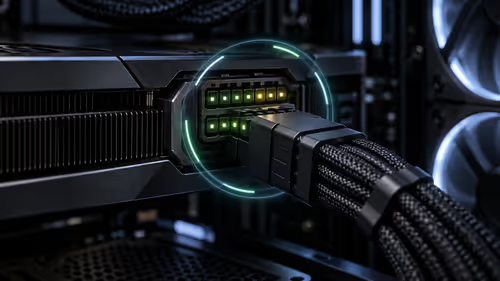
The Cooler Master GPU Shield Adapter monitors current on individual 12+4-pin contacts, adds visual and audible warnings, and can reduce system power during a severe abnormality. Local availability is unconfirmed.