Quick Answer
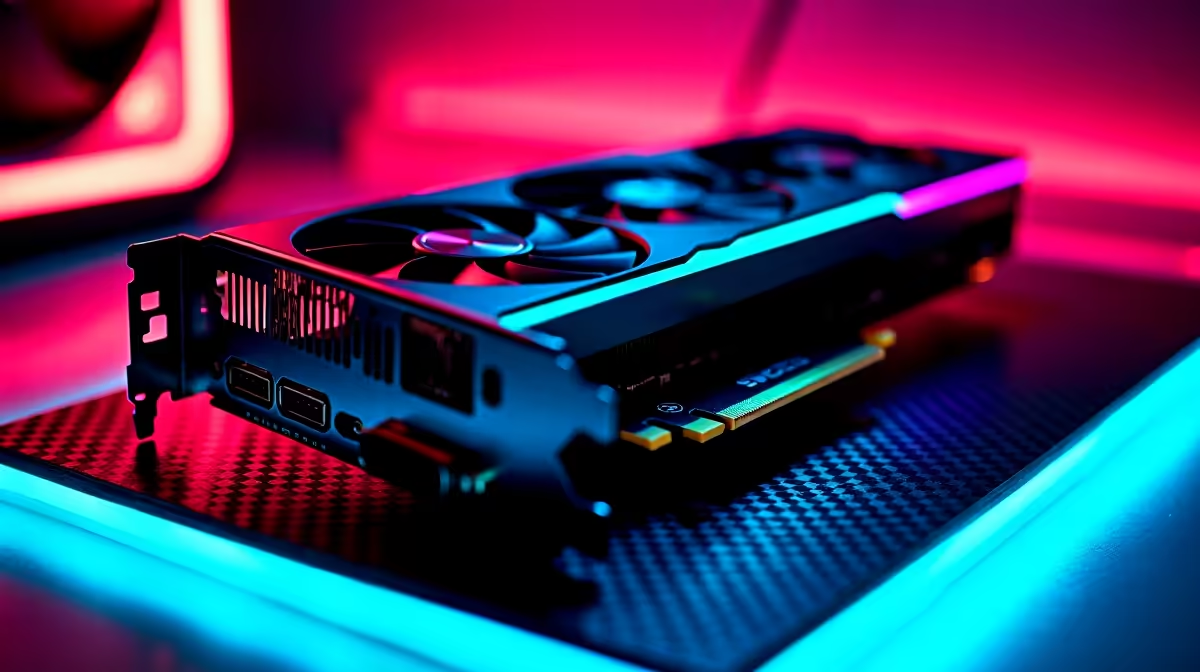
RTX 4070 Ti Super is the better-value starting point than RTX 4080 for first-time builders. Compare it against the monitor, PSU, case clearance, and real workload. Expect roughly 100-180 fps at 1440p in many games and 60-100 fps at 4K High depending on settings.
Best Alternatives To Shortlist
Use RTX 4080 as the reference point, then move only when the saving improves the PC. For first-time builders, prioritise simple fitment, PSU clarity, and driver setup.
- RTX 4070 Ti Super: usually a R18,000-R23,000 decision, with closest NVIDIA value alternative.
- RX 7900 XT: usually a R17,000-R22,000 decision, with strong 1440p and 4K raster option.
- RTX 4070 Super: usually a R14,000-R17,000 decision, with better match for 1080p or 1440p.
- RX 7800 XT: usually a R11,000-R14,000 decision, with budget-friendly 1440p card.
Match The GPU To The Workload
For a first custom PC with fewer setup surprises, NVIDIA stays simplest when CUDA, NVENC, DLSS, or app support matters. AMD can be excellent value for raster gaming when 16GB or 24GB VRAM is cheaper. On a 1080p 144Hz screen, an RTX 4070 Super class card is often already enough.
SA Fit Checks Before Checkout
Check GPU length, slot thickness, PSU wattage, and connector routing. A 650W PSU suits many RTX 4070 Super builds; higher tiers are safer on 750W-850W. Keep the case, cooling, and cables comfortably within spec.
FAQ
Is RTX 4080 still worth buying for first-time builders?
Yes, but only if the workload uses the headroom. For first-time builders, a cheaper card can be smarter when the target is 1080p, light editing, study work, or a quiet daily PC.
Which alternative is easiest for a first SA build?
RTX 4070 Super is usually the cleanest option because it keeps power draw moderate and driver setup straightforward. Pair it with 32GB RAM and a 1TB NVMe SSD if the PC will also handle study, streaming, or creator apps.
How much should I budget around the GPU?
Keep the graphics card inside a broad R18,000-R23,000 to R17,000-R22,000 comparison unless the monitor or workload clearly needs more. Add budget for a quality PSU, airflow case, and 144Hz or 165Hz display before chasing a larger card.
Pro Tip
Before ordering, check card length, PSU connector, and monitor refresh rate beside the shortlist.