Quick Answer
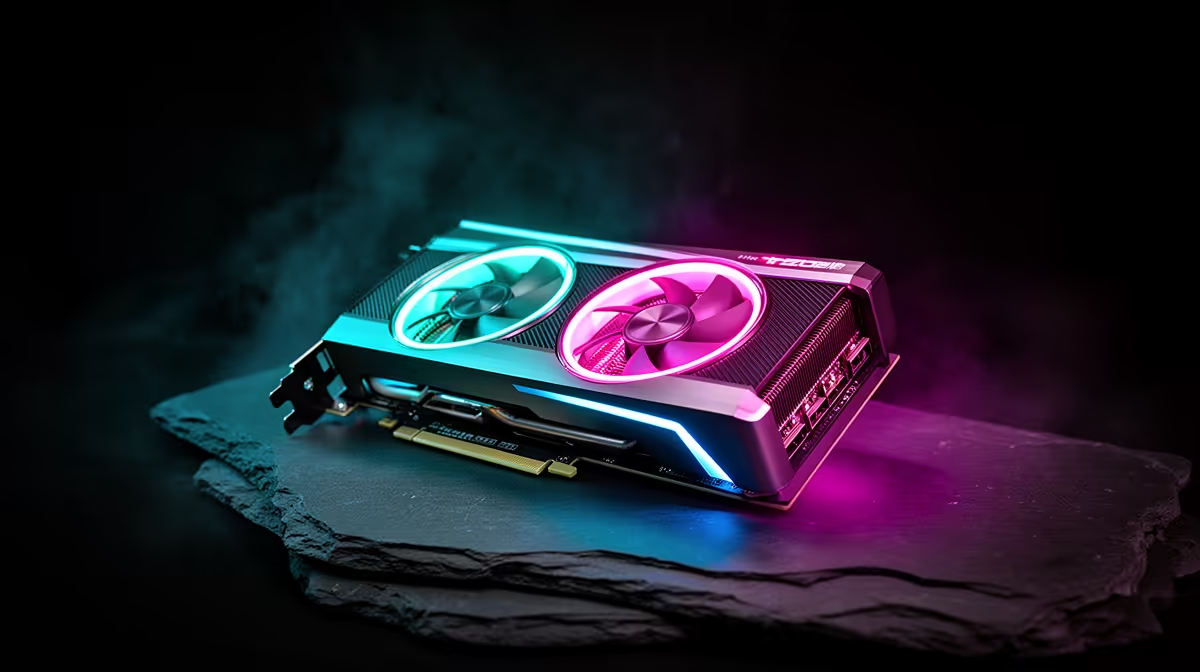
For 4K gaming prioritise VRAM capacity (at least 16GB), high memory bandwidth, and AI upscaling support (DLSS 4 or FSR 4). For AI workloads prioritise VRAM capacity above all else and CUDA or ROCm ecosystem support. For content creation prioritise VRAM capacity, encode/decode hardware, and compute performance. In all three cases, 16GB to 32GB GDDR7 from the RTX 50-series or RX 9000-series ticks every box.
GPU Features That Drive 4K Gaming Performance 🎮
At 4K resolution, the GPU renders four times as many pixels as at 1080p, making VRAM capacity and bandwidth the primary bottlenecks. Prioritise a card with at least 16GB VRAM and a memory bus of 192-bit or wider. AI upscaling via DLSS 4 or FSR 4 is essential at 4K: rendering natively demands four times the GPU compute of 1440p, while upscaling delivers near-native visual quality at half the render cost. The RTX 5070 Ti with 16GB GDDR7 (currently around R22,000 to R28,000 in South Africa) handles 4K gaming in most current titles with DLSS 4 Quality mode active.
Features That Matter for AI Workloads 🤖
For AI inference and training, VRAM capacity is the single most important specification. A model that does not fit in VRAM runs on system RAM via the PCIe bus at 1 to 5 percent of normal GPU inference speed. After capacity, look for Tensor Core generation: RTX 50-series cards include fifth-generation Tensor Cores with FP8 and FP4 support, accelerating inference at quantised precision levels that most local AI models use. CUDA ecosystem support via Nvidia is broader than ROCm for AMD. For South African developers running local LLMs, an RTX 5080 at 16GB GDDR7 is the minimum recommended tier, with the RTX 5090 at 32GB ideal for 70B-parameter models.
Content Creation Specifications to Check 🎨
For video editing and 3D rendering, GPU hardware encode units matter alongside raw compute. The RTX 50-series includes eighth-generation NVENC encoders, which accelerate H.264, H.265, and AV1 encoding directly on the GPU without using shader cores. Export times in DaVinci Resolve 19 are primarily limited by encoder throughput, making encoder generation a meaningful spec. Dual NVENC units on RTX 5080 and above allow simultaneous game streaming and local recording without frame rate impact, a feature South African creators who stream on Kick or Twitch while recording locally will find directly useful.
Enable Hardware Encoding in Your Creative Software Explicitly ⚡
DaVinci Resolve 19 and Premiere Pro both default to software encoding in some export presets even on systems with capable GPU hardware encoders. In Resolve, select H.265 or AV1 from the codec dropdown, then check that GPU encoding is selected rather than CPU. In Premiere Pro, check the Export settings Hardware Encoding checkbox. Enabling this properly can reduce H.265 4K export times by 60 to 80 percent on an RTX 50-series card.
FAQ
Does an AMD or Nvidia GPU matter more for content creation software in South Africa?
For DaVinci Resolve specifically, Nvidia CUDA acceleration is better optimised than AMD OpenCL for complex colour grading and noise reduction. For Blender Cycles and general rendering, both are well-supported. For AI inference, Nvidia CUDA has the wider software support ecosystem by a significant margin.
How much VRAM is enough for 4K gaming without content creation or AI use?
For 4K gaming alone in 2026, 16GB VRAM covers all current titles at maximum settings. 24GB provides headroom through 2028. 32GB is forward-looking and primarily justified when AI or creation workloads are also in the picture.
What is the minimum GPU for comfortable 4K 60fps gaming in South Africa on a budget?
The RX 9070 XT (currently around R18,000 to R24,000 in South Africa) delivers 4K 60fps in most current titles with FSR 4 Quality mode active, making it the budget entry point for 4K gaming performance.
Choosing a GPU for 4K gaming, AI, or creative work?
Evetech stocks the full RTX 50-series and RX 9000-series GPU range with local warranty. Browse the graphics card section at Evetech to compare specs and pricing for your workload.