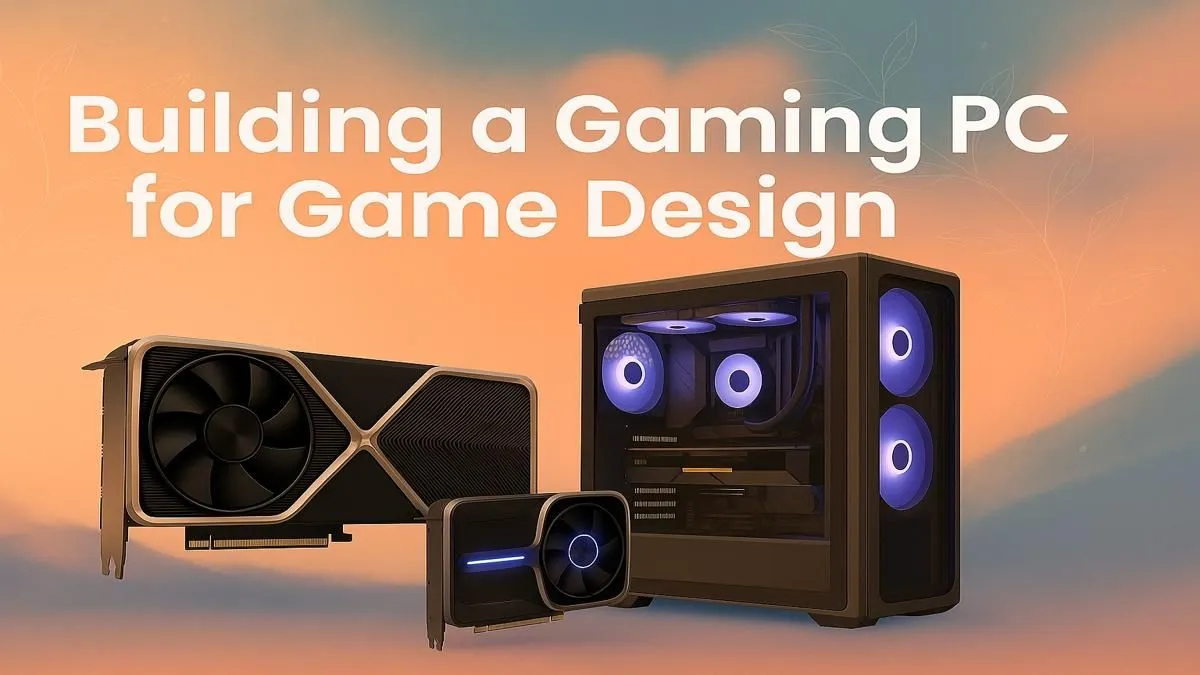
So, you're crafting worlds from scratch. Whether you're modelling assets in Blender, building sprawling levels in Unreal Engine 5, or compiling shaders in Unity, your PC is your most crucial tool. But here’s the thing many people miss: the graphics card a gamer needs is different from what a creator requires. For South African developers, choosing from the best graphics cards for game designers isn't just about frame rates; it’s about workflow, stability, and pure creative horsepower. 🚀
Beyond FPS: What Game Designers Really Need from a Graphics Card
While your future players are chasing high refresh rates, your focus is on a smooth, responsive viewport and lightning-fast render times. A powerful GPU for game design needs to excel in three key areas:
- Raw Performance & VRAM: Game development engines and 3D modelling software are greedy. High-resolution textures, complex geometry, and advanced lighting effects all consume video memory (VRAM). Running out of VRAM leads to stuttering viewports and sluggish performance, killing your creative flow. More is always better.
- Specialised Cores (CUDA/RT): Modern graphics cards have dedicated hardware for tasks like ray tracing (RT Cores) and AI (Tensor Cores). For a game designer, this translates to accelerated light baking, denoising, and even AI-assisted texturing. NVIDIA's CUDA platform is currently the industry standard, with widespread support in most creative applications.
- Driver Stability: A game-ready driver is optimised for the latest AAA release. A creator-focused driver, like NVIDIA's Studio Driver, is optimised for stability and performance in apps like Adobe Creative Suite, Blender, and Unreal Engine. This is a critical distinction, as a crash can mean losing hours of work.
Choosing Your Weapon: NVIDIA GeForce vs. AMD Radeon for Development
The GPU market is a two-horse race, and both teams bring something valuable to the table. However, for most game designers, the ecosystem often makes the decision for them.
NVIDIA's GeForce cards, powered by their CUDA architecture, have a long-standing advantage in the creative space. The maturity of their Studio Drivers and the deep integration of features like DLSS (Deep Learning Super Sampling) for viewport acceleration make them a top choice.
AMD's Radeon cards offer fantastic raw performance, often at a very competitive price point here in South Africa. While their creative software support has improved massively, some key applications are still better optimised for CUDA. For designers on a tight budget focusing on rasterization-heavy tasks, they remain a solid option.
The Best Graphics Cards for Game Designers in South Africa
Finding the perfect GPU involves balancing your budget (in ZAR, of course) with the demands of your projects. Here are our top picks, tailored for different stages of a game designer's journey.
The Indie Dev's Starting Point: NVIDIA GeForce RTX 4060
For students, hobbyists, or indie developers building their first commercial title, the NVIDIA GeForce RTX 4060 is a phenomenal entry point. It provides access to the latest Ada Lovelace architecture, including DLSS 3 and efficient RT Cores, without breaking the bank. Its 8GB of VRAM is sufficient for 1080p asset creation and testing, making it one of the most accessible and best graphics cards for game designers starting out.
VRAM is Your Creative Canvas
Think of VRAM as your digital workspace. 8GB is the minimum for game design today. For complex 4K textures or large, open-world scenes in Unreal Engine, aim for 12GB or, ideally, 16GB+ to avoid performance bottlenecks.
The Professional's Sweet Spot: NVIDIA GeForce RTX 4070 SUPER
This is the workhorse. ⚡ The NVIDIA GeForce RTX 4070 SUPER strikes an almost perfect balance between price and performance for serious game design. With a healthy 12GB of GDDR6X VRAM and a significant bump in CUDA cores over its non-SUPER variant, it tears through complex scenes, 4K texture work, and demanding renders. It's the ideal GPU for a small studio or a freelancer building a professional portfolio.
The Uncompromising Powerhouse: NVIDIA GeForce RTX 4090
When your projects are AAA-scale and deadlines are non-negotiable, you need the absolute best. The NVIDIA GeForce RTX 4090 is less of a component and more of a long-term business investment. Its colossal 24GB of VRAM and unmatched rendering power can slash project timelines, handling cinematic-quality assets, complex physics simulations, and virtual production workloads without breaking a sweat. It's the undisputed king for a reason.
Finalising Your Choice: What Else Matters?
Remember, a graphics card is part of a system. To get the most out of your new GPU, ensure it's paired with a capable CPU, like an Intel Core i7/i9 or AMD Ryzen 7/9. A fast NVMe SSD is also non-negotiable for quick loading of large project files and assets.
Choosing the right graphics card for game design is about empowering your creativity. By focusing on VRAM, core performance, and driver stability, you invest not just in hardware, but in a smoother, faster, and more productive workflow.