Quick Answer
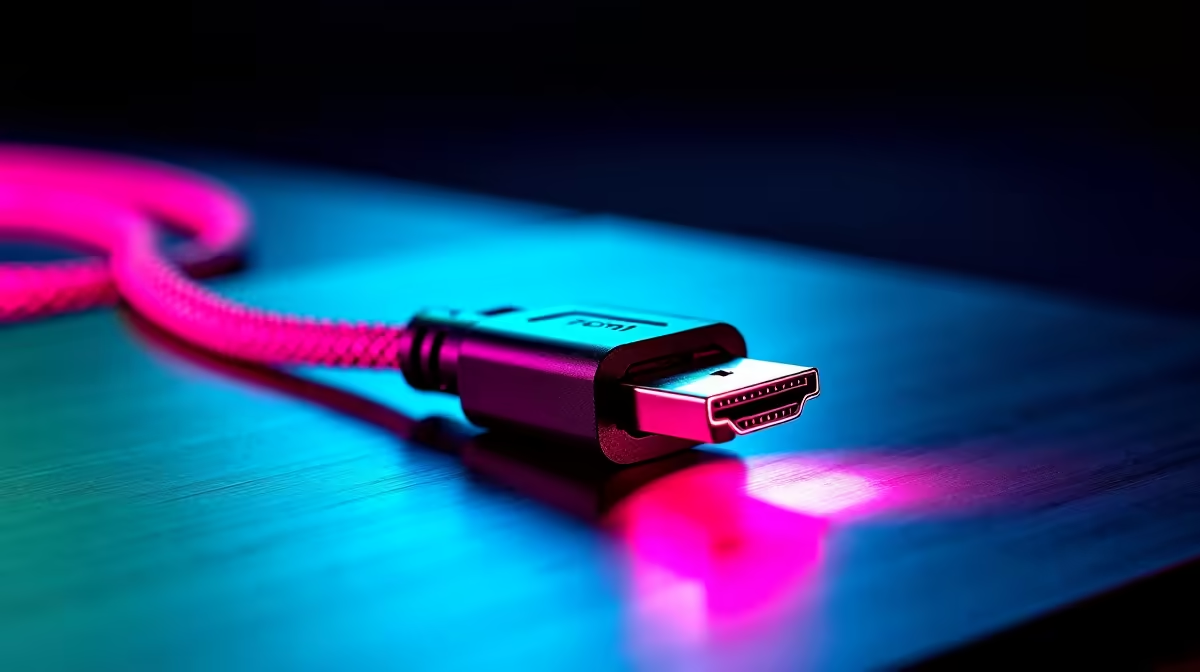
For a rand-conscious SA setup, target an 18Gbps (HDMI 2.0) cable at R120 to R300 depending on length. This single spec covers 4K 60Hz HDR on any modern TV, monitor, or console without paying for HDMI 2.1 bandwidth you will not use at 60Hz.
The Specs That Matter for Each Setup Type 🖥️
TV lounge builds need 18Gbps at 3m to 5m to bridge a wall-mounted panel and an entertainment unit. Monitor desk setups need 18Gbps at 1m or 2m, short enough to keep costs below R180 even for certified units. Console setups pair best with 18Gbps at 3m to 5m for 4K 60Hz; upgrade to 48Gbps (HDMI 2.1) only if you want 4K 120Hz for supported PS5 or Xbox Series X titles. For all three scenarios, the rand-efficient choice is an HDMI 2.0 cable with gold-plated connectors and at least light shielding to handle interference from the multiple wireless devices in a typical SA home (Wi-Fi router, smart TV, cordless peripherals). A cable with these specs costs R150 to R280 locally and delivers identical signal quality to units priced three times higher.
What to Skip When Buying Rand-Consciously 💰
Several features add cost without adding picture quality for standard 4K 60Hz use. Oxygen-free copper (OFC) conductors are marketed as reducing oxidation, but in a sealed HDMI cable the oxygen contact is negligible and OFC cables at 18Gbps perform identically to standard copper at the same bandwidth. Silver-plated conductors similarly offer no measurable digital video improvement. Fabric-braided jackets add durability for cables that move frequently but are unnecessary for a fixed TV or monitor installation. Passive cables at 18Gbps above R400 for a 5m unit are almost always priced on brand premium rather than engineering superiority.
Prioritising Specs on a Tight Budget 📐
If budget is genuinely tight, the single non-negotiable is the 18Gbps bandwidth rating. A plain PVC-jacketed, unbranded certified HDMI 2.0 cable at R130 to R160 for a 1m or 2m run outperforms a premium R500 HDMI 1.4 cable for 4K 60Hz delivery. For 3m to 5m runs, add light shielding to the minimum spec to guard against signal interference in environments with dense Wi-Fi coverage, which is common in SA sectional title complexes and student residences where dozens of wireless networks compete. Light-shielding HDMI 2.0 cables at 5m run R200 to R280 from local SA tech retailers.
Pair Your Cable With the Correct Port Setting ⚡
Even the best-spec HDMI 2.0 cable performs like a 1.4 unit if your TV's port is still set to Standard or HDMI 1.4 mode. After connecting, navigate to Settings, find HDMI Signal Format or Input Signal Plus for the specific port, and switch to Enhanced or HDMI 2.0. This free software change unlocks the full 18Gbps spec and enables HDR without spending a cent more on the cable.
FAQ
Is a R130 HDMI 2.0 cable really as good as a R600 cable for 4K?
Yes, provided both are genuinely certified at 18Gbps. Digital HDMI signals do not benefit from pricier conductors the way analogue audio cables might. Test the cheaper cable with a 4K HDR source; if it delivers a clean signal, you have saved R470 for zero quality loss.
My TV has both HDMI 2.0 and HDMI 1.4 ports. Which do I use for a console?
Always connect your primary video source (console or PC) to the HDMI 2.0 port. Reserve HDMI 1.4 ports for lower-bandwidth devices like older Blu-ray players or HDMI-to-screen extensions running at 1080p.
Does a cheaper HDMI 2.0 cable fail sooner than a premium one?
The electrical performance should last the life of a typical setup. Where cheaper cables may fail earlier is at the connector solder joint if the cable is repeatedly flexed or plugged in at an angle. For fixed installations, a budget cable's lifespan matches that of a premium unit.
Need a 4K-ready cable without the premium price tag?
Evetech stocks certified HDMI 2.0 cables at competitive ZAR prices across all standard lengths, delivered nationwide.