Quick Answer
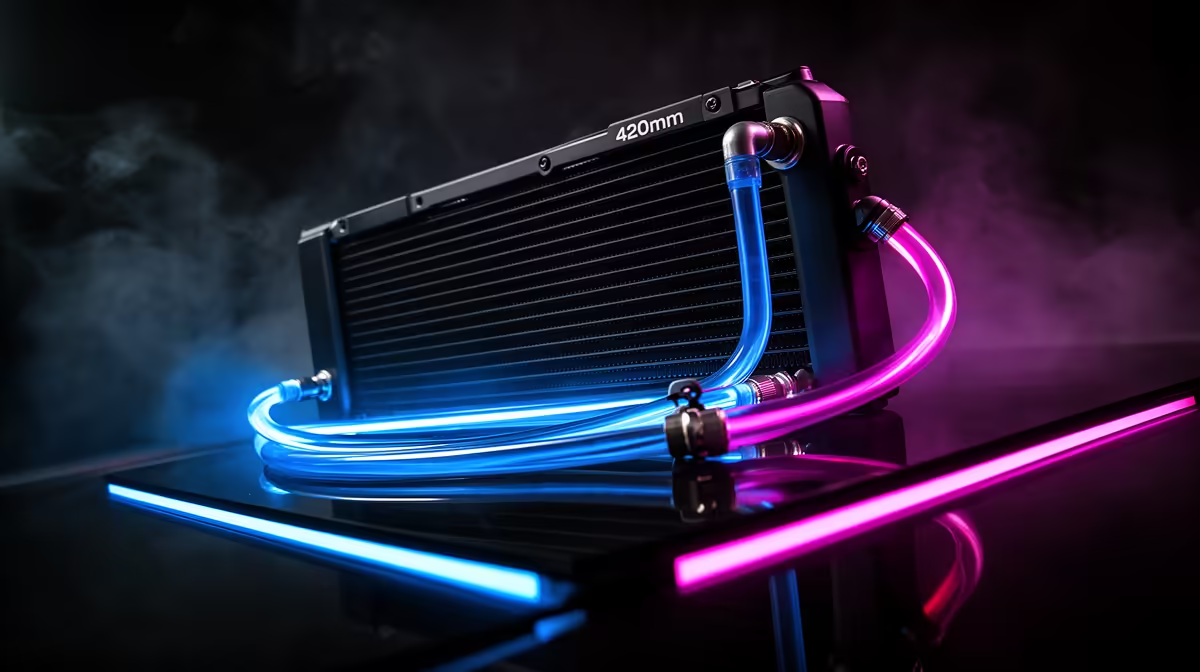
Yes. A 420mm radiator reduces both CPU temperatures and fan noise compared to smaller AIOs. The larger surface area allows three 140mm fans to spin at 900 to 1,000 RPM rather than 1,300 to 1,500 RPM, directly reducing fan noise by 5 to 10 dB(A). For a Ryzen 9 9950X at full all-core load, a 420mm AIO delivers peak temperatures 5 to 8 degrees Celsius lower than a 360mm unit at identical fan speeds.
How a Larger Radiator Reduces Fan Speed and Noise 🌬️
A 420mm radiator contains approximately 17 percent more fin surface area than a 360mm unit. This larger area dissipates the same heat at lower coolant temperatures, allowing fans to spin more slowly while maintaining CPU temperatures within safe limits. Since fan noise scales roughly with the square of RPM, a 20 percent reduction in fan speed produces a disproportionate acoustic improvement.
For South African gamers who play at night in shared living spaces including university residences and townhouses, the acoustic difference between a 420mm and 360mm AIO is practically significant. A system running at 45 dB(A) during gaming is considerably more comfortable in a shared room than the same hardware at 52 dB(A).
Real-World Temperature Data 🌡️
A Ryzen 9 9950X at all-core 5.7GHz boost on a 240mm AIO at 100 percent fan speed reaches 95 degrees Celsius and crosses thermal throttle thresholds. On a 360mm AIO at identical fan speed, the same CPU sits at 82 degrees Celsius. On a 420mm AIO at 1,000 RPM, the CPU holds at 76 to 78 degrees Celsius, well within sustained boost clock territory. For gaming workloads, the differences narrow: a Ryzen 7 9700X sees less than 3 degrees Celsius difference between 360mm and 420mm AIOs. The 420mm advantage is most apparent under sustained compute workloads such as video encoding or 3D rendering.
Case Requirements for a 420mm Radiator 🔧
Installing a 420mm AIO requires three 140mm mounting positions in a single row, typically requiring a full-tower or large mid-tower in the R2,500 to R4,500 range. A 420mm front radiator and 25mm fans occupy 55mm of front-to-back space, reducing GPU clearance by that margin compared to an empty front bay.
For South African builders, the combined cost of a 420mm AIO plus compatible case is typically R1,500 to R2,500 more than a 360mm AIO plus standard mid-tower. This premium is most justified for Ryzen 9 9950X builds where sustained all-core thermal management directly impacts productivity output.
420mm Fan Speed Setting ⚡
Set 420mm AIO fans to a fixed 950 RPM during standard gaming sessions rather than using an automatic PWM curve. At 950 RPM, three 140mm fans keep a Ryzen 9 9950X below 85 degrees Celsius during gaming without noise-producing ramp events. Reserve the automatic curve for sustained rendering workloads where temperatures spike beyond 80 degrees Celsius.
FAQ
Is a 420mm AIO worth it for a gaming-only PC?
For gaming-only use with a CPU under 125W TDP, the benefits over a 360mm AIO are small. A 360mm AIO at R1,500 to R2,800 is better value for pure gaming builds. Reserve the 420mm for CPUs above 150W TDP or builds with significant sustained compute workloads.
Do 420mm AIOs cost significantly more than 360mm AIOs in SA?
Expect a R400 to R900 premium for the 420mm equivalent from the same brand at Evetech. Combined with the higher case cost, the total premium for a 420mm setup over a 360mm is R1,200 to R2,500 depending on case tier.
Can a 420mm radiator be installed in a top position instead of the front?
Only if the case spec sheet confirms 420mm top mount support, which is uncommon. Top-mounted radiators are also less efficient for CPU cooling than front intake mounts because they process air already warmed by other components.
Want quieter gaming with better CPU thermals?
Evetech stocks 420mm AIO coolers and full-tower cases with verified 420mm front radiator support so you can build a quieter, cooler system from day one.