Quick Answer
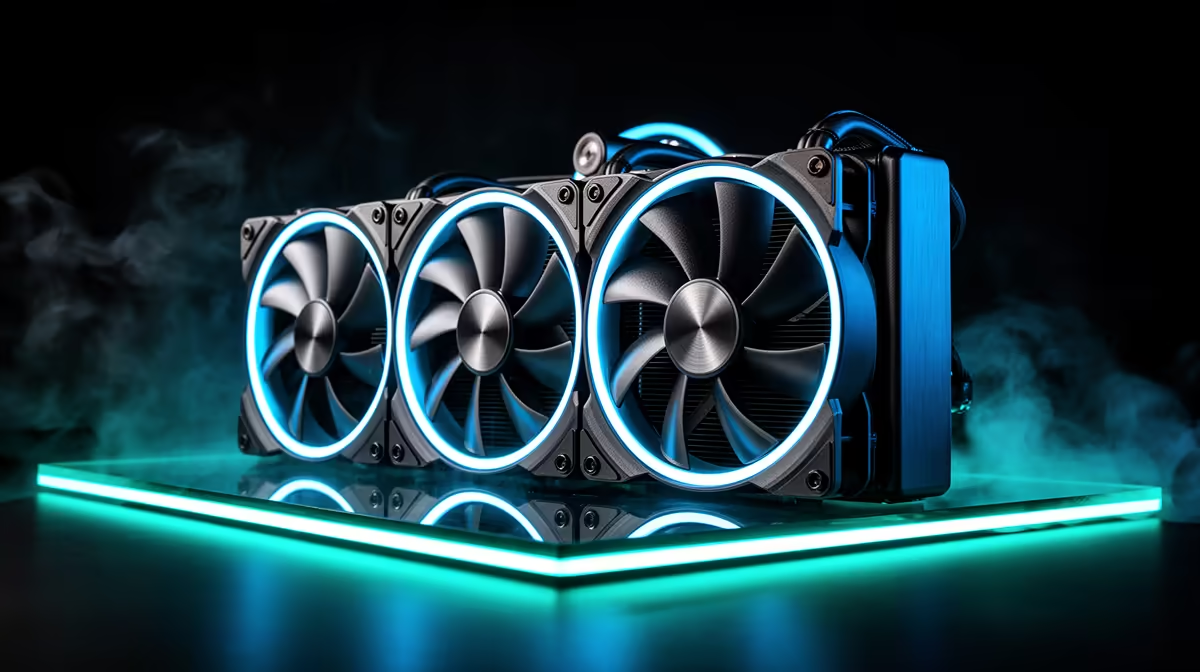
Yes, a 420 mm radiator can keep an overclocked gaming PC significantly quieter. Its larger surface area dissipates the same heat at lower fan RPM than a 240 mm or 360 mm radiator, so fans typically operate at 800 RPM to 1,000 RPM under gaming loads instead of the 1,500 RPM to 1,800 RPM a smaller radiator demands, which is a meaningful reduction in perceived noise.
Surface Area and Fan Speed: The Noise Connection 🔊
Radiator cooling capacity scales with surface area and airflow. A 420 mm radiator uses three 140 mm fans, which move more air per revolution than 120 mm fans and have a larger swept area per unit. At equivalent cooling performance, three 140 mm fans at 900 RPM generate roughly 28 dBA to 32 dBA compared to 38 dBA to 42 dBA from three 120 mm fans at 1,600 RPM on a 360 mm rad. When overclocking a Ryzen 9 9950X or an Intel Core Ultra 9 285K past their power limits, thermal output can spike to 250 watts to 300 watts. A 420 mm radiator handles this without pushing fans past 1,200 RPM in most ambient conditions, keeping the acoustic profile well within the 35 dBA threshold most people describe as inaudible over game audio.
Case Compatibility: The Critical Constraint 🖥️
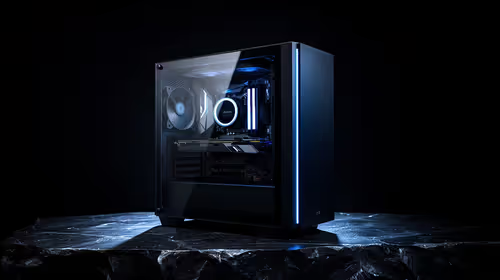
The benefit of a 420 mm radiator disappears if your case does not support it. Top-mounted 420 mm support requires a case with at least 155 mm of clearance between the top fan bracket and the motherboard VRM heatsinks, which is a measurement that eliminates most mid-tower cases. Purpose-built EATX towers and select full-towers (the Fractal Design Torrent XL and Lian Li O11 XL variants, for example) accommodate 420 mm at the top or front. In South Africa, cases supporting 420 mm radiators typically start at around R3,500 to R6,000, which adds to the build budget but is justified for an overclocked flagship CPU.
Overclocking Impact on Temperature and Longevity 🔧
An overclocked CPU running a 420 mm cooler at low fan speeds gains more than just silence. Lower sustained temperatures reduce electromigration risk in the CPU die, which is a primary factor in long-term stability. Running a Ryzen 9 9950X at 5.7 GHz all-core with a 420 mm AIO typically holds CPU temperatures at 75 degrees Celsius to 82 degrees Celsius under sustained Cinebench R24 loads, compared to 88 degrees Celsius to 95 degrees Celsius on a 240 mm AIO. That margin also gives pump and fan curves more headroom before the cooler ramps audibly during a sudden thermal spike.
Fan Orientation Matters ⚡
Mount 420 mm radiator fans as intake at the front of the case rather than exhaust at the top where possible. Intake configuration pulls cooler ambient air directly through the radiator before it is warmed by other components, dropping CPU temperatures by 3 degrees Celsius to 6 degrees Celsius compared to exhaust mounting, and it keeps the rest of the case cooler too.
FAQ
Is a 420 mm radiator overkill for a non-overclocked CPU?
For a stock-clocked mid-range CPU, a 280 mm or 360 mm AIO provides more than enough cooling and costs less. A 420 mm setup makes the most sense for high TDP CPUs running at or beyond PL1 power limits, or for builders who prioritise near-silent operation.
Can I use a 420 mm radiator for GPU cooling too?
Some custom water-cooling loops route both CPU and GPU through a 420 mm radiator, but this requires custom fittings and a reservoir pump combo. For most gamers, separate CPU AIO and GPU blower cooling is simpler and more serviceable.
Does radiator thickness matter as much as length?
Thickness helps but offers diminishing returns past 30 mm. Moving from a 25 mm to a 45 mm thick 360 mm radiator gains roughly 8 percent to 12 percent extra thermal capacity, while stepping from 360 mm to 420 mm gains 16 percent to 20 percent. Length upgrade is the better value.
Overclocking and want to stay quiet?
Evetech stocks 420 mm-compatible cases and a full range of AIO coolers to suit overclocked builds at every budget.