Quick Answer
A certified 5m HDMI 2.0 cable rated at 18 Gbps does not affect picture quality or HDR performance compared to a shorter certified cable. An uncertified or marginal 5m cable that cannot sustain 18 Gbps will force the connection to drop to HDMI 1.4 speed, cutting you to 4K/30Hz and disabling HDR.
Why Cable Length Introduces Risk at 18 Gbps 🔧
HDMI signal quality degrades with distance because copper conductors have resistance that increases proportionally with length. At 18 Gbps (HDMI 2.0), the signal frequency is high enough that even modest resistance increases cause bit errors that push the connected devices into a lower link-rate negotiation. A certified Premium HDMI cable is tested to maintain the full 18 Gbps signal quality at its rated length, including 5 metres. The testing is performed at the full bandwidth ceiling, not at a comfortable margin below it.
HDR-Specific Considerations Over Longer Runs 🎨
HDR10 at 4K/60Hz uses approximately 14.2 Gbps of the 18 Gbps budget. This leaves only 3.8 Gbps of headroom in a perfect cable. Over 5 metres, an uncertified cable may carry 4K/60Hz SDR reliably at 11.9 Gbps but fail when HDR is enabled and bandwidth demand rises to 14.2 Gbps. This is why users with 5 metre cables sometimes report that HDR causes flickering or the display drops to 30Hz while SDR works fine: the cable is marginal, not fully broken. A Premium Certified 5m HDMI 2.0 cable passes testing at the full 18 Gbps ceiling, eliminating this HDR-specific instability. South African buyers setting up a 4K HDR lounge should treat the cable certification as non-negotiable at 5 metres.
When 5 Metres Is Not Enough and What to Do 💡
For runs above 5 metres, passive HDMI 2.0 cables become unreliable regardless of certification. At 7 to 10 metres, an active HDMI 2.0 cable (with a repeater chip, R800 to R1,200) is the correct solution. At 10 metres or more, an active optical HDMI cable (fibre core inside standard HDMI connectors) maintains 18 Gbps over runs up to 30 metres, used in South African homes where the media room and display room are separated. These are stocked locally for permanent installation projects.
Always Test at Full Resolution Before Routing Into a Wall ⚡
If you are routing a 5m HDMI cable inside a wall cavity or through a conduit for a permanent South African home theatre installation, run the cable loose first and verify 4K 60Hz HDR in the display settings. Only route it permanently after confirming the full signal. A cable that fails inside a wall requires cutting access to replace, which costs far more than buying a certified cable upfront.
FAQ
Does a 5m HDMI cable introduce any audio latency or lip-sync issues?
No. HDMI carries audio and video in a synchronised digital stream. Cable length does not introduce audio latency. Any lip-sync issues on a 4K display are caused by display processing delay, which can be corrected in the TV or monitor's settings (usually a Game Mode that reduces processing latency).
Is fibre HDMI worth the cost for a 5 metre home theatre run in South Africa?
Not at 5 metres. Fibre HDMI is technically superior for maintaining signal over very long runs (10 metres and above) but offers no advantage at 5 metres over a Premium Certified copper HDMI cable. Fibre HDMI cables in South Africa start at around R1,500 to R2,000, compared to R450 to R650 for a certified passive copper cable at 5 metres.
Can I coil the excess cable if a 5m cable is longer than my actual run?
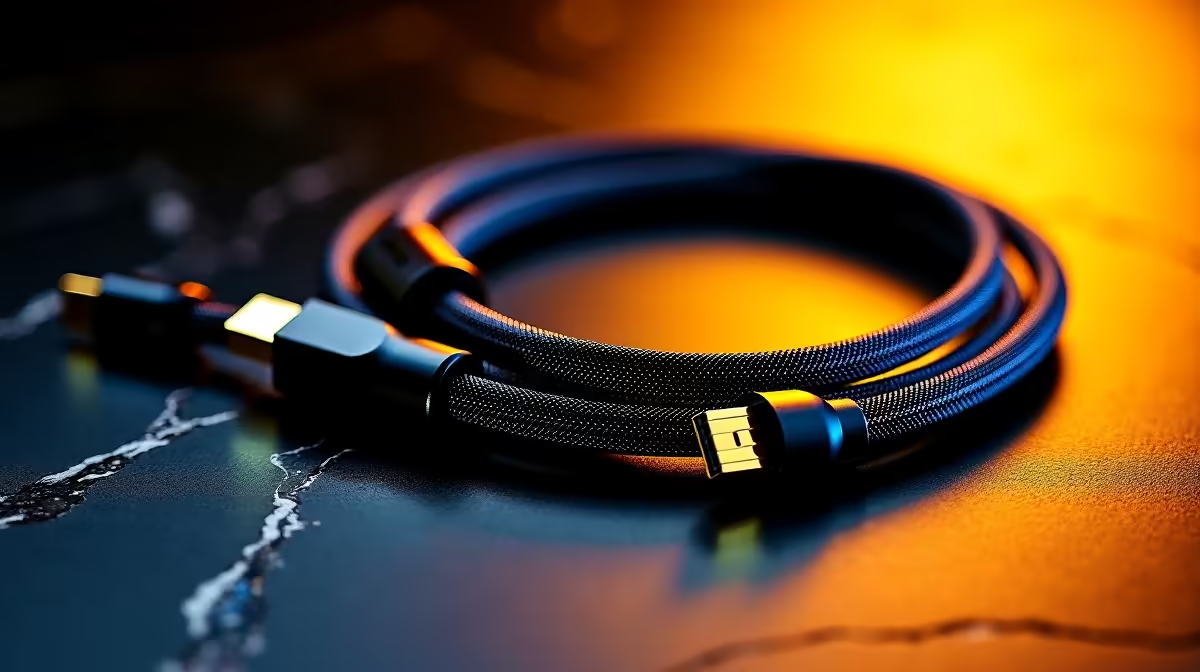
Avoid tight coils of more than 3 to 4 loops at small diameters, as repeated bending at tight radii stresses the conductors over time. A loose, large-diameter coil secured with a velcro tie and kept away from heat sources is safe for excess cable storage.
Need a 5m HDMI cable that reliably delivers 4K/60Hz HDR?
Evetech stocks Premium Certified HDMI 2.0 cables at 5 metre length and beyond, locally available with SA warranty support for permanent home theatre installations.