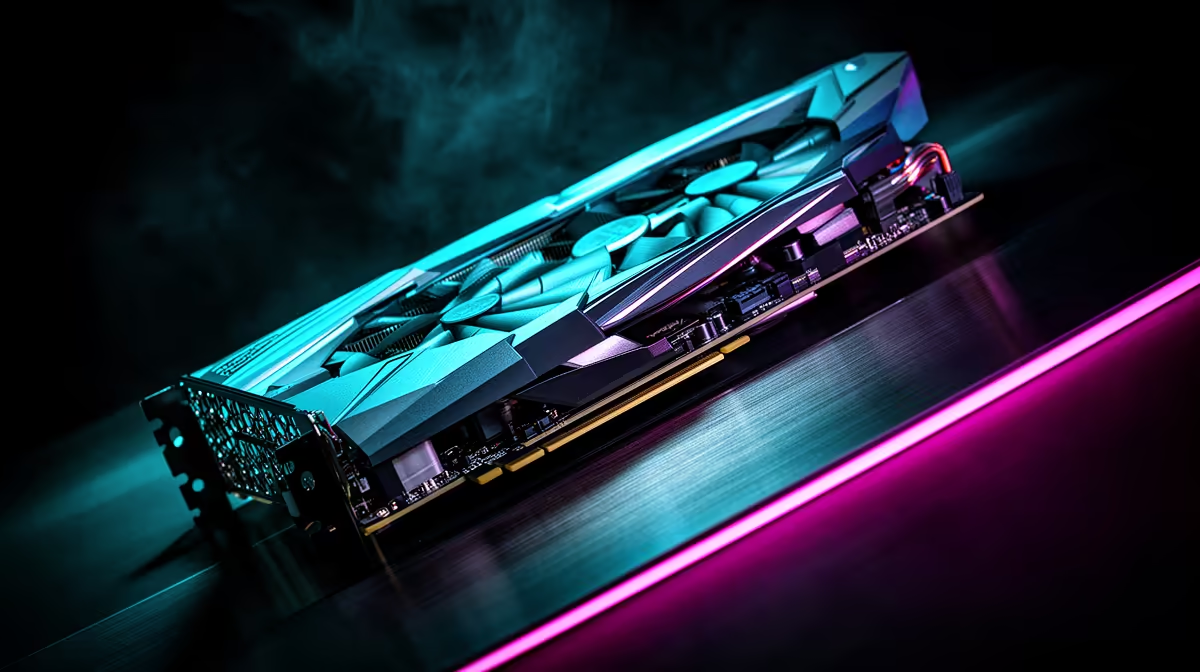
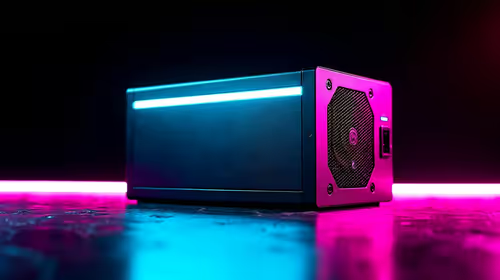
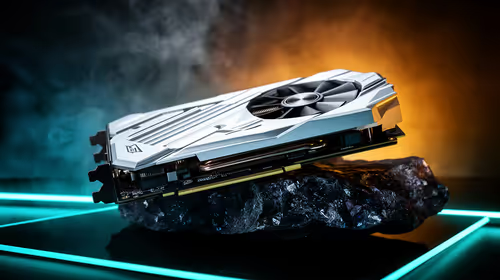
An RTX 5070 on a 550W PSU is too tight to be the standard plan. The card's 250W-class demand leaves a narrow system budget once a modern CPU and the rest of the platform join it. Some combinations may run, but a new build should use a quality 650W supply with the connector and transient response the exact card expects. That avoids turning every black screen into a wattage argument.
Quick Answer
Choose 650W for an RTX 5070 gaming PC. A 550W unit belongs only in a carefully measured exception where the GPU maker permits it, the processor is restrained and the PSU is a proven model in good condition. Do not treat a successful desktop boot as evidence that the machine is stable under a changing game load.
Check the RTX 5070 range, then compare suitable Corsair power supplies and other PSU best sellers. Card model, cable and complete-system guidance need to agree.
Where 550W Gets Crowded
Subtracting a 250W graphics figure from 550W appears to leave 300W. That balance has to cover the CPU, motherboard power conversion, memory, storage, cooling and attached devices. It also has to accommodate rapid shifts in load without unstable voltage or an unwanted protection event.
A mainstream gaming CPU may keep average demand inside the nameplate limit. The margin shrinks with a high-power processor, open motherboard limits or combined rendering work. PSU ageing and ambient temperature add more uncertainty.
The calculation cannot tell you whether an unknown 550W design handles fast load changes well. That comes from model-specific electrical testing.
What a Protection Trip Looks Like
When a PSU protection circuit intervenes, the PC can lose power or restart. It may require the supply to be switched off and reset before the system starts again. That behaviour protects hardware from an unsafe condition; it is not a feature to trigger as a normal operating limit.
A black screen has other possible causes. A graphics driver can reset, a cable can lose contact, memory can be unstable or the GPU can overheat. Record whether fans and lights lose power, whether Windows recovers and whether the event repeats at a certain combined load.
Do not keep launching the same stress test after a hard cut. Inspect the power path and return CPU, memory and GPU tuning to defaults. A visible hot mark, burning smell or arcing sound means stop using the machine.
Why a Low-Power CPU Does Not Settle It
An efficient processor improves the 550W calculation, but it cannot change the graphics card's own connector guidance or the quality of the PSU. Gaming demand moves across CPU and GPU, and short events do not appear in a slow average readout.
If you already own a high-quality 550W unit and want to assess a low-power build, start with the exact card maker's minimum. Check combined 12V delivery, the PSU's age and its independent test record. Follow the higher requirement when any component manufacturer specifies it.
For a fresh purchase, the engineering exercise is rarely worth the small capacity saving. A good 650W unit gives the machine a clearer operating envelope.
Is 600W a Useful Middle Ground?
A suitable 600W supply can support some RTX 5070 systems when it meets the card guidance and the CPU remains sensible. Availability and model choice may be narrower than at 650W, and the price gap can be small.
Compare actual units. A strong 600W platform beats a weak 650W one, but a tested 650W supply is the straightforward target. Do not buy from wattage in isolation.
If an existing 600W model has the correct modern graphics lead, known history and favourable testing, it deserves a proper calculation. The same is not true of an anonymous unit pulled from an old case.
Cable Quality and Routing Matter
The exact RTX 5070 may use a native modern connector or an adaptor arrangement. Follow the card maker's instruction. Use only PSU cables made for that model and ensure every required plug is connected.
Push the connector fully home before closing the case. Keep the first section of cable relaxed and make sure the side panel does not force a sharp turn at the plug. Check clearance around the graphics cooler at the same time.
Extensions add another connection and should be chosen with care. Avoid improvised adaptors and never mix modular leads between supplies.
What to Look for in the 650W Replacement
Start with reputable independent measurements. You want controlled voltage, low electrical noise, sound response through load changes and documented protection behaviour. Review acoustic results if the PC sits close to you.
Confirm 12V capacity, the intended GPU cable and case fit. Read the warranty that applies to the local unit. An efficiency grade can narrow the field, though it is not a quality score for the entire PSU.
The replacement should also support your plausible next build. If that future card belongs to a much higher power class, 750W may be a better once-off choice. Name the target before you pay for it.
Diagnose Random Black Screens Methodically
Begin at default CPU and GPU settings. Update the supported graphics driver and motherboard firmware where needed. Reseat the graphics card and its power connector, then test one workload at a time.
A driver reset that returns to the desktop should lead you toward software logs and GPU stability. A full machine blackout under combined load places more attention on power, thermals and cabling. Memory errors can imitate both, so use a focused memory test rather than changing PSU settings blindly.
If the supply is old or lacks a clear model record, substituting a known-good 650W unit is a useful diagnostic step. Do not open either PSU for inspection.
The Practical Verdict
Could a carefully controlled RTX 5070 machine run on the right 550W unit? Perhaps. Should 550W be the shopping target for this card? No. The margin and model dependencies make 650W the cleaner choice for a gaming PC you want to use without second-guessing every heavy scene.
That extra 100W is not a performance upgrade. It is a better-sized foundation for the whole system.
FAQ
Can a 550W PSU power an RTX 5070?
Only in a narrow combination that meets the exact card maker's guidance and uses a restrained CPU with a proven PSU. It is not the preferred size for a new build.
What actually happens if the PSU trips?
The system may switch off or restart, and the supply may need a power reset. Stop repeated testing and diagnose the cause before loading it again.
What wattage should I use instead?
A quality 650W model is the practical baseline for a balanced RTX 5070 gaming PC. Increase it when the processor or planned upgrade needs more.
Does cable quality matter here?
Yes. Use the supported cable or adaptor layout, seat every plug and keep the connector free from a hard bend or side-panel pressure.
Move an RTX 5070 build to a tested 650W PSU with the correct cable path, and treat any 550W setup as a measured exception rather than the buying rule.