Quick Answer
SA creators, streamers, and WFH professionals need an E-ATX case that fits a large motherboard and a 440mm-class GPU, supports a 360mm or 420mm AIO for all-day thermal stability, keeps fan noise low during long sessions, and occupies a manageable desk footprint. Budget R2,000 to R4,500 for a case with these features locally.
What Makes an E-ATX Case Creator-Ready 🎥
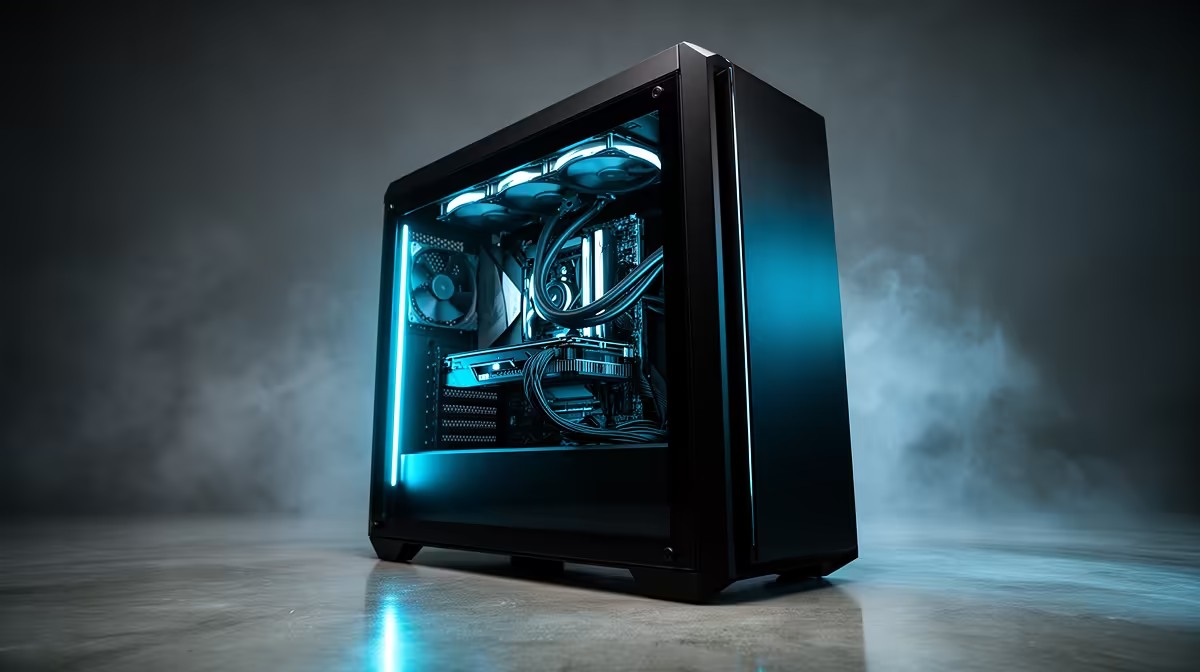
Creator and streaming workloads are sustained rather than bursty. A video render in DaVinci Resolve or a simultaneous stream-plus-game session keeps CPU and GPU near peak for hours, meaning thermal headroom matters far more than it does for a ten-minute gaming spike. An E-ATX case designed for this use should have front intake clearance for at least two 140mm fans, a top mount accepting a 360mm or 420mm radiator, and ample space around the VRM area so hot air from the motherboard power delivery does not stagnate. Soundproofing foam on side panels helps streaming environments where microphone bleed-in from fan noise is a real production concern. Look for case depth of at least 500mm if you plan to run a 440mm GPU alongside a 420mm AIO.
Space and Desk Setup Considerations for SA Homes 🏡
Many South African WFH setups share living or bedroom space, so a case that looks professional and sits quietly is almost as important as raw thermal performance. Several E-ATX-compatible mid-towers now offer full-tower internal volume in a narrower footprint, typically 220 to 230mm wide. Under-desk placement is common in SA homes, meaning the front intake must be unobstructed even on carpet: choose a case with a raised base lifting it 15mm or more off the floor. Top-mounted power buttons are preferable to front-mounted buttons that become inaccessible when the case is tucked away.
Connectivity and Expansion for Streaming Rigs 📡
Streamers run external capture cards, audio interfaces, and multiple USB devices. A front I/O panel with at least two USB 3.2 Gen 1 Type-A ports and one USB Type-C (Gen 2 or 3.2 Gen 2x2) is now a practical baseline. An E-ATX case with three or more 3.5-inch drive bays lets you keep a multi-terabyte project archive on spinning drives while an NVMe SSD handles active project files, a practical split used by most professional editors working in Johannesburg, Cape Town, and Durban production houses.
Side-Panel Dampening for Quieter Streams ⚡
Stick thin acoustic foam squares (R80 to R150 per sheet at local electronics stores) to the interior steel opposite panel. This cuts vibration from fan blades during long sessions and reduces mic bleed-in by several decibels without affecting internal temperatures.
FAQ
Does an E-ATX case fit an ATX or Micro-ATX motherboard?
Yes. E-ATX cases include standoff positions for ATX, Micro-ATX, and Mini-ITX boards as well. Choosing an E-ATX case from the beginning future-proofs the chassis for a later HEDT upgrade without replacing the enclosure.
How important is a tempered glass side panel for streaming?
A glass panel is visually appealing on camera but adds 800g to 1.2kg to the case weight and transmits more fan vibration to the room than a steel panel. For setups where the case is off-screen, a steel panel with sound dampening is the quieter choice.
What PSU size do I need for a full E-ATX creator build?
Plan for at least 850W pairing a Ryzen 9 9950X with an RTX 5080 or RX 9070 XT. With multiple NVMe drives and fan controllers, 1,000W gives comfortable headroom and keeps the PSU fan in low-speed mode during typical loads.
Building a creator or streaming rig and need the right chassis?
Evetech stocks a full range of E-ATX-compatible cases suited to professional content creation and WFH builds in South Africa. Explore the case lineup to match your board and workflow.