Quick Answer
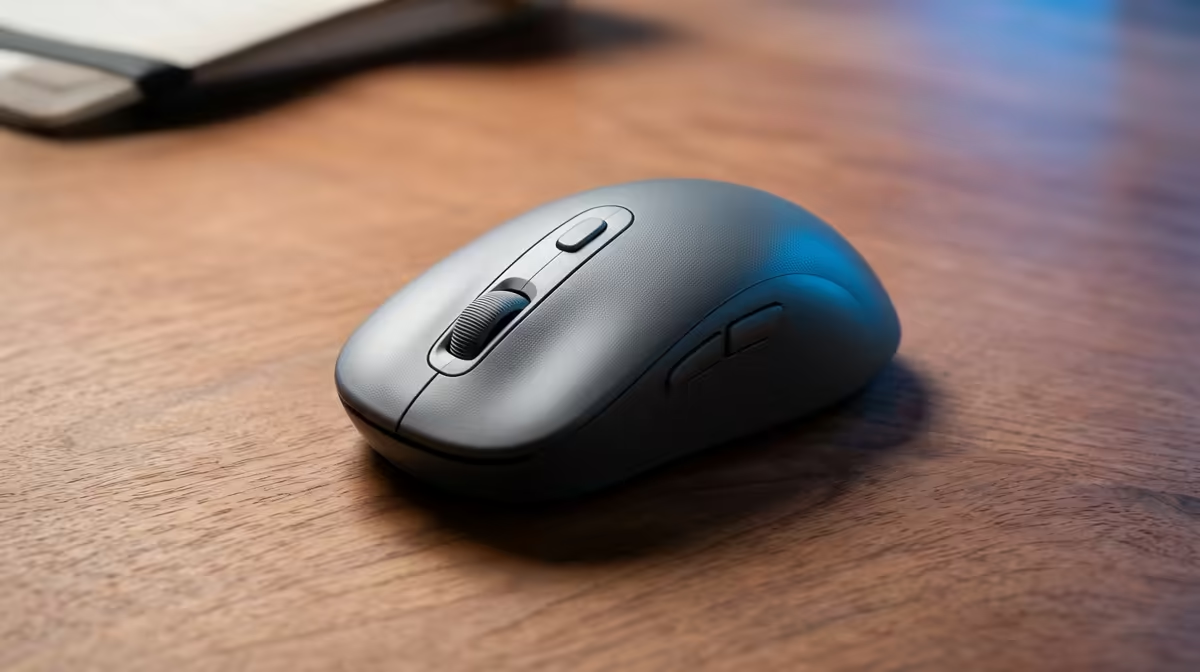
Compact wireless mice weigh 60 to 80 grams and fit in a jacket pocket or pencil case, making them practical for South African students commuting between res and campus or professionals moving between Johannesburg, Pretoria, and Cape Town offices. They eliminate touchpad fatigue and improve productivity on any surface without requiring a desk.
Why Touchpad Use Becomes a Productivity Drain 🖱️
A laptop touchpad forces repeated fine finger movements that tire the hand during extended sessions. For a UCT or Wits student spending four to six hours daily in lectures, library sessions, and group project work, touchpad fatigue is real and measurable. A compact wireless mouse at 60 to 80 grams adds negligible bag weight but restores full cursor control with ergonomic wrist alignment. Accuracy on spreadsheets, slides, and design tools improves noticeably. The Logitech M350 Pebble, for example, weighs 99 grams and connects via both Bluetooth and Logi Bolt receiver, costing around R500 to R700 at Evetech. For NSFAS students with a limited tech budget, a compact wireless mouse in the R300 to R500 range is one of the highest-return productivity purchases relative to cost.
Connectivity Options for Campus Environments 📡
University campuses in SA, particularly libraries at UP (University of Pretoria), Stellenbosch, or UJ, often have wireless interference from dense student device concentration. Nano receiver mice are less susceptible to Bluetooth congestion in these environments. However, Bluetooth mice preserve the laptop's USB-A port, which is useful on thin ultrabooks with only one or two USB-C ports and no USB-A at all. Dual-mode mice supporting both Bluetooth and a nano receiver offer the best coverage: use Bluetooth in less congested environments and switch to 2.4 GHz in crowded lecture halls or libraries. Several mice in the R500 to R900 range support this.
Surface Versatility for SA Working Conditions 🔧
Compact wireless mice with modern optical sensors track on nearly any surface: fabric, wood, carpet, and even denim jeans work adequately in a pinch. The older SA lecture hall tables with worn paint or irregular textures that confuse basic touchpads are handled cleanly by optical sensors above 800 DPI. Battery life ranges from three to 24 months per AA battery or 40 to 70 days per charge for rechargeable models, so battery anxiety is not a practical concern. Students heading to res need only pack a spare AA battery if using a non-rechargeable model.
Multi-Device Pairing Saves Time Between Campus Devices ⚡
If you switch between a personal laptop and a library computer or borrowed lab device during the day, choose a compact mouse with multi-device Bluetooth pairing like the Logitech MX Anywhere 3 or M350 Pebble. Assign your laptop to profile 1 and keep profile 2 for shared devices. Switching takes one button press rather than a full re-pair, saving time between classes.
FAQ
Are compact mice less accurate than full-size gaming mice?
For productivity tasks, compact mice with PixArt or Logitech HERO sensors are fully accurate. The sensor performance at 800 to 1,600 DPI is identical to full-size mice using the same chip. Hand fatigue over hours of use is slightly higher with compact mice due to the cramped grip, but for typical SA student workloads this is not a meaningful issue.
What is the best compact wireless mouse under R500 for a South African student?
The Logitech M220 Silent or Rapoo M300 are reliable options in the R300 to R450 range stocked at Evetech. Both offer Bluetooth connectivity, quiet click switches, and ergonomic shaping for a full semester of daily use.
Does a compact mouse work on a laptop bag or cloth surface?
Yes. Most optical sensors track adequately on uniform cloth. Avoid very dark or very shiny fabrics. A small hard mouse pad rolled in a pencil case costs under R80 and ensures reliable tracking on any surface.
Looking for a lightweight wireless mouse for campus or travel use?
Browse the compact wireless mouse range at Evetech to find the right size, connectivity, and price for your daily commute.