


PCIe 5.0 vs PCIe 4.0 for Video editing in 4k in SA
PCIe 5.0 vs PCIe 4.0 for video editing in 4k is mainly about fit, features, compatibility, cost, and upgrade path, not one automatic winner. SA buyers should match the choice to the setup.
Read moreAudio choice for Low-Latency Wireless Gaming Earphones starts with fit and controls. For low-latency wireless gaming, check device support, secure fit and call controls before judging bass.
Low-latency wireless gaming earphones sounds technical, but the buying decision is practical once it reaches phone gaming. Focus on 50 ms latency check, Bluetooth pairing stability and IPX4 splash resistance before getting pulled into vague premium wording.
Treat low-latency wireless gaming earphones as a fit, control and compatibility decision. Confirm 50 ms latency check, compare Bluetooth pairing stability, and make sure IPX4 splash resistance will not complicate phone gaming.
Begin with the device chain you already use for low-latency wireless gaming earphones. If 50 ms latency check is unclear, the rest of the comparison becomes guesswork, especially when phone gaming demands clearer calls. Check Bluetooth pairing stability for low-latency wireless gaming earphones on the actual phone, laptop, console or desk where the product will live. For local handheld players, IPX4 splash resistance is the detail that often decides whether sore ears stays away.
Do not separate comfort from compatibility when judging low-latency wireless gaming earphones. A product can list 50 ms latency check and still feel wrong if Bluetooth pairing stability is awkward on your device or if IPX4 splash resistance adds friction to phone gaming. For low-latency wireless gaming earphones, local buyers may use the same gear across work, study and entertainment, so the practical winner travels between those roles cleanly. With low-latency wireless gaming earphones, that matters more than a rarely used feature.
Keep the decision grounded in the first week of ownership for low-latency wireless gaming earphones. In phone gaming, low-latency wireless gaming earphones should solve one visible problem during normal desk use. For low-latency wireless gaming earphones, confirm 50 ms latency check on the main device. For low-latency wireless gaming earphones, that is usually better than chasing the longest feature list.
-latency wireless gaming earphones still feels confusing, remove any option that does not explain 50 ms latency check or Bluetooth pairing stability plainly.
Low-latency wireless gaming earphones changes the practical feel of phone gaming through 50 ms latency check, Bluetooth pairing stability and IPX4 splash resistance. Before choosing low-latency wireless gaming earphones, compare 50 ms latency check and Bluetooth pairing stability with the daily setup.
Buyers who repeat phone gaming often will notice low-latency wireless gaming earphones first. Occasional users may only need the basic version if compatibility for low-latency wireless gaming earphones is already clear.
People often treat low-latency wireless gaming earphones as one magic feature. Test low-latency wireless gaming earphones early, not just in copy.
Target 60ms or below for gaming earphones. Most dedicated game-mode earphones achieve 40-60ms over 2.4GHz, which is low enough to eliminate perceptible audio lag.
Yes. Achieving 60ms requires the proprietary 2.4GHz dongle that ships with the earphones. Standard Bluetooth 5.3 over the same earphones typically runs at 200-250ms.
Some models support simultaneous 2.4GHz to PC and Bluetooth to phone, allowing you to switch audio sources without re-pairing when moving between devices.
Yes. The 2.4GHz low-latency link handles both audio output and mic input on supported earphones, keeping your voice transmission in sync with incoming game audio.
Yes. Some mid-range options in the R900 to R1,200 range include proprietary 2.4GHz dongles achieving 40-60ms game mode latency, well below the 100ms comfort threshold.
Game mode at 60ms works fine for movies too.
PCIe 5.0 vs PCIe 4.0 for video editing in 4k is mainly about fit, features, compatibility, cost, and upgrade path, not one automatic winner. SA buyers should match the choice to the setup.
Read more
Wi-Fi 7 vs Wi-Fi 6e for competitive esports comes down to router support, latency goals, device compatibility, and coverage. SA buyers should match the choice to the real network setup.
Read more
ATX 3.1 vs ATX 3.0 for mMO and live-service games buyers - what changes is mostly about compatibility, budget, upgrade path, and setup fit. SA buyers should check device support and real needs before expecting a clear win from either option.
Read more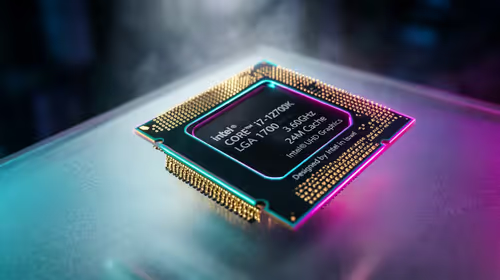
LGA 1851 vs LGA 1700 can affect Twitch and YouTube streaming when gaming and encoding share CPU resources. For SA creators, the real-world difference depends on encoder choice, memory support, motherboard cost, thermals, and upgrade plans.
Read more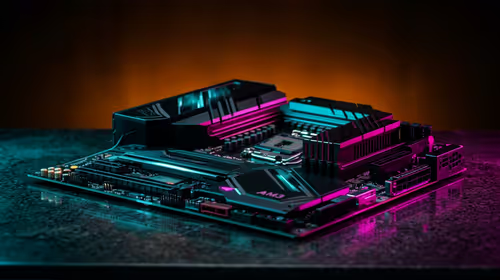
X870E vs X670E for aaa single-player gaming is mainly about fit, features, compatibility, cost, and upgrade path, not one automatic winner. SA buyers should match the choice to the setup.
Read more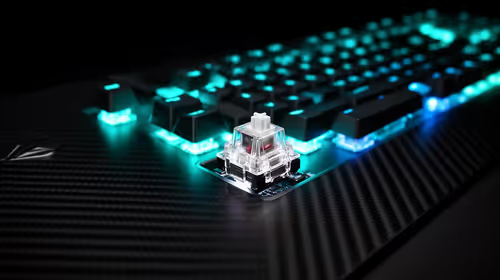
Hall Effect switches vs Mechanical switches for mMO and live-service games is mostly about compatibility, budget, upgrade path, and setup fit. SA buyers should check device support and real needs before expecting a clear win from either option.
Read more
A fake 113GB GTA VI ISO reportedly used empty padding around a small malware payload. SA gamers should delete unofficial builds, keep Windows security active and wait for official channels.

Wi-Fi 6E vs Wi-Fi 6 matters for 4K video editing when files move across a network. The real-world difference between Wi-Fi 6E and Wi-Fi 6 for video editing in 4K depends on NAS access, cloud uploads, router range, and SA creator workflows.

The difference between PCIe 5.0 and PCIe 4.0 for SA gamers is mostly bandwidth headroom. Compare GPU slot needs, NVMe speed, motherboard support, and upgrade timing before paying extra for a newer platform.

Gaming PC stuck pixel checks in South Africa should confirm the monitor fault first. Use colour tests, screenshot comparison, cable swaps, display menu checks, and clear photos before deciding on support.

Shokz OpenFit Air 2 earbuds weigh 7.2g each and use a redesigned dual-driver open-ear layout. SA buyers should choose them for comfort and awareness, not maximum isolation.

AMD's current driver now lists a Radeon RX 9050 4GB, while product coverage details a narrowed memory system. SA buyers should weigh the low VRAM ceiling against current local Radeon options.

Samsung Display has demonstrated a 16-inch 2.5K OLED laptop panel running at 300Hz. SA buyers should wait for a named notebook, full panel specifications and a local price before planning an upgrade.

Microsoft says some Windows 11 game crashes after recent updates are linked to RGB-related drivers. Affected SA gamers should confirm the update and driver before using the published registry workaround.

Minisforum's M2 Pro pairs Core Ultra X7, Arc B390 graphics and 32GB onboard memory in 1.8 litres. SA buyers should weigh its fixed memory and $1,439 launch offer against local mini PCs.

Smart monitors can add apps and convenience, but they also add privacy settings and unwanted-software risk. SA buyers should audit the operating system before paying for extras.

Lenovo says Legion Go failures linked to BIOS N3CN42WW are not user error. Affected SA owners should stop retrying the update, preserve proof and open a support case.
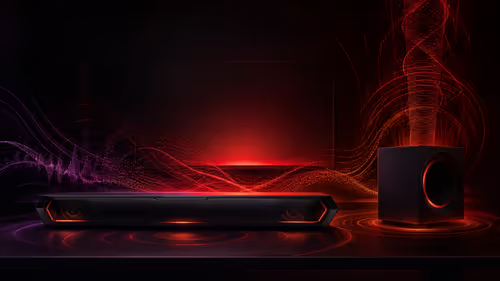
The ROG Gjallar gaming soundbar is now listed in the US at $599.99. SA buyers should compare its 2.1.2 audio, wireless bass and built-in chat controls with simpler local options.