Quick Answer
Adjustable actuation lets you set the exact key travel depth at which a switch registers, while dual-function keys assign two different commands to a single key triggered by press depth. Together they turn one physical key into a two-command input device that reacts differently depending on how far you press it.
Adjustable Actuation: Setting Your Trigger Point 🔧
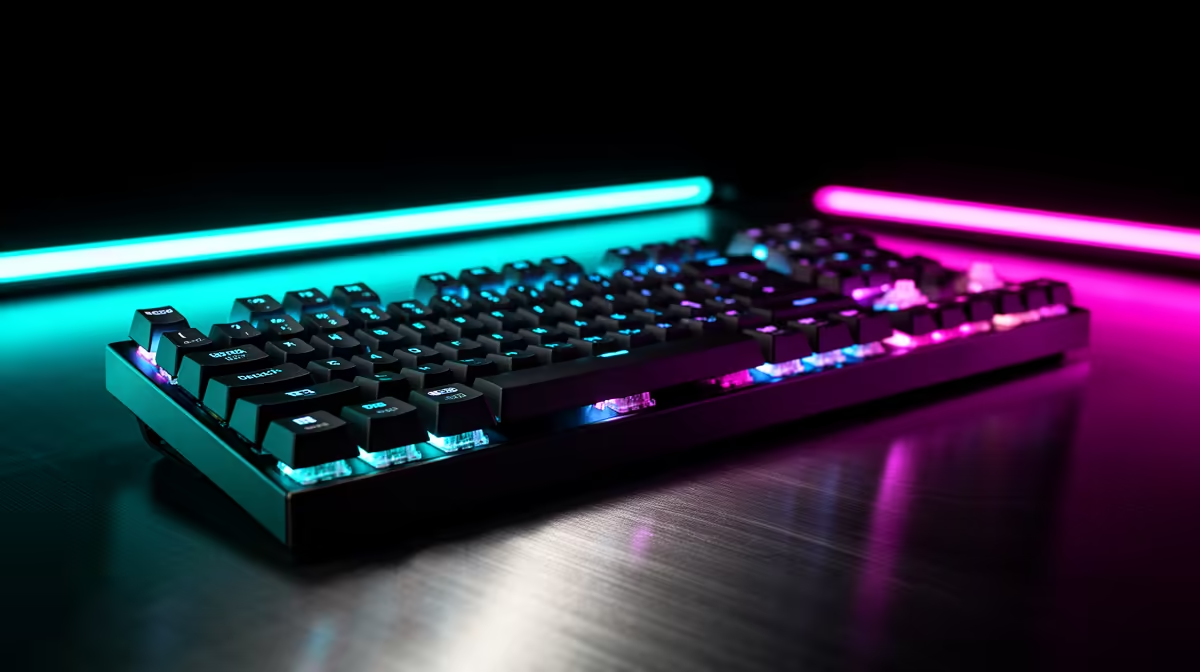
Most standard mechanical switches actuate at a fixed point, typically 2.0 mm on a linear switch or 1.9 mm on a tactile. Adjustable actuation allows you to set this point anywhere within the key's travel range, usually between 0.1 mm and 4.0 mm. Shallow actuation (0.1 to 0.8 mm) makes the key fire almost on contact, reducing the physical movement required per keypress and increasing the rate at which you can execute rapid-fire commands. Deep actuation (2.5 to 4.0 mm) requires deliberate full presses, reducing accidental triggers during positional repositioning.
Dual-Function Keys: Two Commands Per Keystroke 🎮
Dual-function (or dual-zone) keys use two actuation points to assign independent commands per press depth. The first actuation point (say, 1.0 mm) fires Command A. Pressing deeper to the second actuation point (2.5 mm) fires Command B, either simultaneously or as a separate trigger depending on configuration. A practical example: a single keypad key with first-zone aim-down-sights (1.0 mm) and second-zone fire (2.5 mm) consolidates two frequent FPS actions onto one key. For MMO players, the first zone activates a stance buff and the second zone triggers an ultimate ability. This doubles functional command count without adding physical keys.
Implementing Adjustable Actuation in Your Setup 💡
Start by identifying which keys need fast shallow actuation and which need deeper, deliberate presses. Map fast movement keys to 0.8 to 1.2 mm. Map ability rotation keys to 1.5 to 2.0 mm to prevent accidental firing during repositioning. Set utility keys (inventory, map, chat) to 2.5 mm or deeper to avoid triggering them during intensive movement sequences. Save these configurations as a named game profile in your driver software. South African players who participate in MSSA-affiliated events or local LAN tournaments should save profiles to onboard memory so settings are preserved without driver software installation on event PCs.
Test Each Actuation Change In-Game Immediately ⚡
After adjusting any actuation point, load your game and spend five minutes on the adjusted key specifically before resuming normal play. Shallow actuation changes in particular feel dramatically different in motion and may trigger accidental inputs until your finger pressure adapts. A quick isolated test prevents frustration during a ranked match.
FAQ
Do I need an analog optical switch keypad for adjustable actuation?
Yes. Adjustable actuation requires a sensor that reads continuous key position, which is the defining feature of analog optical switches. Standard mechanical switches have fixed actuation points that cannot be changed in software.
Can dual-function keys fire both commands simultaneously?
This depends on the driver implementation. Some systems fire both commands when the key reaches the second actuation point. Others fire Command A at first-zone and Command B only at second-zone, making them sequential rather than simultaneous. Check your keypad driver's dual-zone configuration options before building your layout around simultaneous activation.
Is adjustable actuation useful for productivity outside of gaming?
Yes. Graphic designers and video editors use shallow actuation for high-frequency shortcut keys (undo, brush resize) and deeper actuation for less frequent commands (export, render) to prevent accidental triggers. The same logic that helps in gaming applies to any shortcut-heavy workflow.
Ready to configure every key to your exact press depth preference?
Evetech stocks gaming keypads with analog optical switches and adjustable dual-zone actuation. Browse the keypad range to find a model with per-key actuation configuration and onboard memory.