Two machines can both claim to run a 70-billion-parameter model, and yet one of them does it on a single quiet box while the other needs a tower full of GPUs. The split between the DGX Spark and a high-VRAM workstation is not really about raw speed, it is about how memory is pooled, and that single architectural choice decides which models you can load at all.
Quick Answer
The DGX Spark gives you 128GB of unified CPU-GPU memory, so a 70B model at FP16 loads on one small desktop, something a single discrete GPU usually cannot do. A high-VRAM workstation card like the RTX PRO 6000 Blackwell offers less total capacity but far higher bandwidth, so it generates tokens roughly two to seven times faster on the models that fit. Pick the Spark for large models on a compact budget, the workstation for speed and serious GPU compute.
Two different ways to hold a model in memory
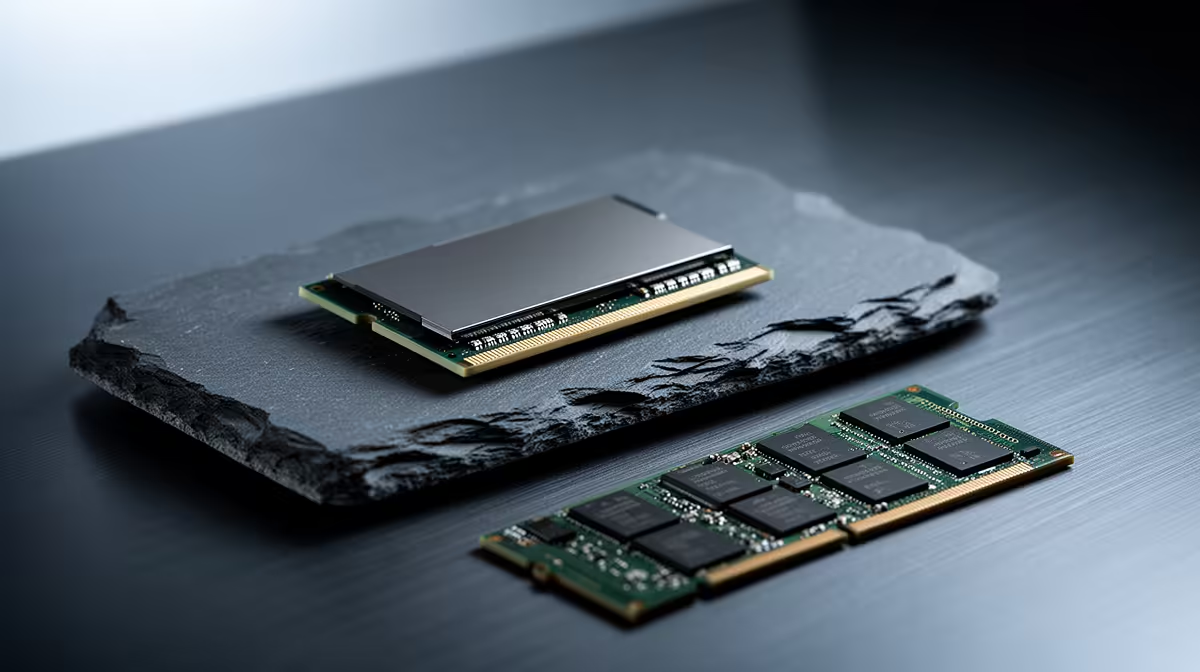
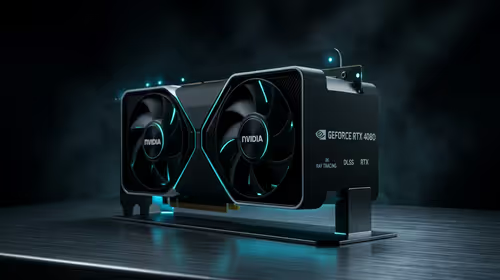
Discrete VRAM is the architecture most people know. A GPU has its own dedicated memory, GDDR7 on current high-end cards, and a model only runs if it fits inside that card's VRAM. The RTX PRO 6000 Blackwell, for example, carries 96GB of fast ECC GDDR7 at 1.79 TB/s bandwidth. That is a lot, but it is a hard ceiling, and a model that needs more than 96GB simply will not load on one card.
The DGX Spark takes the opposite approach. It uses 128GB of LPDDR5X as a single unified pool shared between the CPU and GPU at around 273 GB/s. There is no separate VRAM budget to overflow. The whole 128GB is available to the model, which is why it can hold a 70B model at FP16 that a 96GB discrete card cannot, because a 70B FP16 model needs around 140GB.
Capacity versus bandwidth, the real trade-off
Here is the catch that the capacity numbers hide. Memory bandwidth, not capacity, sets how fast a model generates text once it is loaded. The Spark's unified LPDDR5X runs at roughly 273 GB/s. The RTX PRO 6000's GDDR7 runs at around 1.79 TB/s, more than six times higher.
That gap shows up directly in token speed. In FP8 70B inference the workstation card generates tokens roughly 1.5 to 2 times faster. On smaller models the gap can be wider still; published benchmarks on a 20B model show the workstation reaching around four times the Spark's decode rate. A separate comparison across batch sizes shows the RTX PRO 6000 running 6 to 7 times faster overall across mixed model types. So the Spark wins on what fits, the workstation wins on how fast.
Where the DGX Spark is the right tool
The Spark makes sense when your bottleneck is capacity, not throughput. If you need to run or experiment with large models at FP16 and you do not want to build a multi-GPU tower, a single 128GB box that sips power and sits on a desk is a genuinely elegant answer. It also suits developers prototyping against large models locally before deploying to bigger infrastructure, and teams whose data cannot leave the building for cloud inference.
Where a high-VRAM workstation wins
If you are serving inference to real users, fine-tuning regularly, or running GPU-heavy creative and scientific work alongside your AI, the workstation is the better platform. The higher bandwidth turns into more responsive output, and a discrete card gives you the raw compute that LPDDR5X cannot match. For anything latency-sensitive, the speed difference is felt immediately. The RTX PRO 6000 Blackwell also handles rendering, simulation and training workloads that fall completely outside the Spark's remit.
The cost picture
Neither option is cheap. The DGX Spark is stocked locally at around R70,000. The RTX PRO 6000 Blackwell is a PCIe card that needs a full workstation host, with complete systems typically landing in the R200,000 to R300,000 range depending on CPU and memory configuration. If the workstation's speed advantage is not required for your specific models, the Spark's self-contained simplicity and lower price make it the more efficient buy.
How to decide for your work
Ask what actually limits you. If a model will not fit on the GPUs you can afford, the unified pool of the Spark removes that wall, and that is its whole reason to exist. If your models already fit and you want them to run faster, or you need the GPU for rendering, simulation, or training as well as inference, the discrete high-VRAM route is the stronger buy. Many SA teams that thought they needed the Spark actually need bandwidth, and a workstation card serves them better. You can compare options suited to large-model work at Evetech's AI PC range, and the specific cards that pair well with demanding GPU workloads appear in the GPU best sellers list.
Frequently Asked Questions
Can a single discrete GPU run a 70B model at FP16?
Usually not, because FP16 70B needs around 140GB, more memory than any single high-end card's VRAM provides. That is exactly the gap the Spark's 128GB unified pool fills, which is why it can load models a 96GB card cannot.
Why is the workstation faster if it has less memory?
Because token-generation speed is governed by memory bandwidth, not total capacity. The workstation's GDDR7 moves data at roughly six times the rate of the Spark's LPDDR5X, so the models that fit on both run far faster on the workstation.
Is the DGX Spark good for fine-tuning?
It can fine-tune models up to around 70B, but its bandwidth limits training throughput compared to a dedicated GPU. For regular or heavy fine-tuning a discrete high-VRAM workstation is the more capable choice.
Which uses less power?
The DGX Spark is built as a compact, low-power desktop sitting in a 300W class envelope, so it draws far less than a multi-GPU workstation. If running cost and desk footprint matter, that is a real point in its favour.
Should an SA developer buy the Spark to save money?
Only if capacity is your genuine constraint. If your models already fit on a workstation card, the workstation gives more speed and flexibility for the money, so the Spark is not automatically the cheaper-per-result option.
Building a local AI rig and unsure whether you need raw bandwidth or sheer capacity? Compare the current line-up in the AI PC range at Evetech and match the hardware to your real bottleneck.