



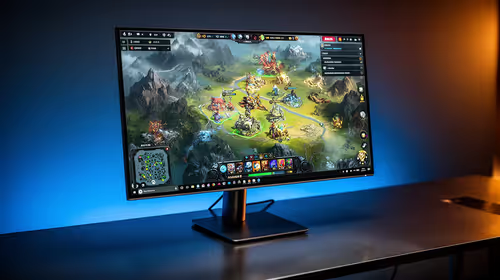
IPS vs VA for Strategy and Sim Games in SA
IPS vs VA for strategy and sim games should be judged by fit, not a single winner. Compare compatibility, latency, capacity, upgrade path, cost planning, and South African setup needs.
Read moreMastering direct drive wheel rigidity is crucial for immersive sim racing. If your rig flexes, you lose detail. 🏎️ Learn why chassis stability dictates force feedback quality and how to secure your setup for the podium. 🏁 Don't let wobble ruin your race!

So, you’ve just unboxed a beast of a direct drive wheel. You can already feel the raw power, the incredible detail, and the lower lap times. You bolt it onto your trusty desk or entry-level cockpit, fire up your favourite sim, and… it feels… wobbly. Disconnected. All that glorious force feedback is being lost in a chassis that’s flexing and creaking. 😥
This is a classic "welcome to the big leagues" moment for many South African sim racers. The truth is, direct drive wheel rigidity isn't a luxury; it's the essential foundation your entire experience is built on.
A direct drive wheelbase is a powerful motor designed to transmit every single bump, kerb, and loss of traction from the virtual car directly to your hands. When you turn the wheel, it pushes back with immense force—sometimes over 20 Newton-metres (Nm) of torque.
If your rig flexes under this load, two things happen:
Think of it like trying to tighten a bolt with a rubber spanner. All the effort, none of the results. Ensuring you have a solid platform is the first step to unlocking the true potential of your high-end sim racing gear.
How can you tell if your setup is suffering from a lack of direct drive wheel rigidity? It’s not always about loud creaks and groans. Sometimes, the signs are more subtle.
A sturdy rig from a reputable brand like Playseat is specifically engineered to combat these forces, providing a stable platform for you to perform at your best.
With your PC off, grab your wheel rim at the 9 and 3 o'clock positions. Try to push, pull, and twist it firmly. Do the same for your pedals. If you can see or feel significant movement in the rig structure itself (not just the wheel's internal quick release), you've found a flex point that needs addressing. A truly rigid rig will feel like it's bolted to the floor.
When you're ready to invest in a cockpit that can handle serious power, the material and design are everything. The goal is to eliminate flex entirely, creating a 1:1 connection between you and the simulation.
The gold standard for direct drive wheel rigidity is an aluminium profile rig (often called an 8020 rig). This system uses extruded aluminium beams and heavy-duty brackets, offering incredible strength and near-infinite adjustability. While the initial investment in ZAR might be higher, it's a "buy once, cry once" solution that will last a lifetime.
However, well-designed tubular steel rigs can also offer excellent rigidity, especially when they feature smart triangulation and thick-gauge steel. It’s crucial to match your rig to your equipment. A powerful set of Thrustmaster load cell pedals, for example, demands just as much rigidity from the pedal deck as the wheelbase does from its mount. 🚀
Ultimately, upgrading your rig isn't just about holding your new wheel; it's about unlocking its full performance. Don't let a wobbly foundation compromise your multi-thousand-rand investment in a direct drive system. A solid rig provides the consistency and confidence you need to push your limits on the track.
Ready to Build Your Ultimate Cockpit? A solid foundation is the key to unlocking your true pace. A powerful direct drive wheel is only as good as the rig it's mounted on. Explore our complete range of sim racing gear and build the unshakable setup you deserve.
Yes, standard desks often wobble. A dedicated rig with high direct drive wheel rigidity ensures you feel every bump without dampening the force feedback.
Even 5Nm wheels can cause flex on weak frames. Wheels above 8Nm typically require an aluminum profile rig to maintain chassis stability and safety.
It is risky. High torque can damage desks. If you must, use low torque settings, but you will sacrifice the benefits of direct drive wheel rigidity.
8020 aluminum extrusion is the gold standard. It offers superior rigidity and modularity compared to tubular steel, handling high-torque wheelbases easily.
Absolutely. Flex acts as a damper, absorbing force feedback signals. A rigid setup allows for precise steering inputs and consistent braking, improving lap times.
Mount the wheel and apply force up, down, and sideways. If the frame moves before the suspension in the game would, your setup lacks necessary stiffness.
IPS vs VA for strategy and sim games should be judged by fit, not a single winner. Compare compatibility, latency, capacity, upgrade path, cost planning, and South African setup needs.
Read more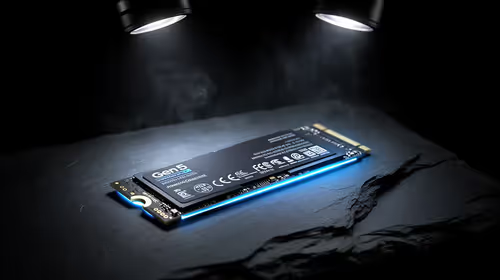
Gen 5 NVMe SSD guide for Bloemfontein gamers should be shortlisted around the job it must do. South African buyers should compare capacity, speed, thermals, and motherboard support, warranty path, and upgrade room before treating any pick as best.
Read more
Skip the RTX 5070 if your first-time builder budget needs better balance. Better SA picks can free room for the right CPU, PSU, case, monitor, storage, and cooling while still giving a strong first gaming PC experience this year in South Africa.
Read more
RTX 5080: weighing the pros and cons for SA should be shortlisted around the job it must do. South African buyers should compare GPU tier, VRAM, cooling, and PSU headroom, warranty path, and upgrade room before treating any pick as best.
Read more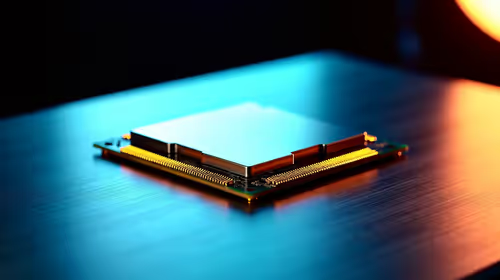
Core i5-13400F gives South African PC builders a capable mid-range CPU choice with clear limits. Check its gaming fit, discrete GPU requirement, LGA1700 platform costs, and upgrade path before locking in your parts list.
Read more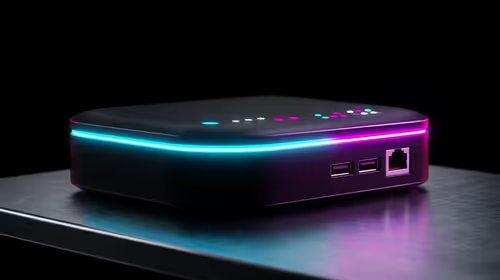
Pros and cons of the Wi-Fi 7 routers for SA should be shortlisted around the job it must do. South African buyers should compare WiFi standard, coverage, latency, and device support, warranty path, and upgrade room before treating any pick as best.
Read more
Steam content servers unreachable needs a download-path check, not an immediate reinstall of every game. Restart the client, inspect download settings and compare another connection when practical. Clearing the download cache is separate from deleting installed games.

Keychron G6 HE has built-in and swappable battery versions with different weights. The product brief lists 42g and 46g respectively, each with a 3g tolerance. Choose by grip and battery preference before treating one headline weight as universal.

Corsair HS80 v2 MAX supports 2.4GHz wireless and Bluetooth. Its maximum battery figures use RGB-off conditions and differ by connection. Check microphone routing, comfort and the exact device support before assuming every wireless mode behaves alike.

Windows taskbar notification badges can be shown or hidden in Taskbar behaviours. This changes the small app indicators, not the underlying messages. Choose a calmer desktop while keeping a deliberate routine for checking important conversations and app updates.

Windows title bar window shake can minimise other open windows when you shake the active window by its title bar. Inspect the Multitasking setting and switch it off if that gesture interrupts your work. The preference costs R0 and does not require new hardware.

Windows Print Screen opens Snipping Tool when its keyboard preference is enabled. Change the option under Accessibility, Keyboard to choose another workflow. Test whether you need a clipboard image or a saved file.

Windows desktop icons missing may be a visibility setting. Right-click the desktop, choose View and inspect Show desktop icons. If only system icons are absent, use Desktop icon settings. Check the Desktop folder before assuming files were deleted.

Windows set time zone automatically greyed out calls for a location and device-policy check. Automatic time-zone selection relies on location services. A manual time-zone choice is separate from synchronising the clock; check both before replacing hardware.
Windows title bar window shake can minimise other open windows when you shake the active window by its title bar. Inspect the Multitasking setting and switch it off if that gesture interrupts your work. The preference costs R0 and does not require new hardware.
Windows Print Screen opens Snipping Tool when its keyboard preference is enabled. Change the option under Accessibility, Keyboard to choose another workflow. Test whether you need a clipboard image or a saved file.
Windows desktop icons missing may be a visibility setting. Right-click the desktop, choose View and inspect Show desktop icons. If only system icons are absent, use Desktop icon settings. Check the Desktop folder before assuming files were deleted.
Windows set time zone automatically greyed out calls for a location and device-policy check. Automatic time-zone selection relies on location services. A manual time-zone choice is separate from synchronising the clock; check both before replacing hardware.