Quick Answer
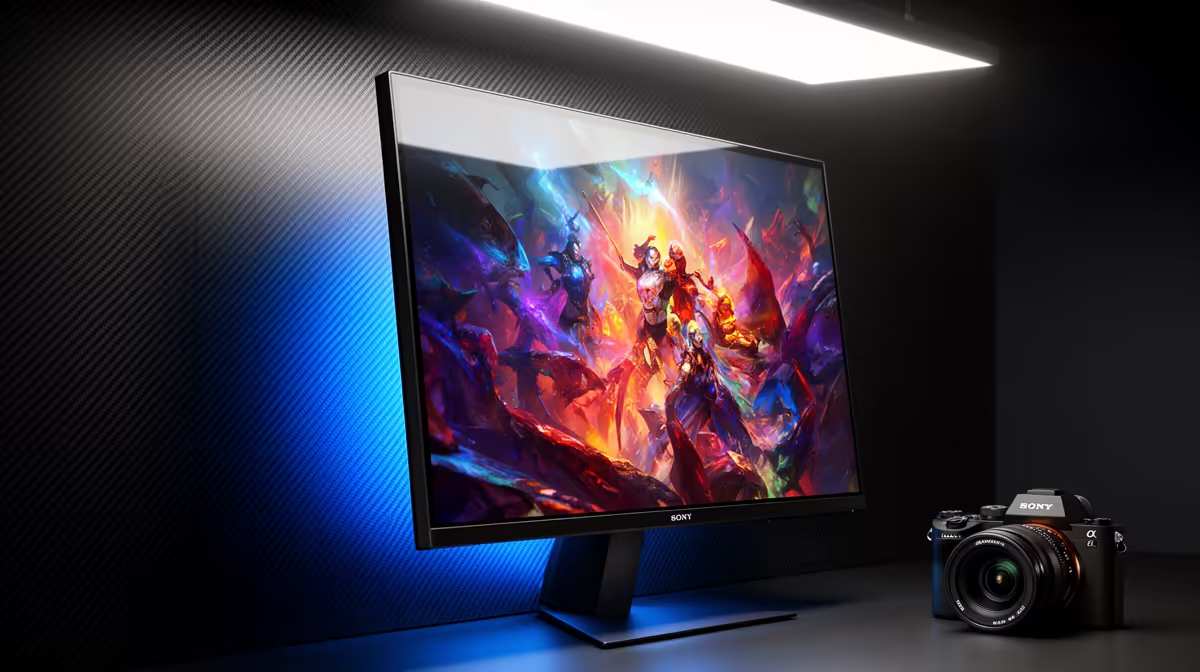
DisplayHDR 600 is a meaningful HDR standard requiring 600 nits of peak brightness with stricter colour volume and local dimming requirements. Standard HDR on monitors typically means HDR400 or generic HDR certification that may only deliver 400 nits with large dimming zones. The difference is noticeable: DisplayHDR 600 produces highlights that pop convincingly while HDR400 can appear flat by comparison.
Understanding the DisplayHDR Certification Tiers 🖥️
VESA's DisplayHDR certification runs from HDR400 at entry level through HDR600, HDR1000 and the OLED-specific True Black 400 and True Black 600 standards. HDR400 requires 400 nits peak brightness but has no black level or local dimming requirement, so a standard IPS panel passes. HDR600 requires 600 nits sustained with higher colour volume requirements. The gap between the two is larger than the numbers suggest.
How HDR Looks in Practice on Each Standard 🎮
In HDR-enabled games like Cyberpunk 2077 or Returnal, the visual difference between HDR400 and HDR600 is visible in highlight detail and specular rendering. On a DisplayHDR 400 monitor, bright light sources in dark scenes clip quickly, losing detail at the top of the brightness range. On DisplayHDR 600, that same source sustains detail at higher luminance, producing a more natural rendering of extreme brightness. For creators working with HDR footage, DisplayHDR 600 provides a closer reference to how content appears on premium consumer displays.
OLED True Black vs DisplayHDR 600 IPS: A Different Comparison 💡
OLED True Black 400 (400 nits peak, 0.0005 nits black level) produces a higher perceived contrast ratio than a DisplayHDR 600 IPS with 600 nits peak and 0.3 nits minimum black, even though the IPS has higher absolute peak brightness. For most gaming and creator use cases, an OLED True Black 400 monitor in the R12,000 to R16,000 range at Evetech delivers more impactful HDR than a DisplayHDR 600 IPS at a similar price, due to the infinite contrast advantage. The exception is very bright ambient environments where 600-nit peak brightness outperforms OLED in daytime visibility.
Calibrate In-Game HDR Peak Brightness to Your Monitor ⚡
Many games default to HDR Peak Brightness of 1,000 nits or higher in their calibration menus, causing clipping on DisplayHDR 600 panels. Set the in-game peak brightness to 600 nits to match your monitor's certified ceiling. Miscalibrated HDR settings make content look blown out or washed out rather than delivering the visual improvement HDR promises.
FAQ
Is DisplayHDR 600 good enough for professional video editing in South Africa?
For most commercial video production workflows, DisplayHDR 600 on a wide-gamut IPS panel is a workable editing reference for SDR-to-HDR projects. For final colour grade sign-off on premium HDR deliverables, a mastering-grade monitor at HDR1000 or above is more appropriate. For hybrid gaming-creator use, DisplayHDR 600 is a strong practical standard.
Does enabling HDR in Windows affect non-HDR content quality?
Yes. With Windows HDR enabled, SDR applications are tone-mapped into the HDR colour space, which can make colours appear washed out or over-saturated. Modern monitors and Windows 11 handle this better than earlier implementations, but toggling HDR on and off based on your current activity remains the most reliable approach for accurate colour across all content types.
Are DisplayHDR 600 monitors noticeably more expensive than HDR400 in SA?
The price difference at the same size and refresh rate is typically R1,500 to R4,000. Given that the HDR experience quality gap is substantial, the upgrade cost is generally worth it for gamers who regularly play HDR-enabled titles or consume HDR streaming content on their gaming monitor.
Choosing a monitor with meaningful HDR performance?
Evetech stocks gaming monitors with DisplayHDR 400, 600 and OLED True Black certification across multiple sizes and refresh rates. Browse the monitors section at Evetech to compare HDR specifications and find the panel for your gaming and creator requirements.