DLSS can swing a graphics-card decision when you play demanding games with ray tracing. NVIDIA's current stack combines upscaling, ray reconstruction, frame generation and latency tools, while AMD has closed much of the image-quality gap with machine-learning FSR. You still need to compare the features your own games support.
Quick Answer
DLSS 4 gives a compatible GeForce card an edge in a library rich in supported ray-traced games. Its transformer-based Super Resolution and Ray Reconstruction can improve detail, stability and lighting reconstruction, while RTX 50-series cards add Multi Frame Generation. AMD FSR 4 makes Radeon RX 9000-series options far more competitive, especially when raster performance and VRAM are strong for the price.
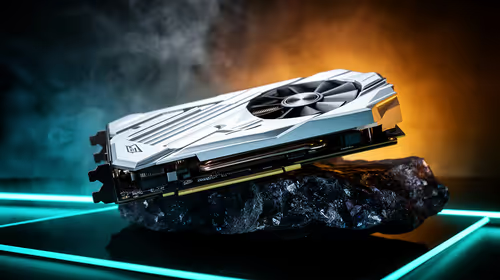
Compare the full graphics card range with GPUs South African buyers are viewing. Build the decision from your games, monitor and live card prices. A feature name on the box cannot replace that shortlist.
DLSS 4 Is a Suite
Super Resolution renders at a lower internal resolution and reconstructs the output image. The DLSS transformer model draws on information across the image and across frames, aiming for steadier fine detail, less ghosting and cleaner edges in motion. All RTX generations can use compatible Super Resolution features, subject to game and driver support.
Ray Reconstruction tackles another problem. It replaces parts of the conventional denoising pipeline used with ray-traced effects. This can improve lighting detail and stability in a title built to support it, though results still vary by game, output resolution and quality mode.
Frame Generation sits beside those tools. RTX 40 and RTX 50 cards can generate frames in supported titles, while Multi Frame Generation is tied to RTX 50-series hardware. NVIDIA has since developed the stack beyond its original DLSS 4 launch, so check the current feature matrix for the exact card and game rather than assuming every RTX GPU receives every mode.
What AMD Brings in 2026
FSR 4 moved AMD's upscaling to a machine-learning approach on Radeon RX 9000-series cards. Supported games can produce a more stable image than older FSR versions, which makes a current Radeon easier to choose when the hardware value is right.
Support remains central. A game may include FSR 3.1, offer a driver upgrade path, or have native FSR 4 integration. Those routes can differ by API, driver and GPU. Check AMD's current supported-game list and the release notes for the driver you plan to use.
FSR's wider history across hardware can still matter when you share settings guides with friends or keep an older card. The newest ML quality, however, belongs to supported Radeon generations. Separate the open availability of earlier FSR releases from the hardware requirements of FSR 4.
Image Quality Needs a Game Test
Look at foliage, thin wires, particle effects and objects revealed from behind other geometry. These are harder reconstruction cases than a still screenshot. Watch for trailing, shimmer and detail that changes when the camera moves.
Quality mode at 1440p or 4K is a sound starting point. Performance modes use a lower internal resolution and give the algorithm less source information. A clean result at 4K Quality cannot prove that 1440p Performance will look equally convincing.
Use recent footage captured from the same game version. Patches can update an upscaler, and driver overrides can change the model in supported titles. Keep native rendering in the comparison so you know what the performance gain costs.
Frame Generation Changes the Feel Differently
Generated frames improve motion smoothness and animation presentation. They do not increase the rate at which the game simulates input. Start from a healthy base frame rate, enable the platform's latency reduction tool, and judge mouse response alongside the counter.
For a single-player game on a high-refresh screen, that trade can be excellent. In a ranked shooter, native rendered frames and low input delay deserve priority. This distinction applies to both vendors.
Choose by the Games You Keep
Make a list of ten titles. Mark which support DLSS Super Resolution, Ray Reconstruction, Frame Generation, FSR 4 and each vendor's latency tool. Then give extra weight to the five you play most.
Compare native raster speed and VRAM before adding feature value. A card that needs aggressive upscaling to meet your target may age poorly, while a faster raster card can give you more freedom to choose native rendering. Power, cooler quality and warranty complete the local comparison.
Keep Version Names in Perspective
DLSS and FSR labels cover several components. A game's menu may say DLSS while offering Super Resolution alone, or it may expose Frame Generation and Ray Reconstruction as separate switches. FSR can refer to upscaling, frame generation, or a package that combines them. Read the individual settings rather than scoring a title from one logo.
Driver overrides add another layer. They can move a compatible game to a newer model without a full game patch, yet support is tested title by title. Record the game version, driver and override state when you compare footage. Otherwise two reviews may appear to disagree while testing different rendering paths.
Long ownership also changes the weighting. NVIDIA has carried Super Resolution improvements across older RTX generations, while its newest frame-generation modes require newer hardware. AMD's current ML upscaling is tied to supported Radeon products and games. Judge the feature set your chosen card can use today, then treat future expansion as a bonus.
For a fair local buying test, price the complete card and any PSU change. Compare cooler noise and size, because an excellent software stack cannot make an unsuitable three-slot model fit your case. If two GPUs land within your budget and meet the same native target, the supported upscaler becomes a useful tie-breaker. A large gap in base performance or memory deserves more weight.
DLSS has the stronger case when your library uses its full ray-tracing stack and you care about reconstruction quality. Radeon can win when its named card offers the better base performance, memory and price while FSR 4 covers the games that matter. The ecosystem should follow your library, rather than the other way round.
FAQ
Does DLSS 4 work on every RTX card?
Feature support differs. Compatible RTX cards can use supported Super Resolution features, while Multi Frame Generation requires RTX 50-series hardware.
Is FSR 4 available on older Radeon cards?
Its launch support centred on Radeon RX 9000-series products. Check AMD's current compatibility information for your exact GPU and driver.
Should upscaling decide which GPU I buy?
It can break a close tie. Start with native performance, VRAM and price, then score the upscalers in your actual games.
Map DLSS and FSR support across your most-played games, then compare the named cards on native speed, VRAM and live local value.