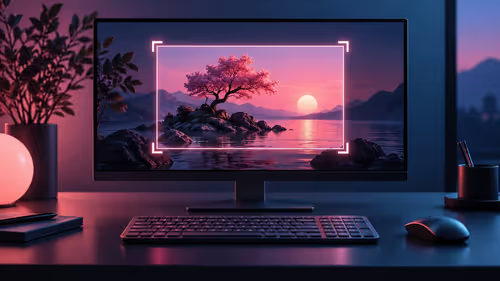
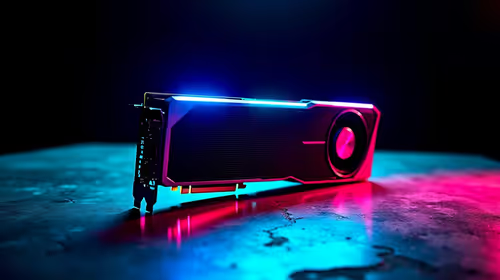
Forget waiting for international AAA titles. South Africa’s own game dev scene is exploding, with local studios crafting incredible worlds. But how do they compete visually without massive budgets? The secret lies in two powerful technologies: NVIDIA's DLSS and AMD's FSR. This isn't just about higher frame rates; it’s about how smart upscaling is fundamentally changing game development right here in South Africa, making amazing games more accessible for everyone.
Demystifying the Magic: What Are DLSS and FSR?
At their core, both DLSS (Deep Learning Super Sampling) and FSR (FidelityFX Super Resolution) are clever upscaling technologies. They allow your graphics card to render a game at a lower internal resolution (like 1080p) and then use sophisticated algorithms to output a high-quality image at a higher resolution (like 4K). The result? A massive performance boost. ⚡
But how they achieve this is where they differ.
NVIDIA's AI-Powered Approach: DLSS
DLSS is exclusive to NVIDIA's RTX graphics cards because it relies on specialised hardware called Tensor Cores. It uses a deep learning neural network, trained on super-high-quality game scans, to intelligently reconstruct the image. This AI-driven process is incredibly effective at preserving fine details, often resulting in an image that looks as good as, or sometimes even sharper than, the native resolution. It’s a key feature for anyone looking at modern NVIDIA GeForce graphics cards for high-refresh-rate gaming or ray tracing.
AMD's Open-Source Challenger: FSR
FSR, on the other hand, is an open-source spatial upscaler. It doesn't require specialised AI hardware, which means it works on a much wider range of GPUs, including older NVIDIA cards and, of course, the full lineup of AMD Radeon graphics cards. While earlier versions were less detailed than DLSS, the latest iterations of FSR have dramatically closed the quality gap, making it a fantastic option for developers who want to offer performance-boosting features to the largest possible audience.
How DLSS & FSR Empower South African Game Developers
This technology has a profound impact on game development in South Africa, a market with a unique mix of hardware capabilities. For local studios, these tools are not just a nice-to-have; they are vital for success.
Imagine a small indie team in Johannesburg. They've designed a stunning game set in the Karoo, complete with realistic lighting and detailed textures. Five years ago, optimising this for the average South African PC would be a nightmare of compromises... cutting features, lowering texture quality, and spending months on performance tuning.
Today, the story is different. By implementing FSR or DLSS, they can deliver that breathtaking vision without forcing players to own a R40,000 rig. This has two huge benefits:
- Expanded Audience: They can sell their game to a much wider local market, from students with budget gaming laptops to hardcore enthusiasts. More players mean more sales and a healthier studio.
- Creative Freedom: Developers can be more ambitious. They can add demanding features like ray-traced shadows or complex particle effects, knowing that upscaling tech will make it playable for most of their audience. This allows South African developers to punch well above their weight on the global stage.
The impact of DLSS and FSR on game development in South Africa is, therefore, one of democratisation. It levels the playing field, enabling our local talent to create world-class experiences. ✨
Choosing Your Upscaling Sweet Spot 🔧
Start with the 'Quality' setting for DLSS or FSR. In most games, this offers a huge performance boost with almost no noticeable visual difference from native resolution. Only switch to 'Balanced' or 'Performance' if you're still not hitting your target frame rate (like a stable 60 FPS). It's all about finding the right balance for your specific monitor and GPU!
Your Turn: Maximising Performance as a Gamer 🚀
For gamers, this is all great news. More beautiful games from local studios will run better on your machine. To take advantage, simply dive into your game's graphics settings and look for the "DLSS" or "FSR" option.
Enabling it can be the difference between a choppy 30 FPS and a silky-smooth 60 FPS or more, especially at higher resolutions like 1440p or 4K. It breathes new life into older hardware and lets new hardware push visual boundaries like never before.
Of course, to truly harness the power of this tech, having a capable modern GPU is key. If your current card is struggling with the latest titles even with upscaling, checking out the latest graphics card deals can be the single biggest upgrade you make to your gaming experience.
Ultimately, DLSS and FSR are more than just lines of code. They are enablers, fostering a more vibrant, ambitious, and successful gaming ecosystem right here at home.
Ready to Power Up Your Gaming?
Whether you're building the next great South African game or just want to play it at max settings, DLSS and FSR demand the right hardware. Explore our incredible graphics card deals and find the perfect GPU to unlock next-gen performance today.