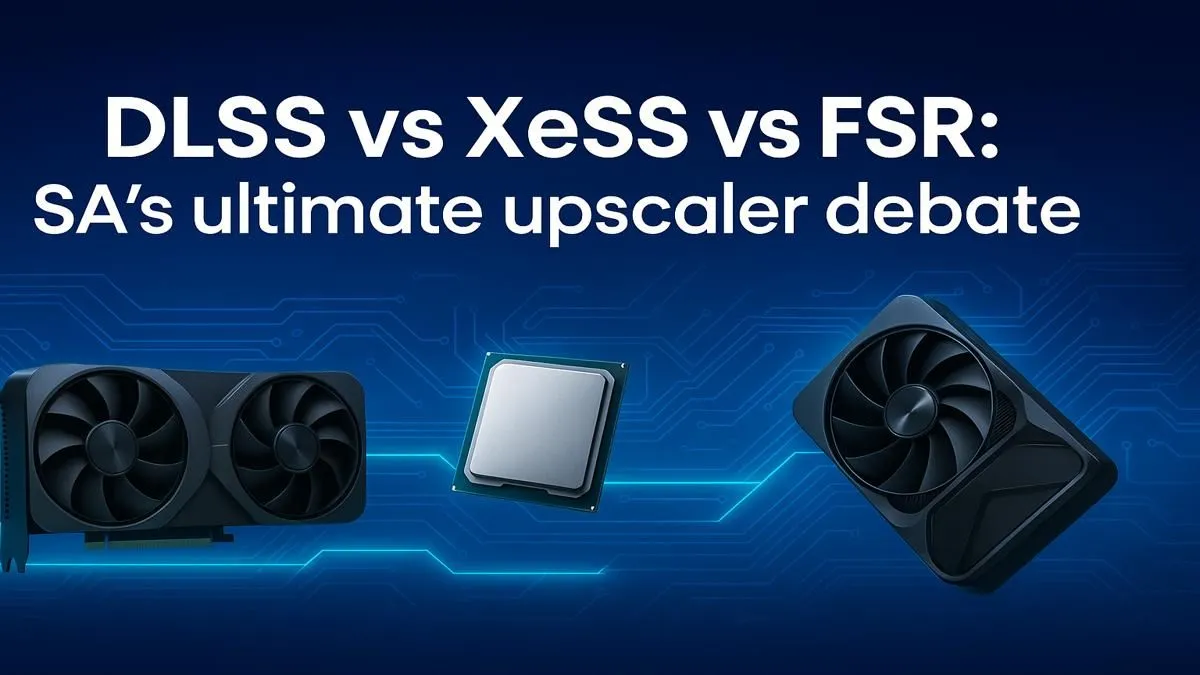
Chasing high refresh rates in the latest titles but your rig sounds like it’s about to take off? You’re not alone. In the quest for silky-smooth frame rates without melting your GPU, upscaling technology is your secret weapon. But with Team Green, Red, and Blue all in the ring, the DLSS vs. XeSS vs. FSR debate can get confusing. This ultimate upscaler guide for South African gamers will clear things up for good. 🚀
What Is GPU Upscaling, Anyway?
Before we dive into the DLSS vs. XeSS vs. FSR showdown, let's quickly cover the basics.
Imagine telling your PC to draw a game at a lower resolution, like 1080p, which is easy on the hardware. Then, a smart algorithm (the upscaler) stretches that image up to your monitor's native resolution, like 1440p or 4K. It uses clever AI and image data to fill in the missing pixels, giving you a sharp final image with a massive performance boost. More frames, same great visuals... what's not to love?
The Contenders: A Deep Dive into DLSS vs. XeSS vs. FSR
Each major GPU manufacturer has its own flavour of upscaling tech. While they all aim for the same goal—more FPS—they get there in slightly different ways. This is the core of our South African upscaler guide.
### NVIDIA DLSS: The AI Powerhouse
NVIDIA’s Deep Learning Super Sampling (DLSS) is the OG. It uses dedicated Tensor Core hardware inside NVIDIA GeForce RTX cards to run a sophisticated AI model. This model reconstructs the image from a lower resolution, often resulting in an image that looks as good as, or sometimes even better than, native resolution.
- Pros: Incredible image quality and massive performance gains. Frame Generation on RTX 40-series cards is a legitimate performance multiplier.
- Cons: It's a closed standard, meaning it only works on NVIDIA RTX GPUs.
### AMD FSR: The Open-Source Challenger
FidelityFX™ Super Resolution (FSR) is AMD's answer. Unlike DLSS, FSR is open-source. This is its superpower. It doesn't require specialised AI hardware, so it works on a huge range of GPUs—including older cards from both AMD and NVIDIA! While its image quality was initially a step behind DLSS, the latest versions (FSR 2 and 3) have seriously closed the gap. It's a fantastic option for anyone running one of AMD's Radeon lineup.
- Pros: Works on almost any modern graphics card. It’s a free performance boost for everyone.
- Cons: Image quality, while excellent, can sometimes be slightly softer than DLSS in fast-moving scenes.
### Intel XeSS: The Flexible Newcomer
Intel's Xe Super Sampling (XeSS) is the newest entry in the DLSS vs. FSR vs. XeSS battle. It's a hybrid, which makes it fascinating. On Intel Arc graphics cards, it uses dedicated XMX cores for AI-accelerated upscaling, similar to DLSS. On other cards (AMD/NVIDIA), it uses a more general-purpose fallback that performs a lot like FSR.
- Pros: Flexible; offers both hardware-accelerated and universal modes. The image quality is very competitive.
- Cons: Newer tech, so game support is still growing compared to the other two.
Pro Tip: Driver Updates Are Key 🔧
No matter which upscaler you use, always make sure your graphics drivers are up to date! NVIDIA, AMD, and Intel constantly release updates that optimise performance and improve image quality for their respective upscaling technologies. It’s a free, easy way to get more FPS.
The Ultimate SA Upscaler Showdown: Which is for You?
So, after comparing DLSS, FSR, and XeSS, which one wins? The best upscaler for you depends entirely on the hardware you own... or plan to buy.
- If you have an NVIDIA RTX card: Use DLSS. It’s tailor-made for your hardware and generally offers the best image quality.
- If you have an AMD card or an older NVIDIA card: FSR is your champion. It delivers a fantastic performance uplift on a wide variety of hardware.
- If you have an Intel Arc GPU: XeSS is the obvious choice, giving you the best of its AI-powered potential.
The underlying principles of this tech are so powerful they're even transforming workflows on professional workstation graphics cards, where AI-accelerated tasks are becoming more common. For gamers, it simply means we get to push settings to ultra without our framerates taking a nosedive. ✨
Ultimately, this comparison of DLSS, XeSS, and FSR shows there’s no single loser. The real winner is you, the South African gamer, who now has more tools than ever to achieve the perfect balance of performance and visual splendour.
Ready to Boost Your FPS?
Now that you're an expert on upscaling, it's time to get the hardware that makes it all possible. Find your perfect graphics card upgrade for performance that leaves lag in the dust.