Quick Answer
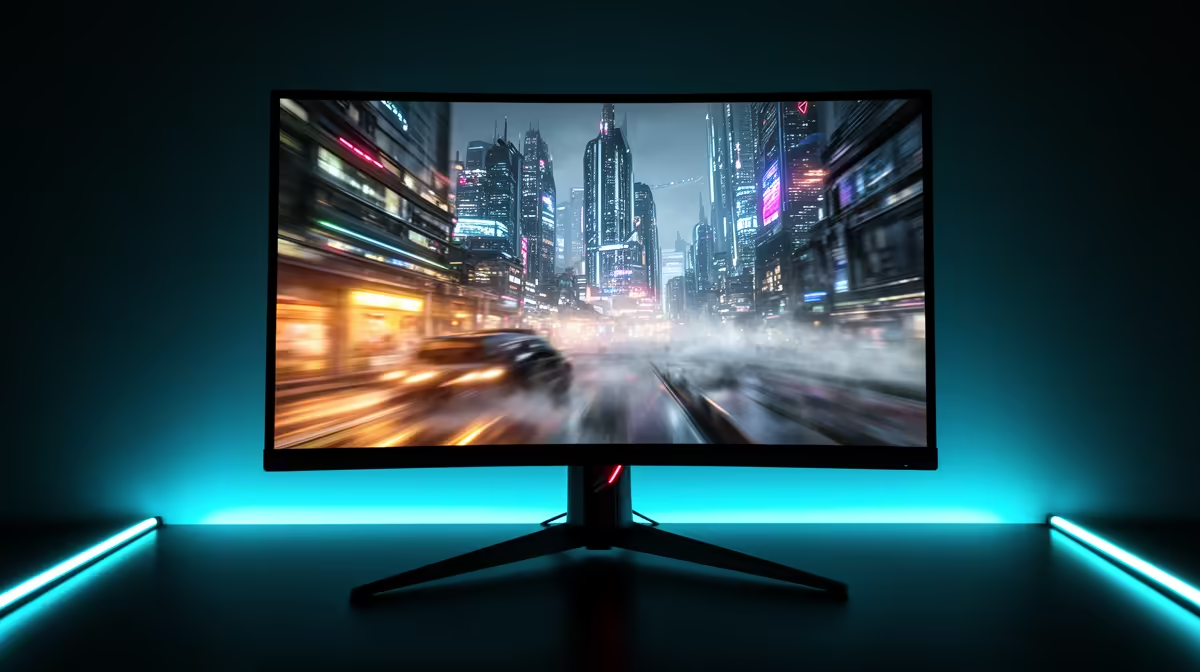
Yes, both technologies reduce their target artefact. VRR (G-Sync or FreeSync) eliminates screen tearing by synchronising the monitor's refresh to the GPU's output. ELMB Sync reduces perceived motion blur by strobing the backlight during VRR operation, addressing ghosting on fast-moving content.
How VRR Stops Tearing 📡
Screen tearing occurs when the GPU submits a new frame while the monitor is mid-refresh, causing two partial frames to display simultaneously. You see a horizontal split across the image, most obvious during panning shots or fast lateral movement. VRR solves this by making the monitor wait for the GPU to signal frame completion before starting a new refresh cycle.
G-Sync Compatible and FreeSync Premium Pro monitors support this over DisplayPort and HDMI, and the practical effect is that tearing is eliminated across the full variable range, typically 48Hz to 300Hz on current high-refresh panels. South African gamers running multiplayer titles over Vumatel or Frogfoot fibre with sub-20ms ping to local servers benefit most from VRR, as stable server-side physics means more consistent GPU frame output, which VRR handles cleanly.
What ELMB Sync Adds to the Picture 🔧
ELMB (Extreme Low Motion Blur) is ASUS's branded backlight strobing technology. Backlight strobing works by briefly turning the backlight off between refresh cycles, which prevents the eye from tracking a decaying pixel value.
ELMB Sync, the updated version, operates during VRR rather than requiring a fixed refresh rate. On older implementations, you had to choose between tear-free VRR and blur-reduced strobing. ELMB Sync combines them. The practical effect in a fast-paced FPS is cleaner crosshair tracking during flick movements and less smear behind moving characters.
Are Both Features Worth It for Your Setup? 💡
For competitive SA gamers playing at 200 fps and above, VRR is a baseline requirement on any monitor in the R7,000 to R14,000 price range. At 200 fps with VRR active, the display is refreshing every 5ms, tearing is absent, and the gaming experience is clean.
For casual or RPG-focused gamers, neither feature provides meaningful benefit compared to their impact on competitive play. Investing in resolution or panel size is a better priority if frame rate does not regularly exceed 144 fps.
Lower ELMB Sync Duty Cycle for Brighter Output ⚡
If you enable ELMB Sync and find the image too dim, check the monitor's OSD for a duty cycle or pulse width setting. Reducing the strobing intensity to 60 to 70 percent of maximum restores most of the brightness while retaining a meaningful portion of the motion blur reduction.
FAQ
Does VRR introduce any input lag penalty?
On monitors with G-Sync Compatible or FreeSync Premium Pro certification, the input lag penalty from VRR is zero to one millisecond, imperceptible in gameplay. The older G-Sync hardware module (dedicated chip in the monitor) added no latency either.
Can I use ELMB Sync with G-Sync and FreeSync at the same time?
ELMB Sync is designed to work alongside VRR on supported ASUS monitors. However, ELMB Sync's effectiveness is highest when frame rates are consistently high, typically above 120 fps. If your GPU is only pushing 80 fps at your chosen settings, disabling ELMB Sync and relying on VRR alone gives a more stable-looking image.
Are there alternatives to ELMB Sync on non-ASUS monitors?
Yes. LG uses Motion Blur Reduction, Samsung has Black Frame Insertion, and MSI offers Anti-Motion Blur settings. All are variations of backlight strobing. The implementation quality varies by panel, and some third-party monitors allow strobing during VRR while others require you to disable VRR to use strobing. Check the specification sheet before purchasing.
Need a monitor with solid VRR and low motion blur?
Evetech stocks gaming monitors with G-Sync Compatible and FreeSync Premium Pro support, including panels with advanced strobing features. Compare models in the monitors section to find your best match.