



PCIe 5.0 vs PCIe 4.0 for Video editing in 4k in SA
PCIe 5.0 vs PCIe 4.0 for video editing in 4k is mainly about fit, features, compatibility, cost, and upgrade path, not one automatic winner. SA buyers should match the choice to the setup.
Read moreSanwa Denshi controls provide a named hardware reference for button actuation and joystick direction. The R1,799 C2 uses these parts, while execution still depends on technique, layout comfort and the game's input handling during competitive play.
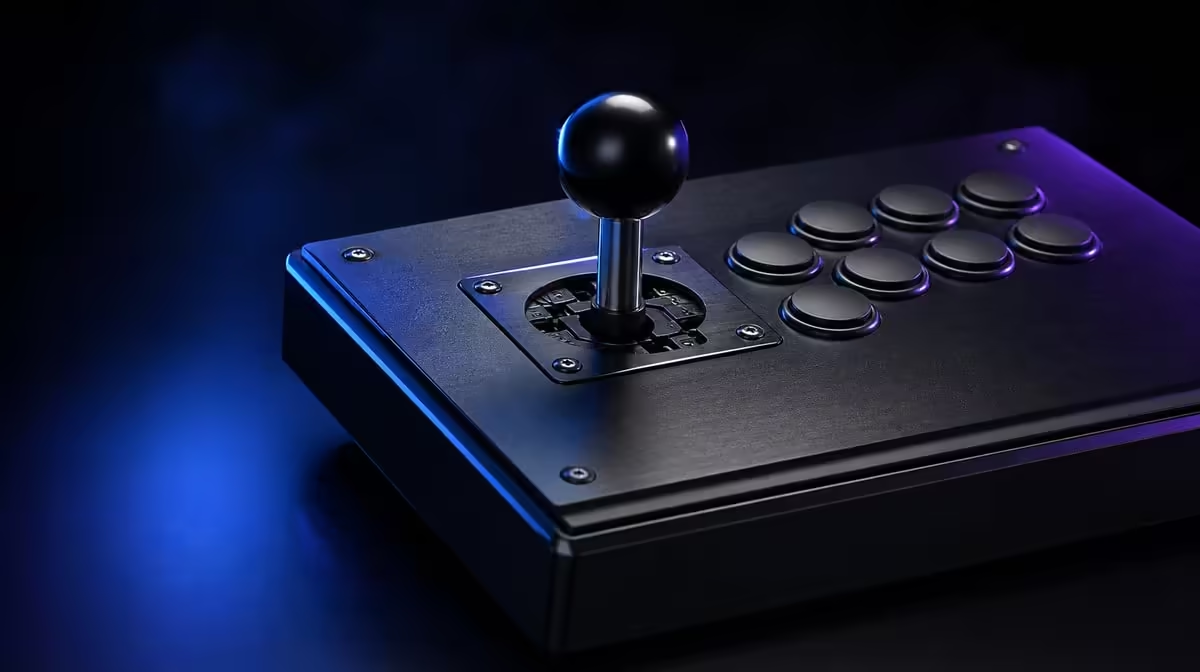
Named controls improve a buying conversation because they give players something specific to test. On the Sanwa Denshi GameSir C2, the buttons and lever create a known arcade starting point, but cleaner input still comes from the relationship between mechanism, layout, hand position and the game's interpretation.
Sanwa Denshi controls improve the C2's arcade input case by providing identified button-and-lever hardware that can be checked for consistent response. The R1,799 fightstick still needs comfortable placement, correct directional mode and practiced technique; the component name alone cannot guarantee better match results.
Arcade buttons separate actions across a wide face rather than concentrating them under one thumb. This can help players assign individual fingers and build combinations with less finger travel. The benefit appears only when spacing suits the hand and unused fingers remain controlled.
Test every C2 button with single presses first. Observe whether each game input appears once and whether the cap returns without catching. Alternate between neighbouring controls, then try distant combinations that matter in the chosen character's move set.
Do not invent actuation force or travel figures. Sound can also mislead because the enclosure affects what is heard. Pair physical feel with the game's visible input history and repeat the test after the hands are warm.
A stable desk or lap position is essential. If the enclosure shifts, the action hand may strike at changing angles and make consistent hardware appear unreliable.
Use a practice pattern that visits every button rather than only a comfortable pair. Outer controls reveal reach and wrist rotation, while rapid neighbouring presses reveal whether inactive fingers are resting too heavily. Record both missed and unintended actions.
Repeat the layout check after the player has relaxed. First attempts can be unusually forceful because arcade buttons look as if they need to be struck. Consistent light presses may reduce fatigue without changing the hardware at all.
The joystick activates cardinal directions and paired diagonals. Practise them slowly enough to see each point in an input display. A complete circle is useful only after each corner has been proved on its own.
Return to neutral deserves equal attention. A command can fail because the previous direction remains active too long or releases too early. Watch the transition history instead of focusing solely on the final move animation.
Identify the installed joystick model and gate shape before planning a replacement. Sanwa Denshi branding narrows the hardware family but does not define internal mounting, restrictor or switch details.
Players can compare complete arcade and conventional layouts in Evetech's gaming controller range. The important comparison is the complete hand-and-game system, not the part name in isolation.
Lever grip should remain a personal experiment, not a copied rule. Test a few comfortable holds through the same motion list, changing only the hand position. The best option is the one that keeps neutral return and diagonals clean without tightening the forearm.
Do not ride the outer boundary harder after a miss. Extra force can extend the path and make recovery slower. Use the input display to find the activation rather than treating the enclosure edge as the command point.
The C2 includes a multi-functional directional toggle. It changes how the supported setup receives lever commands, not the physical feel of the joystick. Record its starting position and use the same eight-direction drill after one adjustment.
If an input returns in the new position, mode was relevant. If the same corner fails on PS4 or Xbox One menus and games across positions, preserve that evidence and inspect a different layer.
Keep the Key Lock state visible during tests. A protected function can look absent even while the Sanwa buttons and lever work correctly. Configuration notes prevent a switch state from being blamed on component quality.
Evetech's gaming accessories category can support a stable station, though no surrounding product alters the underlying direction mode.
Save a configuration note per game when necessary. Include toggle state, map and the practice motion that proves it. That note prevents a change made for one title from quietly following the player into another.
After transport or cleaning, read the controls before play. Physical switches can be moved while the Sanwa parts remain perfectly healthy. A ten-second baseline prevents the wrong layer from being blamed.
Choose a fixed practice sample and count outcomes. Ten attempts at a diagonal, charge motion, button pair and complete command produce a small but useful baseline. Repeat the set on another day and note fatigue.
Change one habit at a time. A lighter lever grip, a lower wrist or a quieter neutral finger may improve consistency. Simultaneous changes hide which adjustment mattered.
At R1,799, the C2 combines the Sanwa hardware with PS4 and Xbox One support, toggle, Key Lock and artwork-ready faceplate. Each feature strengthens the purchase only when it enters the player's actual routine.
Evetech's popular accessories collection provides a current-availability view for the rest of the station. Keep the evaluation centred on repeatable input rather than reputation.
Maintenance should be gentle and observational. Keep dust off exposed surfaces, moisture away from openings and weight off the lever during storage. Test before deciding a control needs internal attention.
A named part is most valuable when it supports a clear learning loop: observe, adjust technique, repeat and compare. That method gives the C2's hardware a fair chance while keeping claims anchored to what the player can actually see.
Add a recovery drill after intentional mistakes. Miss one command, return the lever to neutral and perform the next input cleanly. Reliable components help make that reset visible, while practiced composure stops one error from contaminating the rest of the sequence.
Compare the first and final ten minutes of a session. If button accuracy remains steady but direction errors increase, lever-hand fatigue deserves attention. If outer buttons become harder to reach, posture or action-hand tension may be responsible.
Do not change the direction mode while evaluating physical feel. Preserve one electronic state so the player's observations belong to the same setup. Run configuration experiments as a separate block with their own notes.
The final judgement should distinguish identity, condition and preference. Sanwa Denshi names the family; repeated tests describe how this C2 behaves; the player's comfort decides whether that behaviour is desirable. Keeping those layers separate produces a fairer component assessment.
They provide a specific hardware family for comparison and maintenance research. They still do not disclose every internal model or measurement.
Look for one clear game response, consistent return and comfortable reach across repeated presses. Record those observations instead of trying to assign force figures.
Test cardinals, diagonals, transitions and return to neutral in an input display. Repeat from both player sides.
No. Hardware can support consistency, but timing, game knowledge, layout comfort and practice still decide results.
It changes command presentation for the setup, not the physical mechanism. Test its modes separately from hardware feel.
The GameSir C2 reference price is R1,799. Judge it as a complete controller rather than pricing the name alone.
Ready to turn named parts into measurable practice? Compare Evetech's controller layouts, then test each C2 input through the same visible drill until your results are repeatable.
They provide a specific hardware family for comparison and maintenance research. They still do not disclose every internal model or measurement.
Look for one clear game response, consistent return and comfortable reach across repeated presses. Record those observations instead of trying to assign force figures.
Test cardinals, diagonals, transitions and return to neutral in an input display. Repeat from both player sides.
No. Hardware can support consistency, but timing, game knowledge, layout comfort and practice still decide results.
It changes command presentation for the setup, not the physical mechanism. Test its modes separately from hardware feel.
The GameSir C2 reference price is R1,799. Judge it as a complete controller rather than pricing the name alone.
PCIe 5.0 vs PCIe 4.0 for video editing in 4k is mainly about fit, features, compatibility, cost, and upgrade path, not one automatic winner. SA buyers should match the choice to the setup.
Read more
Wi-Fi 7 vs Wi-Fi 6e for competitive esports comes down to router support, latency goals, device compatibility, and coverage. SA buyers should match the choice to the real network setup.
Read more
ATX 3.1 vs ATX 3.0 for mMO and live-service games buyers - what changes is mostly about compatibility, budget, upgrade path, and setup fit. SA buyers should check device support and real needs before expecting a clear win from either option.
Read more
LGA 1851 vs LGA 1700 can affect Twitch and YouTube streaming when gaming and encoding share CPU resources. For SA creators, the real-world difference depends on encoder choice, memory support, motherboard cost, thermals, and upgrade plans.
Read more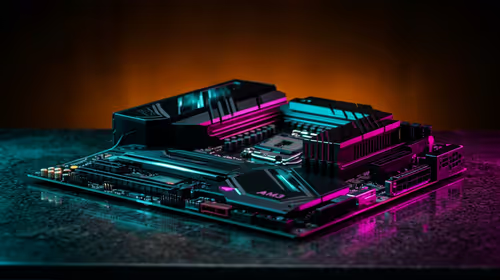
X870E vs X670E for aaa single-player gaming is mainly about fit, features, compatibility, cost, and upgrade path, not one automatic winner. SA buyers should match the choice to the setup.
Read more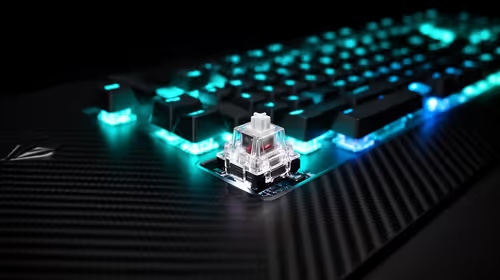
Hall Effect switches vs Mechanical switches for mMO and live-service games is mostly about compatibility, budget, upgrade path, and setup fit. SA buyers should check device support and real needs before expecting a clear win from either option.
Read more
A fake 113GB GTA VI ISO reportedly used empty padding around a small malware payload. SA gamers should delete unofficial builds, keep Windows security active and wait for official channels.

Wi-Fi 6E vs Wi-Fi 6 matters for 4K video editing when files move across a network. The real-world difference between Wi-Fi 6E and Wi-Fi 6 for video editing in 4K depends on NAS access, cloud uploads, router range, and SA creator workflows.

The difference between PCIe 5.0 and PCIe 4.0 for SA gamers is mostly bandwidth headroom. Compare GPU slot needs, NVMe speed, motherboard support, and upgrade timing before paying extra for a newer platform.

Gaming PC stuck pixel checks in South Africa should confirm the monitor fault first. Use colour tests, screenshot comparison, cable swaps, display menu checks, and clear photos before deciding on support.

Shokz OpenFit Air 2 earbuds weigh 7.2g each and use a redesigned dual-driver open-ear layout. SA buyers should choose them for comfort and awareness, not maximum isolation.

AMD's current driver now lists a Radeon RX 9050 4GB, while product coverage details a narrowed memory system. SA buyers should weigh the low VRAM ceiling against current local Radeon options.

Samsung Display has demonstrated a 16-inch 2.5K OLED laptop panel running at 300Hz. SA buyers should wait for a named notebook, full panel specifications and a local price before planning an upgrade.

Microsoft says some Windows 11 game crashes after recent updates are linked to RGB-related drivers. Affected SA gamers should confirm the update and driver before using the published registry workaround.

Minisforum's M2 Pro pairs Core Ultra X7, Arc B390 graphics and 32GB onboard memory in 1.8 litres. SA buyers should weigh its fixed memory and $1,439 launch offer against local mini PCs.

Smart monitors can add apps and convenience, but they also add privacy settings and unwanted-software risk. SA buyers should audit the operating system before paying for extras.

Lenovo says Legion Go failures linked to BIOS N3CN42WW are not user error. Affected SA owners should stop retrying the update, preserve proof and open a support case.
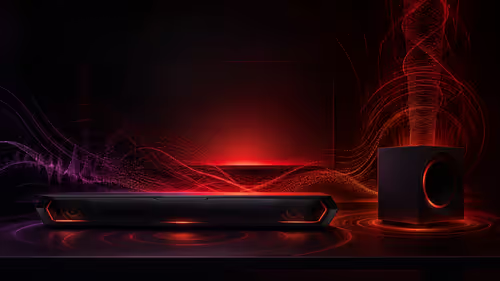
The ROG Gjallar gaming soundbar is now listed in the US at $599.99. SA buyers should compare its 2.1.2 audio, wireless bass and built-in chat controls with simpler local options.