


PCIe 5.0 vs PCIe 4.0 for Video editing in 4k in SA
PCIe 5.0 vs PCIe 4.0 for video editing in 4k is mainly about fit, features, compatibility, cost, and upgrade path, not one automatic winner. SA buyers should match the choice to the setup.
Read moreTri-mode connectivity lets players compare supported routes, but the mode name cannot guarantee lower total input delay. The R999 Cyclone 2 offers three paths, while game processing, display output and platform implementation still shape response.
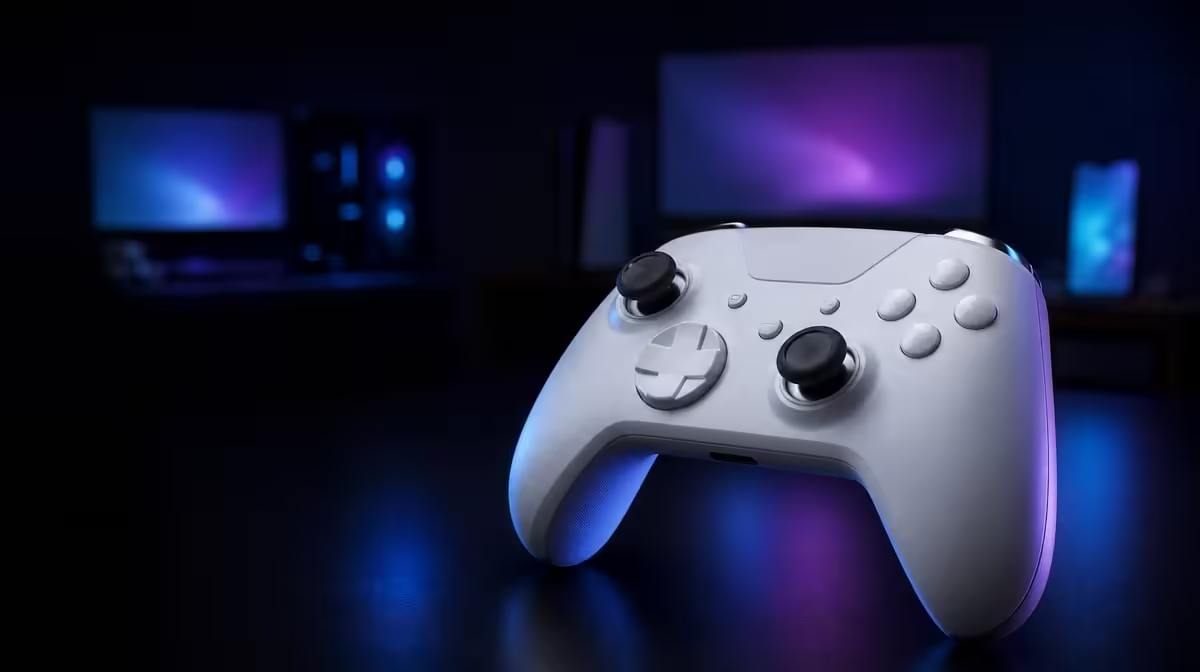
More connection options can improve diagnosis, but they cannot promise the lowest total response time. Tri-mode connectivity and input delay should be tested across the local controller path, game processing and display. The R999 GameSir Cyclone 2 offers three routes, while TMR sticks and Hall triggers address control sensing rather than wireless latency.
Tri-mode lets players compare supported connection routes, which can reveal whether delay follows one local path. It does not guarantee that one mode is always fastest. The R999 Cyclone 2 should be tested in the same game, host and display conditions, with online server latency kept separate.
Controller response begins with the press or stick movement, travels through the connection, reaches the host, passes through game processing and appears on the display.
Online play adds another journey from the host to a server and back. A delayed online action may have left the controller promptly.
Use a local menu or offline scene first. This removes much of the server path and makes connection differences easier to observe.
Device performance remains in the local chain. If the host drops frames or the display updates unevenly, input may appear late regardless of connection. Keep the scene simple enough that performance is stable.
Define the symptom before testing. A steady delay, occasional missed response and screen stutter are not the same. Recording the pattern points towards connection, host or display without relying on a vague feeling.
Do not use vibration timing as the only cue. A game may trigger physical feedback after the visual action by design, which does not prove the original press arrived late.
The Evetech gaming controller category can help compare connection packages after the test method is clear.
Choose one host, game scene, display mode and repeatable action. Test the first Cyclone 2 route several times, note consistency and then change only the connection.
Human timing varies, so one press is weak evidence. A sequence of menu movements, camera turns or trigger inputs provides a better feel for repeatability.
If a mode behaves differently, confirm host recognition and default input before loading a custom profile. Mappings or response curves can imitate a connection problem.
Run at least five deliberate actions per route. Human timing varies, so a single press can overstate a small difference. Consistency across repetitions is the better practical result.
Keep controller position and surrounding wireless conditions similar. Comparing one route beside the host and another across the room is not fair.
Write the result in a table: route, local scene, repeated action and observation. This makes the next platform test easier to compare.
Mag-Res TMR sticks can improve resistance to contact-related drift. Hall analog triggers can report graduated travel. Neither feature shortens the connection path by itself.
Keep the stick and trigger settings unchanged during mode comparison. If their behaviour changes only on one route, inspect that path before recalibrating magnetic input.
Customisable RGB also has no role in latency. It may help identify profiles, but should not receive performance credit.
Hall trigger travel may make an action feel different because partial press values change the response. Use a simple face-button or menu input before adding graduated controls to the latency test.
Likewise, stick deadzone affects when movement begins. Preserve the same TMR profile across routes so software does not become the changing variable.
The magnetic hardware can strengthen control consistency without affecting packet timing. Keeping those claims separate protects both features from exaggerated conclusions.
Browse Evetech gaming accessories after the local path has been isolated.
Tri-mode and multiplatform do not guarantee that every connection works identically on each host. Test the exact PC or Android combination used by the buyer.
Create a route table with host, connection, local result and game support. A mode earns value when it has a real device and passes the test.
Repeat the test on the second important platform rather than assuming the first host's result transfers. Multiplatform support can involve different device implementations.
Display performance and frame behaviour still shape what the player sees. If delay survives all routes, investigate the host and game rather than cycling connections indefinitely.
Use the most dependable route while diagnosing the others. Tri-mode flexibility can keep play moving, but it should not encourage constant switching once a stable session has begun.
At R999, the Cyclone 2 provides the routes, magnetic controls and charging dock in one package. Its value lies partly in offering a controlled comparison, not in promising one universal low-latency mode.
Build a four-layer fault map. Connection covers the route to the host. Processing covers the game's handling of input. Display covers when the response becomes visible. Network covers online travel after the host. Place every symptom on the earliest layer supported by evidence.
Then perform a mode round trip. Test route A, move to route B and return to A without changing the profile. A consistent return is stronger evidence than one isolated success.
If all routes feel delayed only in one demanding scene, hold the controller constant and investigate performance. If one route differs across several local scenes, focus on that connection.
Tri-mode reduces uncertainty by offering alternatives, not by erasing the rest of the response chain. That is the durable value statement for the Cyclone 2.
Save the results by host because PC and Android implementations can differ. A route that feels consistent on one device should not be declared identical everywhere before the second platform passes.
Use the included dock after testing as a fixed storage point, but keep charging outside the latency score. The base and Smart Start-Stop routine add package value without changing the controller-to-host timing.
At the end, choose the route that remains dependable in the real playing position. A theoretical winner that complicates daily setup may be less useful than a stable connection backed by a clear profile and fallback.
The included dock and Smart Start-Stop Charging are part of the R999 package, but charging hardware does not affect connection latency. Once the response question is resolved, browse Evetech's popular accessories to complete the setup.
A sensible result may differ by host. One supported route can feel best at the desk while another suits a nearby Android setup or acts as a fallback. Keep those conclusions local to the tested device, room and game.
Repeat the preferred path on another day before finalising it. A single comparison can be distorted by background software, display mode or temporary wireless conditions. Consistency across ordinary sessions matters more than a dramatic one-off impression.
Tri-mode earns its value by offering usable choices. It should never be converted into one unqualified promise about response speed.
It can affect the local route between controller and host. Game processing and display remain further parts of the response chain.
No. Host implementation, the game and surrounding conditions influence the result.
Yes. Server travel adds another delay path, so begin with a local menu or offline scene.
No. TMR describes magnetic stick sensing, not the timing of the controller link.
The Phantom White Cyclone 2 with its included charging dock is R999.
Ready to test response one connection at a time? Compare tri-mode gaming controllers at Evetech and separate the local link, game processing, display and online path before choosing.
It can affect the local route between controller and host. Game processing and display remain further parts of the response chain.
No. Host implementation, the game and surrounding conditions influence the result.
Yes. Server travel adds another delay path, so begin with a local menu or offline scene.
No. TMR describes magnetic stick sensing, not the timing of the controller link.
The Phantom White Cyclone 2 with its included charging dock is R999.
PCIe 5.0 vs PCIe 4.0 for video editing in 4k is mainly about fit, features, compatibility, cost, and upgrade path, not one automatic winner. SA buyers should match the choice to the setup.
Read more
Wi-Fi 7 vs Wi-Fi 6e for competitive esports comes down to router support, latency goals, device compatibility, and coverage. SA buyers should match the choice to the real network setup.
Read more
ATX 3.1 vs ATX 3.0 for mMO and live-service games buyers - what changes is mostly about compatibility, budget, upgrade path, and setup fit. SA buyers should check device support and real needs before expecting a clear win from either option.
Read more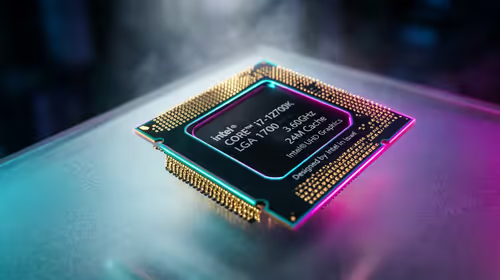
LGA 1851 vs LGA 1700 can affect Twitch and YouTube streaming when gaming and encoding share CPU resources. For SA creators, the real-world difference depends on encoder choice, memory support, motherboard cost, thermals, and upgrade plans.
Read more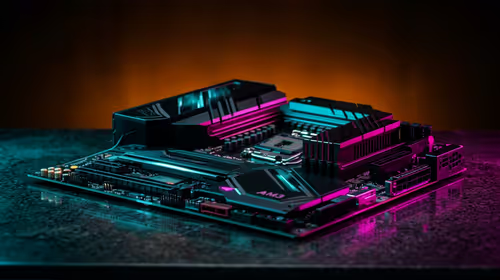
X870E vs X670E for aaa single-player gaming is mainly about fit, features, compatibility, cost, and upgrade path, not one automatic winner. SA buyers should match the choice to the setup.
Read more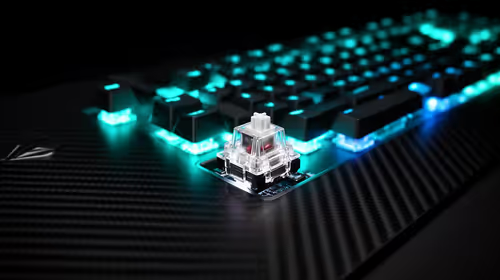
Hall Effect switches vs Mechanical switches for mMO and live-service games is mostly about compatibility, budget, upgrade path, and setup fit. SA buyers should check device support and real needs before expecting a clear win from either option.
Read more
A fake 113GB GTA VI ISO reportedly used empty padding around a small malware payload. SA gamers should delete unofficial builds, keep Windows security active and wait for official channels.
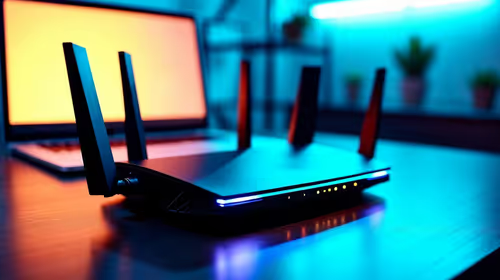
Wi-Fi 6E vs Wi-Fi 6 matters for 4K video editing when files move across a network. The real-world difference between Wi-Fi 6E and Wi-Fi 6 for video editing in 4K depends on NAS access, cloud uploads, router range, and SA creator workflows.

The difference between PCIe 5.0 and PCIe 4.0 for SA gamers is mostly bandwidth headroom. Compare GPU slot needs, NVMe speed, motherboard support, and upgrade timing before paying extra for a newer platform.

Gaming PC stuck pixel checks in South Africa should confirm the monitor fault first. Use colour tests, screenshot comparison, cable swaps, display menu checks, and clear photos before deciding on support.

Shokz OpenFit Air 2 earbuds weigh 7.2g each and use a redesigned dual-driver open-ear layout. SA buyers should choose them for comfort and awareness, not maximum isolation.

AMD's current driver now lists a Radeon RX 9050 4GB, while product coverage details a narrowed memory system. SA buyers should weigh the low VRAM ceiling against current local Radeon options.

Samsung Display has demonstrated a 16-inch 2.5K OLED laptop panel running at 300Hz. SA buyers should wait for a named notebook, full panel specifications and a local price before planning an upgrade.

Microsoft says some Windows 11 game crashes after recent updates are linked to RGB-related drivers. Affected SA gamers should confirm the update and driver before using the published registry workaround.
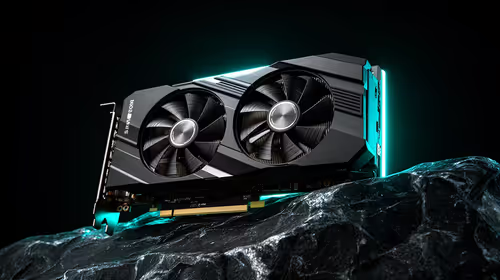
RTX 5090 on a 650W PSU is a tight pairing with very limited headroom. For SA gaming PCs, focus on total system draw, PSU quality, connector support, CPU choice, and avoid OC plans unless the full build is carefully power-limited.
PCIe 5.0 vs PCIe 4.0 for video editing in 4k is mainly about fit, features, compatibility, cost, and upgrade path, not one automatic winner. SA buyers should match the choice to the setup.
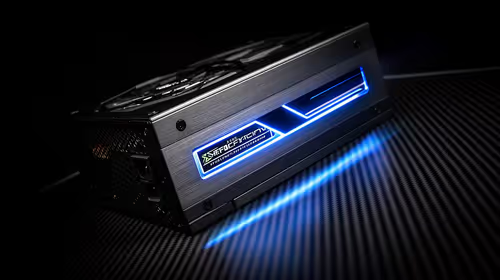
850W PSU safety for RTX 5090 is plausible with a quality unit and balanced parts. In SA, confirm connector support, CPU power draw, case airflow, PSU age, and spare capacity before building around 850W.
Wi-Fi 7 vs Wi-Fi 6e for competitive esports comes down to router support, latency goals, device compatibility, and coverage. SA buyers should match the choice to the real network setup.