Quick Answer
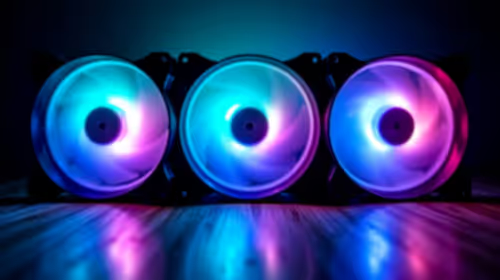
Dual ball bearing fans last significantly longer than sleeve bearing fans, particularly in warmer climates and horizontally mounted components. Dual ball bearing fans carry rated lifespans of 40,000 to 70,000 hours MTBF; sleeve bearing fans typically rate at 15,000 to 30,000 hours under ideal conditions, dropping faster in heat or horizontal mounting.
Why Bearing Design Determines Fan Lifespan 🔧
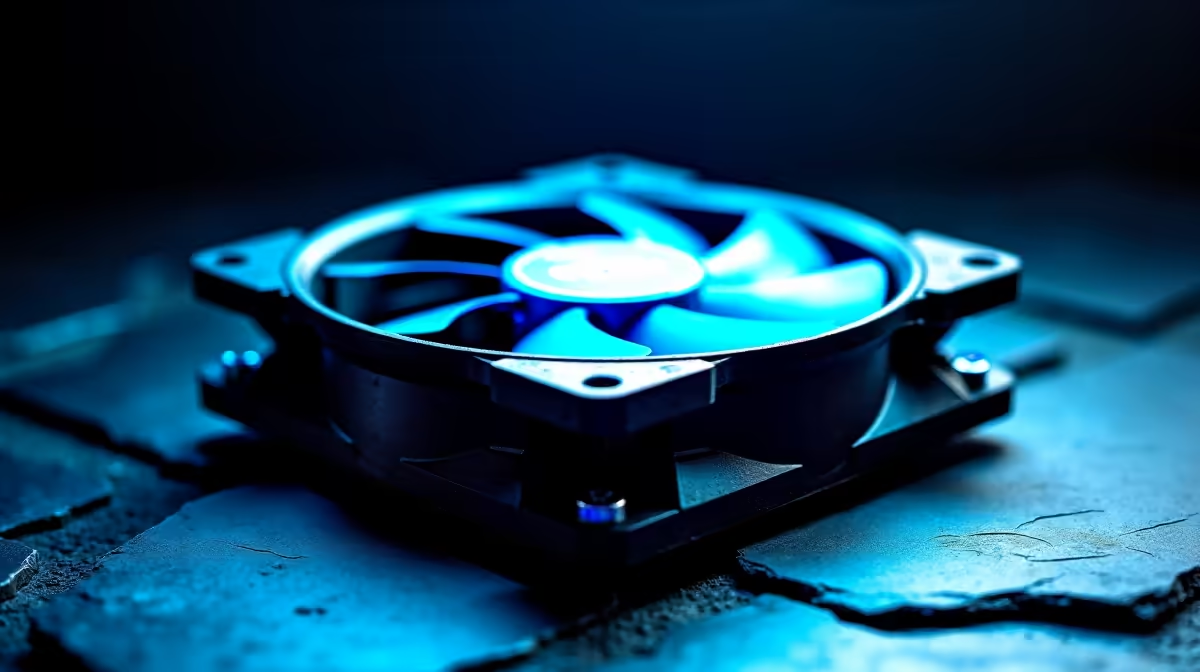
A sleeve bearing fan uses a porous brass sleeve saturated with lubricating oil. The fan shaft rides on this oil film with no metal-to-metal contact during normal operation. The problem is that oil gradually wicks away due to heat, causing friction to increase and the bearing to seize or produce grinding noise. A sleeve bearing fan in a case where ambient temperature reaches 40 to 45 degrees Celsius (realistic in a SA summer) may reach audible degradation in three to four years rather than the rated six to eight years at 25 degrees Celsius test conditions. A dual ball bearing fan uses two sets of precision ball races with sealed lubricant-filled chambers, tolerating heat and non-vertical mounting far better.
Mounting Orientation and SA Use Cases 💡
Sleeve bearing fans suffer accelerated wear when mounted horizontally with the shaft pointing upward, because gravity causes the shaft to rest on one side of the sleeve rather than centring on the oil film. Most case fans mount vertically, which is fine for sleeve bearings. But PSU fans and cooler fans mounted over horizontal heatsinks operate in orientations that stress sleeve bearings. In South Africa, where summer temperatures in Gauteng regularly reach 28 to 32 degrees Celsius in rooms without air conditioning, the thermal stress on sleeve bearings makes dual ball bearings worth the R50 to R150 premium per fan.
Acoustic Differences and Long-Term Expectations 🔊
New sleeve bearing fans are typically quieter than ball bearing fans because the oil film provides inherent vibration damping. However, this advantage degrades as the lubricant thins: an aging sleeve bearing fan develops clicking or grinding noise that worsens over time. Ball bearing fans maintain consistent acoustics throughout their service life. For a quiet, long-lived SA gaming build, hydraulic or dual ball bearing fans from Noctua, be quiet!, and ASUS ROG are worth seeking out.
Check Fan Specs Before Bulk-Buying for a Build ⚡
When purchasing multiple case fans, verify the bearing type in the specification, not just the brand. Many fan product lines include both sleeve and ball bearing models under the same product family name. The ball bearing variant is usually indicated in the model number suffix or listed as "dual ball bearing" or "DBB" in the spec sheet.
FAQ
Can a sleeve bearing fan be re-lubricated to extend its life?
Yes, but with limitations. Remove the fan, peel back the sticker covering the bearing shaft port, and apply one to two drops of light machine oil. This restores the oil film temporarily. In a high-heat environment the re-lubrication will deplete again within six to eighteen months.
Are dual ball bearing fans significantly more expensive in South Africa?
The premium is typically R50 to R150 per fan at the same performance tier. For a build expected to run four or more years, this premium is easily justified by avoiding premature fan replacement and acoustic degradation from failing sleeve bearings.
Do budget PSUs use sleeve bearing fans?
Yes, budget and mid-range PSUs frequently use sleeve bearing fans. For a gaming PC used three to five hours daily this is acceptable over a five to seven year horizon. For a workstation running more than eight hours daily, a PSU with a dual ball or hydraulic bearing fan is a meaningful reliability upgrade.
Choosing fans for a long-lived South African build?
Evetech stocks case fans and PSUs with quality bearing specifications from trusted brands. Browse the cooling and PSU sections at Evetech for options suited to SA conditions.