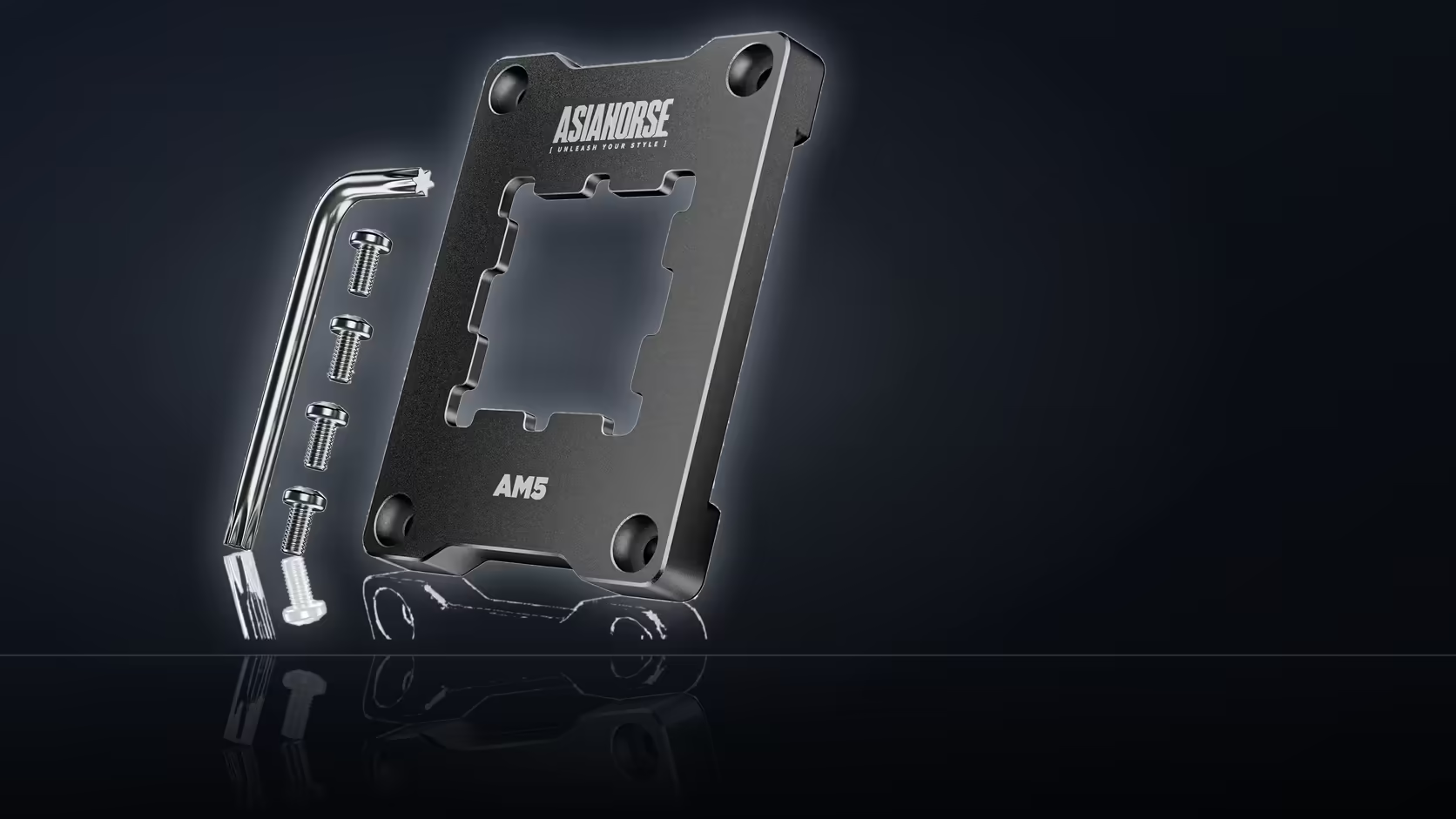
Marketing copy for any CPU contact frame tends to promise even pressure and consistent contact, and it is worth pausing on what that phrase actually means before treating it as a lab result. AsiaHorse's own description of the Pulsar reads as a statement of intent - what the part is engineered to achieve - not a number measured on your board, your cooler, or your paste.
Quick Answer
The R299 Pulsar's even-clamping claim is a design intent, not a measured outcome, so nothing in the listing tells you what your own build will see in temperatures. The only way to know is to test your own machine before and after, and to look at how the thermal paste spreads when the cooler comes off - that spread pattern is the most direct evidence a home builder actually has access to.
📐 Reading a design claim for what it is
The wording centres on spreading clamping force evenly over the die so a cooler sits flatter against it, and every part of that sentence is about intent rather than result. It says what the frame is engineered to achieve, in the same way a chassis might be described as improving airflow - a statement about design, not a guaranteed figure that applies identically to every build it goes into.
Why that distinction is not a criticism
This is simply how mechanical design claims are usually written, and there is nothing unusual or evasive about it. A frame's geometry is fixed and the same for every unit sold, but the result on any one processor depends on variables the frame itself does not control - the flatness of the cooler's own base, how the original stock mounting was behaving beforehand, and which thermal paste is used to fill the gap between surfaces.
🌡️ What actually varies between builds
No two AM5 builds arrive at a cooler swap in quite the same condition. A board that has run for two years may have slightly different mounting pressure history than one fresh out of the box, simply from repeated thermal cycles gently working at fasteners over time. The cooler's own base plate varies slightly between units too, even within the same model line, and the thickness and spread technique of the paste applied changes how evenly heat actually transfers regardless of how flat the frame sits.
None of that is covered by a general design claim, because a general claim cannot describe a specific processor on a specific desk. It describes the mechanism, and the outcome on your machine is a separate question the mechanism only partly answers.
The paste spread as evidence
When a cooler next comes off - whether to check the fit or for any other reason - the pattern the paste has spread into tells you more than any marketing line. An even, roughly circular spread that reaches close to the edges without excess pooling in the centre suggests the surfaces met flatly and consistently. Gaps, thin patches, or paste pushed heavily to one side suggest the opposite, regardless of what any frame was designed to achieve.
🔬 Testing it properly on your own build
If you want a genuine before-and-after picture rather than an assumption either way, record temperatures under a fixed, repeatable workload with the stock retention arms still fitted, then repeat the same workload after the frame swap with the same cooler and comparable ambient conditions. That comparison, done on your own hardware, is worth far more than any general claim - it tells you what actually happened here, on this board, with this cooler, rather than what the frame is generically built to do.
Consistency between the two test runs matters as much as the frame itself. Ambient room temperature drifting by a few degrees between the "before" run and the "after" run muddies the comparison, as does switching workloads or letting background processes vary between passes. A repeatable benchmark, run at roughly the same time of day with the case in the same position, gives numbers you can actually trust to reflect the mounting change rather than noise from everything else around it.
Isolating the frame from the paste
Because the frame and the paste applied at the same time both affect the result, a fair test really needs one variable held constant. Using the same thermal compound for both the "before" and "after" runs, applied with a similar technique and quantity each time, means any difference you record is more likely to come from the mounting hardware rather than from a change in paste brand or spread pattern happening at the same moment. Skipping that step is the most common reason two builders report different experiences with the identical frame - one changed the paste at the same time and attributed the whole result to the hardware.
What a null result actually means
Not every build will show a dramatic shift in numbers, and that is worth expecting rather than treating as a failure. A board whose stock mounting was already seating evenly has less room to improve than one where the original arms were applying pressure unevenly to begin with. A small or negligible change on your own thermals does not mean the frame did nothing - it can just as easily mean your starting point was already reasonably good, which the paste spread pattern will usually confirm either way.
Whatever the result, a clean base plate and a properly applied layer from the thermal solutions range does more for the outcome than the frame alone, and pairing either with a cooler from the cpu coolers shelf that suits your case airflow rounds out the picture properly.
Frequently Asked Questions
How is the claim actually worded?
AsiaHorse describes it as a mechanism that distributes clamping force evenly across the chip, aiming for steadier contact with whatever cooler sits on top.
Is that a measurement?
No. It describes the design intent rather than reporting a figure measured on any particular build.
Why does that distinction matter?
Because outcomes depend on the cooler, the paste and how the original mounting behaved, none of which the claim covers.
How would I test it myself?
By logging thermals on a repeatable load both before the swap and once it is done, and by looking at the paste spread when the cooler comes off.
Does the paste spread prove anything?
It shows how evenly the surfaces met, which is the most direct evidence available without instrumentation.
Could results vary between processors?
They can, since the starting condition differs, which is why a general claim cannot predict one specific build.
Is that a criticism of the product?
Not at all. It is how mechanical design claims work, and the description is appropriately stated as an aim.
Want to measure your own results?
Have a look through Evetech's cooler range so a fair before-and-after comparison is easy to set up.