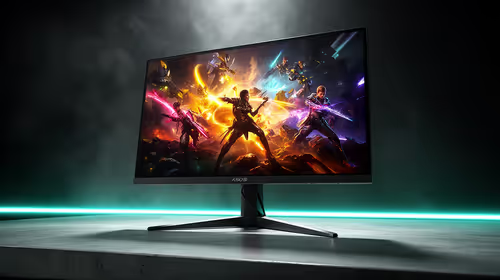
Display labels become confusing because DQHD, ultrawide QHD and dual-monitor setups describe related ideas at different levels: pixel dimensions, screen shape and physical panel count. Differences between DQHD, ultrawide QHD and dual monitors are easiest to understand through workspace geometry. Dahua's 5120 x 1440 LM49 is the R14,999 DQHD reference.
Quick Answer
DQHD 5120 x 1440 is an extremely wide single-canvas resolution that can resemble two QHD-width desktops joined together. Ultrawide QHD commonly describes a narrower wide-screen format, while a dual-monitor setup uses two independent panels. The R14,999 LM49 adds a curve and Picture-By-Picture to the DQHD option.
🧮 Separate resolution from panel count
Resolution describes the pixel grid, not the number of physical displays. The LM49 has 5,120 pixels across and 1,440 vertically on one continuous panel. Software can divide that canvas into two, three or more regions without introducing a physical centre bezel.
Two QHD monitors provide two separate 2,560-by-1,440 desktops. Together they offer a broad horizontal concept, but their bezels, stands, inputs and operating-system identities remain distinct. Windows may cross between them, yet the seam stays visible.
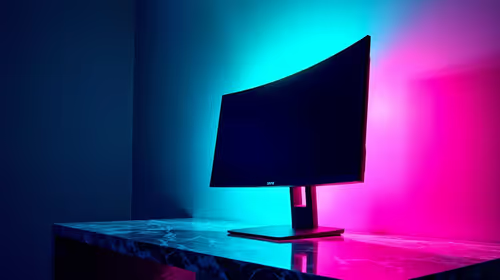
Ultrawide QHD refers to a wide-screen QHD-class layout that is generally less expansive than DQHD. The exact shape changes application width, game support, desk fit and pointer travel. Evetech's curved monitor range lets buyers compare these physical proportions.
Compare usable space after scaling
Pixel numbers do not automatically equal readable workspace. Set each candidate to comfortable text scaling at the normal viewing distance, then measure how many useful columns, tool panels or timeline sections remain visible. Tiny text is not a productivity advantage.
Keep the same application and content during the comparison. A familiar project reveals whether width or height removes more scrolling.
🪟 Understand the working boundaries
Dual monitors provide obvious task separation. Communication can stay on one screen while the primary application fills the other. Independent panels can also be angled differently or rotate for vertical documents.
DQHD removes the centre barrier. A spreadsheet, timeline, map or supported game can occupy the middle without crossing a bezel. Saved window zones recreate boundaries when needed and can be resized around the current project.
An ultrawide QHD panel sits between conventional and DQHD width, often providing a large central application plus one meaningful side tool area. It may require less physical width and pointer travel while giving up some simultaneous window capacity.
Test restoration after sleep
Disconnect one source, restart the computer and check where applications return. Dual-monitor systems can collect windows onto one display after a connection change. A single wide panel can lose software zones or scaling after an update. The better format is the one whose recovery is easiest to preserve.
🎮 Match screen geometry to gaming
Supported games can use DQHD as a panoramic field without a bezel across the central action. The graphics system must handle the 5120 x 1440 workload, and the game must place interface elements comfortably across the wide aspect.
Dual monitors normally keep the game on one conventional panel while chat or monitoring occupies the other. This is easier for titles that expect a standard shape, but the main display must be positioned directly ahead to avoid an off-centre playing posture.
An ultrawide QHD format offers broader immersion than a conventional screen with a lower horizontal workload than DQHD. Test the actual titles rather than assuming every game treats wide aspects alike.
Evetech's gaming monitor catalogue helps compare these options around the R14,999 LM49 reference.
🔀 Include devices, connections and colour
The LM49 supports Picture-By-Picture, so two sources can occupy the DQHD panel at once. This restores a visual division without requiring two physical screens. Each host needs its own resolution, scaling and peripheral-control plan.
The USB-C power path reaches a 65W ceiling for a compatible laptop, while RJ-45 supplies its wired Ethernet route. A dual-monitor setup may need a separate dock or more cables to deliver the same functions, depending on the existing equipment.
The Dahua also provides 99% sRGB and Delta-E under 2 colour accuracy. Use these with a neutral, managed sRGB workflow. Browse the Dahua monitor selection for the full product context.
Compare the complete desk footprint
Measure stands, monitor arms, power leads, display cables, speakers and laptop position. The LM49 uses one tilt/swivel stand but needs substantial width and depth. Dual displays need two secure mounting positions but can adapt their angles independently.
Keep cable service loops and test ergonomic movement before tightening channels. Physical comfort and recovery often decide between formats after their theoretical pixel advantages are understood.
Compare collaboration and presentation
A dual-monitor desk can turn one independent panel towards a colleague while the other remains private. A single curved DQHD panel is designed around one central viewing position, so an in-person review works best in a planned middle region with seating adjusted safely.
Remote collaboration creates another difference. Sharing the entire 5120-pixel desktop often shrinks text for viewers, while sharing one QHD monitor can be immediately legible. DQHD users should select an application or defined region and preview the result before the meeting.
Account for pointer and focus behaviour
On two displays, the operating system knows each panel boundary and can keep full-screen applications inside one screen. On DQHD, software zones need to provide that discipline. Test maximising, snapping and keyboard navigation in the applications used every day.
Long pointer journeys are not inevitable. Group related tools into a centre-weighted project area and use saved layouts to move between tasks. If far-edge travel remains frequent, a narrower ultrawide or two firm screen zones may suit the workflow better.
Use a consistent comparison project
Open the same spreadsheet, editing timeline, meeting window and supported game on each candidate format. Measure readable space after scaling, not at the smallest possible text. Record window restoration after restart and the number of cables needed for the laptop.
This complete trial prevents one advantage, such as the missing bezel or portrait rotation, from deciding a desk that must serve many different hours.
Repeat the trial after sleep and a graphics restart. Restoration behaviour often separates two otherwise convincing formats once daily reliability enters the comparison.
Record the result beside the desk map.
Preserve it.
Frequently Asked Questions
Is DQHD the same as two monitors?
No. DQHD is one 5120 x 1440 pixel canvas, while dual monitors remain two independent physical displays.
Does DQHD have a centre bezel?
Not on a single-panel display such as the LM49, so content can span the centre uninterrupted.
Why choose dual monitors?
They provide independent positioning, optional rotation and strong physical boundaries between tasks.
What is the role of Picture-By-Picture?
It lets two connected sources share separate regions of the one DQHD panel.
Can the LM49 support a laptop dock routine?
Yes. It offers USB-C charging pass-through up to 65W and built-in RJ-45 Ethernet.
How much is the DQHD Dahua?
The 49-inch LM49 costs R14,999.
Ready to choose a screen geometry by the boundaries your work actually needs?
Compare Evetech wide displays, test readable space after scaling, and price the complete desk rather than treating every QHD label as interchangeable.