Quick Answer
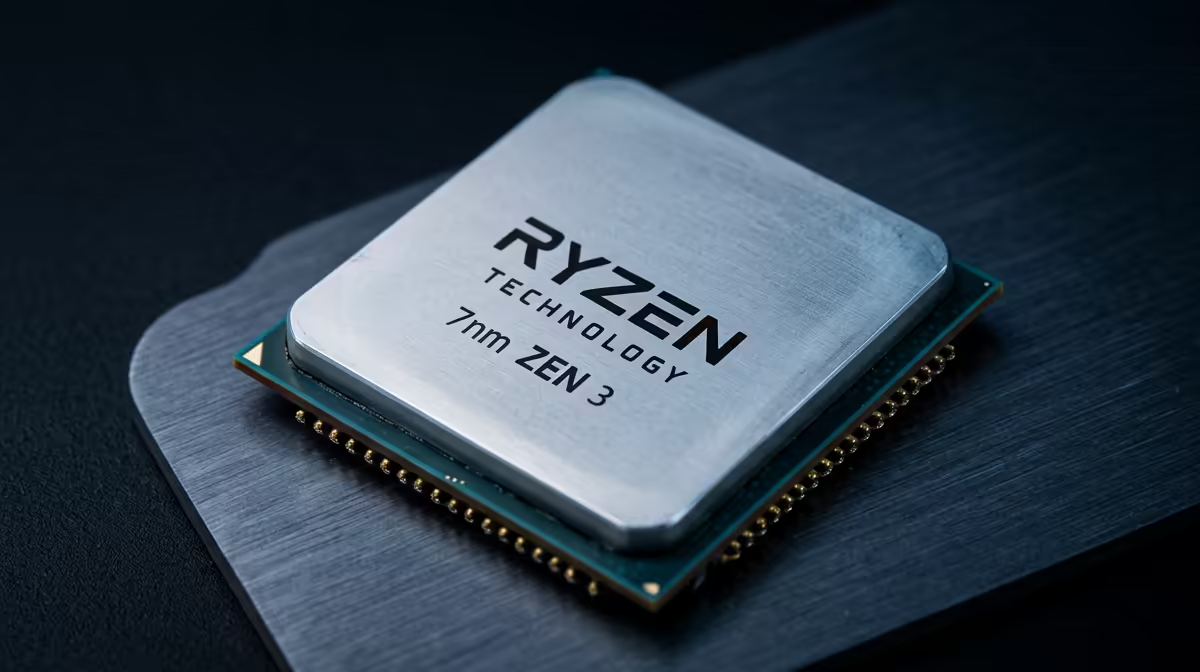
Ranked on value, the Ryzen 5 7600 near R4,200 wins for budget gaming builds, the Ryzen 7 7700 around R6,000 is the balanced all-rounder, and the Ryzen 7 7800X3D near R8,500 leads for pure gaming frame rates. All slot into the long-lived AM5 platform.
Every Ryzen 7000 Option, Ranked
The 7600 (6c/12t, 65W) is the entry point that already clears 144fps in esports titles. The 7700 (8c/16t, 65W) adds two cores for streaming and multitasking headroom. The 7900X (12c/24t) and 7950X (16c/32t) climb into creation territory at 170W each. For gaming, the cache-stacked 7800X3D and 7950X3D sit at the top. SA-stock pricing bands: roughly R4,200, R6,000, R8,500, R8,800 and R11,500 respectively.
Performance and Power
At 1080p the 7800X3D leads the 7700 by around 18% average fps in CPU-bound games, but that lead narrows at 1440p and nearly vanishes at 4K where the GPU rules. In multi-core rendering the 7950X roughly doubles the 7700's throughput. The 65W chips stay quiet under a basic air cooler; the 170W parts want a 240mm-plus AIO to keep boost clocks high under sustained load. For a streamer who games and broadcasts at once, the 7700's eight cores leave headroom for the encoder while the GPU drives 144fps gameplay, which the 7600 cannot always sustain.
FAQ
Which Ryzen 7000 chip is best for a first gaming PC?
The 7600. It is affordable, cool-running and fast enough to push high frame rates at 1080p and 1440p with a matched GPU.
Is DDR5-6000 worth it on Ryzen 7000?
Yes. DDR5-6000 CL30 is the AM5 sweet spot and delivers measurably better frame times than slower kits at little extra cost.
Should a content creator pick the 7900X or 7950X?
The 7950X if rendering and exports dominate your day; its 16 cores cut those times noticeably. The 7900X saves money while still beating the 8-core chips at heavy multitasking.
balanced SA gaming build, the 7700 plus a DDR5-6000 CL30 kit and a Gen4 SSD gives a quiet, fast machine with room to grow on AM5.