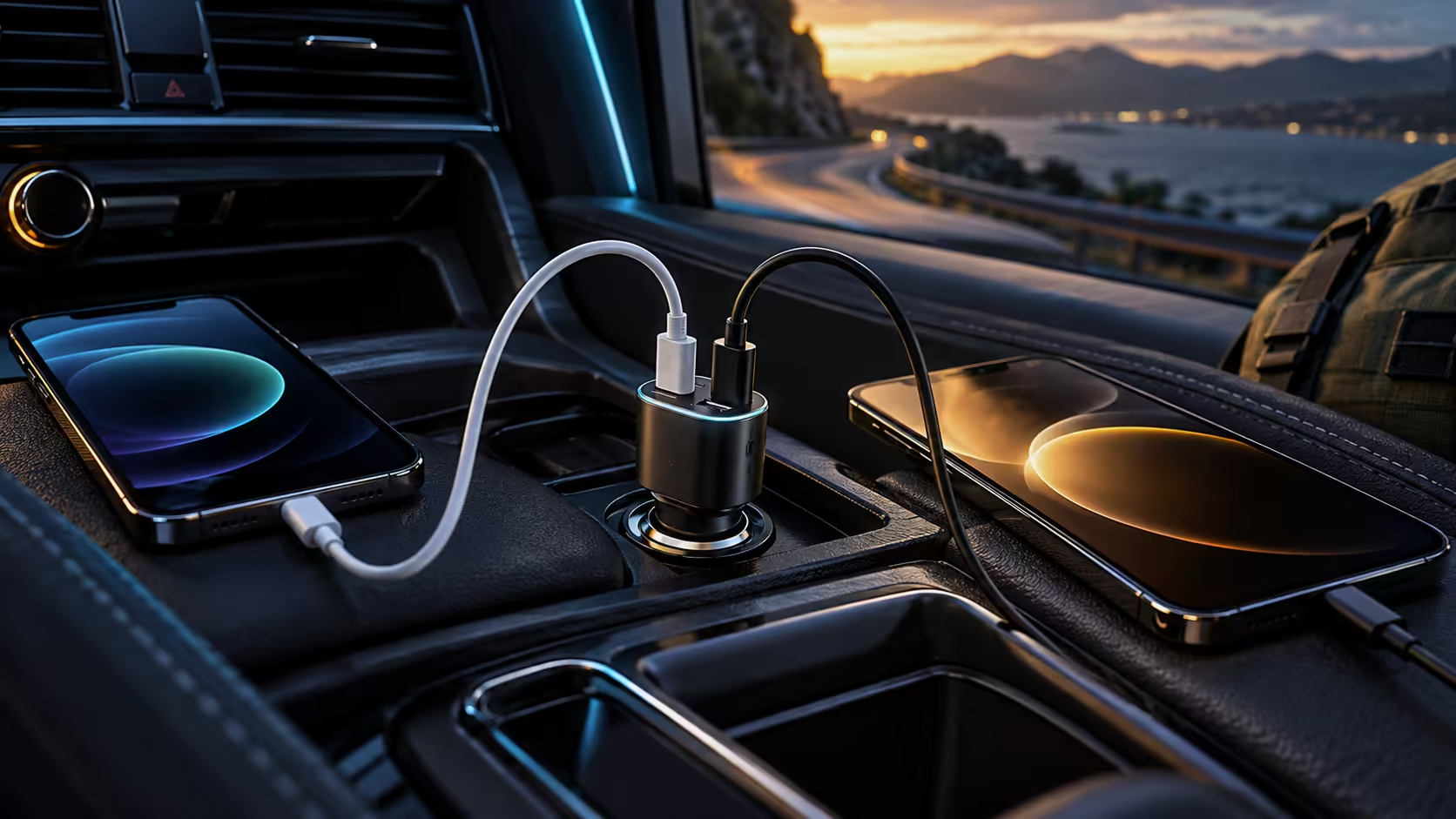
Flush-fit and full-size car chargers are often marketed as a straightforward trade-off, small and convenient against bulky and powerful. In practice the two properties barely relate to each other, and treating them as opposites leads to buying decisions based on the wrong comparison.
Quick Answer
The real difference between a flush-fitting plug and a full-size one is clearance, how far the charger protrudes past the socket, not electrical performance. A low-profile plug tucks under a console lid or sits clear of an armrest; a longer body has no inherent wattage or safety disadvantage from its size alone. Grip belongs entirely to the socket's own spring contacts either way. Anker's compact two-port charger for this style of socket costs R349.
📏 Size and wattage are unrelated variables
A charger's physical length is mostly a function of how its internal components are laid out and packaged, not a direct consequence of how much power it can deliver. A compact charger and a noticeably longer one can both carry an identical 30W USB-C PPS port and an identical 22.5W USB-A output, since the electronics that determine wattage do not necessarily need extra physical length to fit.
Assuming a bigger charger must be more powerful, or a smaller one automatically less capable, is a reasonable-sounding guess that does not hold up against how these products are actually engineered. The only reliable way to compare two chargers on power is reading the stated wattage and protocol on the car charger range, not eyeballing their relative size.
🚙 Where clearance genuinely decides the choice
Clearance matters specifically where something folds, closes or sits close to the socket: a console lid that needs to shut over it, an armrest that lowers onto it, or a tight dashboard layout where a driver's knee brushes past. In those specific spots, a plug protruding an extra 20mm to 30mm can be the difference between a charger that disappears into the car and one that catches on something every single trip.
Outside of those cases, an open rear-seat socket or an exposed boot outlet with nothing nearby, a longer charger causes no practical problem at all, since there is nothing for the extra length to interfere with.
🔌 Grip is decided somewhere else entirely
Neither a flush-fitting plug nor a full-size one holds any better in the socket than the other, because that job belongs to a mechanism inside the car itself, unrelated to how much of the plug sits outside the recess once seated. A shorter charger is not inherently more secure, and a longer one is not inherently looser, whatever the shop copy might imply.
Age, grime and how firmly a plug was originally pushed home have far more say over how well any given unit sits in that specific socket than a charger's outer profile ever will. A cable pulling at an odd angle near the connector adds its own risk on top, again regardless of the charger's shape. Other small accessories and general gaming accessories sharing the same socket day to day face an identical set of variables.
🛒 The comparison worth actually making
Buying decisions go wrong when flush-fit and full-size are compared as if choosing between them trades away performance for convenience, or vice versa. Compact car chargers on the market typically run somewhere between 40mm and 70mm in length; the genuinely useful comparison is between the specific clearance your car's socket presents and wherever a candidate charger's stated length falls in that range, alongside a separate, entirely independent comparison of wattage and protocol between the models on offer.
Treated as two separate questions rather than one spectrum, both end up easier to answer correctly.
Frequently Asked Questions
Does a smaller charger charge more slowly than a bigger one?
Not because of its size. Charging speed comes from the stated wattage and protocol, which do not scale directly with a charger's physical length.
Is a flush-fit charger worth paying extra for?
Only if your specific socket has genuine clearance issues, an armrest, a console lid, a tight dashboard layout. For an open socket, the extra is not buying anything functionally useful.
Does length affect how firmly a charger stays in the socket?
No. What holds a plug in place lives inside the socket itself, entirely separate from how far the charger's body protrudes once it is seated.
How do I know if my car's socket actually needs a flush-fit charger?
Check what sits near the socket: a folding armrest or closing lid means clearance matters; an open rear-seat or boot outlet means it almost certainly does not.
📐 A five-second check before you buy either style
Measuring the recess depth of your specific socket, often somewhere between 10mm and 40mm depending on the vehicle, and comparing it against a candidate charger's stated length, settles the flush-fit question far more reliably than reading a product description that uses the word "compact" without a figure attached. A tape measure or a folded strip of paper against the socket rim is enough, and it takes less time than reading a single review.
This matters more than it might seem, because the same charger can genuinely sit flush in one car's deep console recess and protrude noticeably in another car's shallower dashboard socket, purely from differences in how each vehicle was built. Neither outcome says anything about the charger's quality; it is a mismatch between one fixed length and a recess depth that varies by vehicle.
Do all cars sold in South Africa have similar socket recess depths?
No. Recess depth varies meaningfully between a hatchback's tight console, a larger SUV's more open layout, and a bakkie's dashboard, even though the socket opening itself follows the same standard barrel size across nearly all of them on the road today.
Does a longer charger take longer to negotiate with a phone?
No. Negotiation speed is governed by the charger's internal electronics and the phone's own charging chip, not by the physical length of the housing sitting between the socket and the port, so a longer body carries no downside on that front at all.
Is it worth keeping both a flush-fit and a full-size charger in the car?
Only if the car genuinely has two sockets with different clearance needs. For a single socket, matching one charger to that specific recess is simpler than carrying a spare for a problem that only exists in a different vehicle entirely.
Ready to pick based on your actual socket, not a size assumption?
Have a look at the car charger range and check your socket's clearance before deciding.