Quick Answer
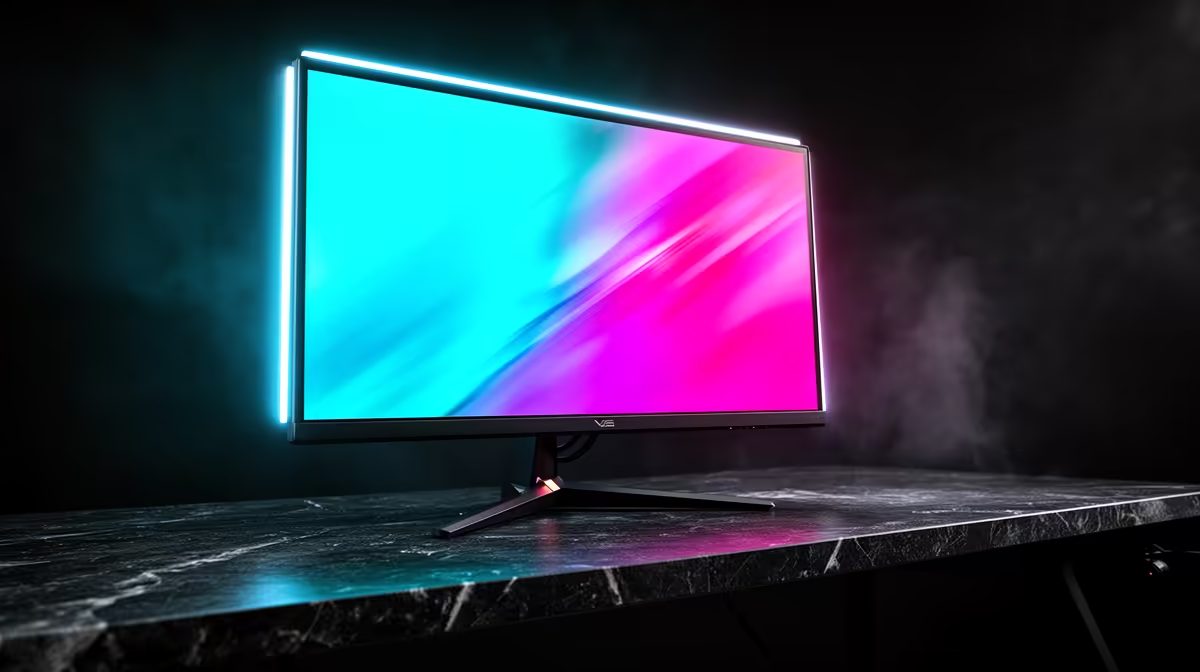
FreeSync Premium Pro and G-Sync Compatible are both adaptive sync certifications that eliminate screen tearing and reduce stutter. FreeSync Premium Pro adds HDR certification and a minimum 120Hz refresh rate at FHD to AMD's baseline FreeSync standard. G-Sync Compatible is NVIDIA's validation badge. Most monitors carry both certifications and work with either GPU brand.
What FreeSync Premium Pro Adds Over Standard FreeSync 🔧
Adobe's base FreeSync standard simply requires adaptive sync support over DisplayPort. FreeSync Premium adds a Low Framerate Compensation (LFC) requirement, which means the monitor's minimum VRR floor is low enough that the display can double frames when the GPU drops below it, preventing sync loss at low frame rates. FreeSync Premium Pro raises the bar further: it mandates a minimum 120Hz refresh rate at FHD resolution, requires HDR support and factory-validated HDR calibration, and specifies colour gamut requirements.
How G-Sync Compatible Differs in Practice 🎮
NVIDIA tests G-Sync Compatible monitors against 300 validation checks covering flicker-free operation across the full VRR range, luminance consistency, and absence of visual artefacts during sync transitions. Monitors that pass are officially certified; monitors that fail some checks may still work acceptably and can be enabled manually in NVIDIA Control Panel. G-Sync Compatible does not mandate HDR certification or a specific minimum refresh rate at FHD, so it focuses purely on the quality and reliability of the adaptive sync signal with GeForce GPUs.
Choosing Between the Two Based on Your GPU 💡
The decision is primarily GPU-driven. AMD Radeon users should prioritise FreeSync Premium Pro certification for the best validated HDR and adaptive sync experience. NVIDIA GeForce users should look for G-Sync Compatible certification. Since most premium gaming monitors carry both certifications, the typical SA buyer does not need to choose between them: a FreeSync Premium Pro and G-Sync Compatible monitor works optimally with both AMD and NVIDIA GPUs, which is useful if you plan to upgrade GPU brands in future.
Confirm VRR Is Active After Setup ⚡
After connecting a new monitor and enabling adaptive sync in your GPU driver, open a GPU overlay or monitoring tool and check that the displayed refresh rate changes dynamically during a game. A static refresh rate during gameplay means adaptive sync is not active, usually because the GPU driver setting was not saved or the monitor's FreeSync or VRR option was not enabled in the OSD.
FAQ
Can FreeSync Premium Pro monitors work with NVIDIA GPUs?
Yes. NVIDIA's G-Sync Compatible mode activates adaptive sync on FreeSync monitors via the NVIDIA Control Panel. Enable G-Sync Compatible in the G-Sync setup menu and the monitor's adaptive sync feature functions with GeForce GPUs, regardless of the FreeSync branding on the panel.
Does the HDR requirement in FreeSync Premium Pro guarantee good HDR quality?
FreeSync Premium Pro's HDR requirement is a baseline, not a high-bar. The certification requires HDR support and factory calibration but does not mandate a specific brightness tier. A FreeSync Premium Pro monitor could be DisplayHDR 400, which is the entry-level tier and not transformative. For impactful HDR, look for FreeSync Premium Pro combined with DisplayHDR 600 or higher, or DisplayHDR True Black 400 on OLED panels.
Does adaptive sync cause any input lag overhead?
No. Adaptive sync operates at the signal timing level and does not add processing delay to the GPU-to-display pipeline. Input lag is determined by the monitor's scaler and display pipeline, not by whether adaptive sync is active. There is no trade-off between tear-free output and input responsiveness when using VRR.
Looking for a monitor certified for both FreeSync and G-Sync?
Evetech stocks gaming monitors with dual FreeSync Premium Pro and G-Sync Compatible certification across IPS and OLED panel types. Find your adaptive sync display at Evetech.