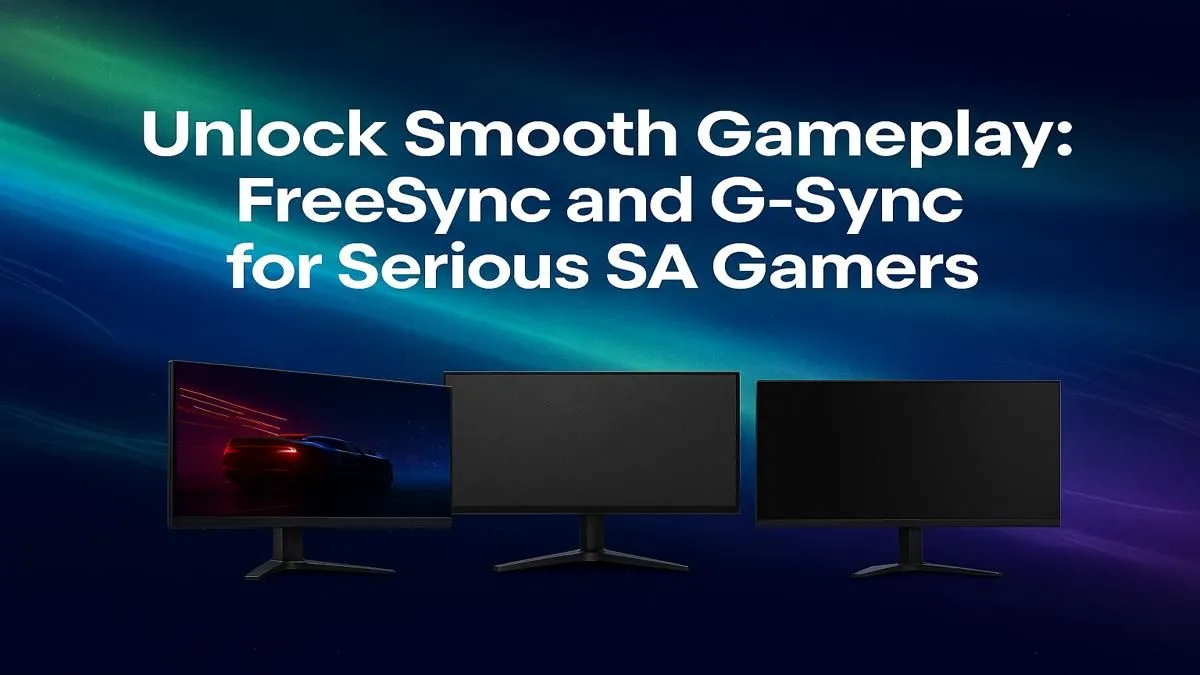
You've spent a fortune on a beastly graphics card, your rig is lit up like a Christmas tree, and you’re ready to dominate in Sandton. You load into your favourite game, the action kicks off, and then it happens… a jarring horizontal line tears across your screen, ruining your immersion and your shot. That, my friend, is screen tearing. 💔
For South African gamers, the battle against screen tearing and stuttering comes down to one crucial decision: FreeSync vs G-Sync. Let's dive deep.
What is Adaptive Sync, Anyway?
Before we get into the FreeSync vs G-Sync South Africa showdown, we need to understand the problem they solve. Your graphics card (GPU) renders frames at a variable rate, while your monitor refreshes its image at a fixed rate (e.g., 144Hz). When these two are out of sync, you get visual artefacts like tearing (seeing parts of multiple frames at once) or stuttering (laggy, jerky motion).
Adaptive sync technology forces your monitor to refresh exactly when your GPU sends a new frame. This synchronisation creates buttery-smooth gameplay, making every movement feel responsive and fluid. It's a non-negotiable feature in modern PC monitors. Both FreeSync (by AMD) and G-Sync (by NVIDIA) are types of adaptive sync.
Team Green: Understanding NVIDIA G-Sync
G-Sync is NVIDIA's proprietary solution. Traditionally, G-Sync monitors required a special hardware module built directly into the display. This dedicated chip handles the communication with your NVIDIA GeForce GPU, ensuring a premium, rigorously tested experience.
The G-Sync Tiers
NVIDIA has a tiered system, which helps you know what you're getting:
- G-Sync Compatible: These are actually FreeSync monitors that NVIDIA has tested and certified to work well with their GPUs. They don't have the dedicated hardware module but offer a great baseline experience.
- G-Sync: The classic experience. These monitors have the NVIDIA hardware module, guaranteeing excellent performance, low input lag, and variable overdrive to reduce ghosting.
- G-Sync Ultimate: The top dog. This tier requires the hardware module and mandates brilliant HDR (High Dynamic Range) performance, stunning contrast, and vibrant colour. You'll find this on many of the best all gaming monitors designed for competitive and cinematic play.
The main drawback? That hardware module adds to the cost, making G-Sync monitors typically more expensive.
Team Red: Understanding AMD FreeSync
FreeSync is AMD's answer to G-Sync, built on an open standard called VESA Adaptive-Sync. This means monitor manufacturers don't need to pay licensing fees or install a special chip. The result? FreeSync is far more common and generally more affordable. You can find it on everything from ultra-immersive curved monitors to budget-friendly 1080p screens.
The FreeSync Tiers
Like NVIDIA, AMD has its own quality tiers:
- AMD FreeSync: The basic tier that eliminates tearing and stuttering.
- AMD FreeSync Premium: Adds a key requirement: a minimum 120Hz refresh rate at 1080p resolution and Low Framerate Compensation (LFC). LFC prevents stutter when your FPS drops below the monitor's minimum refresh rate.
- AMD FreeSync Premium Pro: Includes all the above, plus strict requirements for low latency and high-quality HDR rendering. This is especially important for vibrant colours on high-resolution 5K & 4K monitors.
Pro Tip: G-Sync on a FreeSync Monitor? 🔧
Yes, you can! If you have an NVIDIA 10-series GPU or newer, you can enable G-Sync on many FreeSync monitors (look for the "G-Sync Compatible" badge). Open the NVIDIA Control Panel, go to "Set up G-SYNC," check the box for "Enable G-SYNC, G-SYNC Compatible," and select your monitor. It’s a great way to get smooth gameplay without the premium price tag.
FreeSync vs G-Sync: The South African Verdict
So, which one should you choose? The G-Sync vs FreeSync decision in South Africa often comes down to your GPU and your budget.
Choose G-Sync if:
- You have an NVIDIA GeForce graphics card.
- Budget is less of a concern, and you want the most reliable, "it just works" premium experience (especially with G-Sync Ultimate).
- You play competitively and demand the absolute lowest input lag and best motion clarity.
Choose FreeSync if:
- You have an AMD Radeon graphics card.
- You're on a tighter budget. You can often find a FreeSync monitor with similar specs to a G-Sync one for a few thousand Rand less.
- You have an NVIDIA card and are happy to use a "G-Sync Compatible" monitor to save some cash. The experience is often indistinguishable from a native G-Sync display.
Ultimately, the performance gap has narrowed significantly. A high-quality FreeSync Premium Pro monitor can easily go toe-to-toe with a G-Sync monitor. The landscape has even expanded to include portable monitors with adaptive sync for gaming on the go.
The most important thing is to have some form of adaptive sync. Going back to a screen without it feels like a massive step backwards. 🚀 And remember to pair your choice with the right DisplayPort cable from our monitor accessories section to ensure you have enough bandwidth for high refresh rates!
Ready to Banish Screen Tearing for Good?
The FreeSync vs G-Sync debate shows there's a perfect monitor for every rig and budget in South Africa. Unlocking your GPU's true potential starts with the right screen. Explore our latest PC monitor deals and find the perfect display to conquer your game.