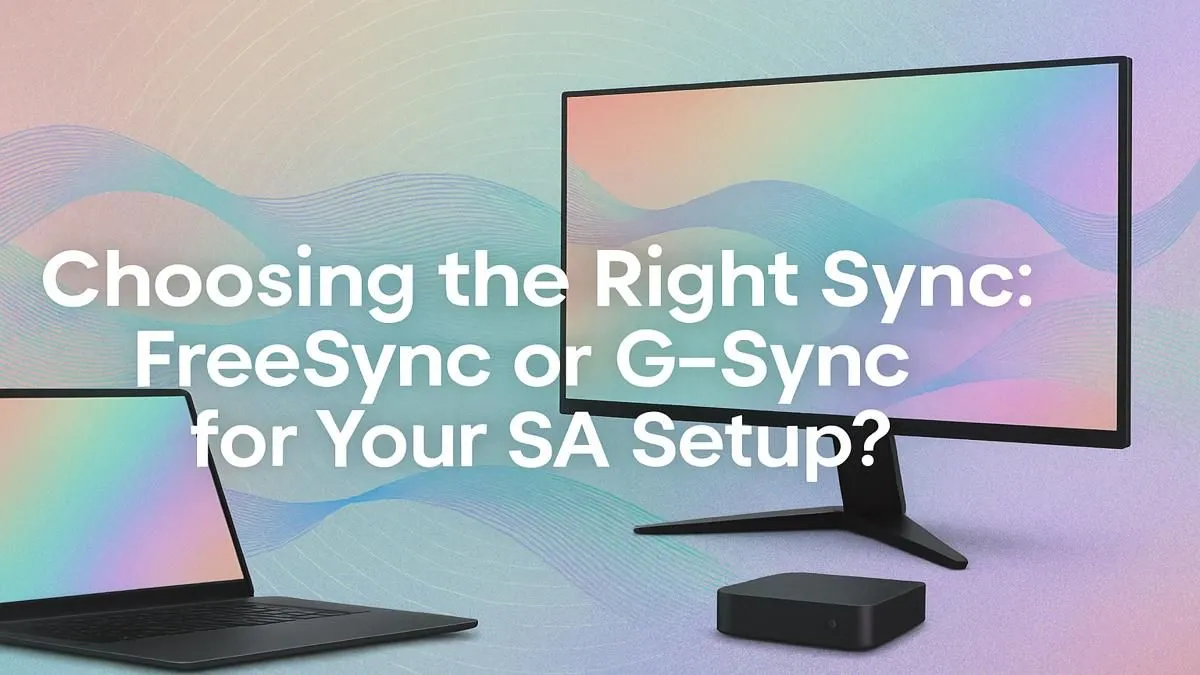
You’re in the final circle in Apex Legends, your heart is pounding… you line up the perfect shot, and then it happens. A jagged, horizontal tear rips across your screen, throwing off your aim for a split second. It’s enough. You’re toast. This frustrating scenario, known as screen tearing, is exactly what adaptive sync technology was born to fix.
But for South African gamers, the big question remains: in the epic battle of FreeSync vs G-Sync, which one is the champion for your setup?
Understanding the Enemy: What is Screen Tearing?
Before we dive into the FreeSync vs G-Sync debate, let's quickly break down the problem. Screen tearing occurs when your graphics card (GPU) sends out new frames at a different rate than your monitor can display them. The monitor gets caught between two frames, showing a piece of each one, creating that ugly tear.
Adaptive sync is the brilliant solution. It allows your monitor to adjust its refresh rate on the fly to perfectly match the frame rate of your GPU. The result? Buttery-smooth, tear-free gameplay that feels incredibly responsive. ✨
The Case for AMD FreeSync
AMD FreeSync is an open-standard technology, which means any monitor manufacturer can implement it without paying licensing fees to AMD. This has a massive impact on the market.
Key Advantages of FreeSync:
- More Affordable: Because it's an open standard, FreeSync monitors are generally cheaper than their G-Sync counterparts, giving you more bang for your Rand.
- Wider Selection: You'll find FreeSync on a huge range of PC monitors, from budget-friendly 1080p screens to high-end 4K displays.
- Cross-Compatibility: While designed for AMD GPUs, most modern NVIDIA cards (10-series and newer) can also run FreeSync, giving you incredible flexibility.
There are different tiers (FreeSync, FreeSync Premium, and FreeSync Premium Pro), which offer features like low framerate compensation and HDR support. The experience can vary slightly, so it's always good to check reviews.
The Power of NVIDIA G-Sync
NVIDIA G-Sync is a proprietary technology. For the best experience (G-Sync and G-Sync Ultimate), monitors must include a dedicated hardware module from NVIDIA and pass over 300 stringent quality tests. This ensures a flawless, premium experience.
Key Advantages of G-Sync:
- Rock-Solid Performance: The dedicated hardware ensures the most consistent and reliable adaptive sync performance, with superior variable overdrive to eliminate ghosting at any refresh rate.
- Guaranteed Quality: The strict certification process means if a monitor has the official G-Sync or G-Sync Ultimate badge, you know you're getting a top-tier product.
- G-Sync Compatible: NVIDIA also has a "G-Sync Compatible" tier, which are essentially high-quality FreeSync monitors that have been tested and certified to work well with NVIDIA cards.
This premium experience usually comes at a higher price, making it a key consideration in the G-Sync vs FreeSync decision. You can see the difference when browsing through all our gaming monitors.
Check Your GPU First! 🔧
Before you even start shopping for a monitor, confirm your graphics card. If you have an AMD Radeon card, FreeSync is your native choice. If you're running an NVIDIA GeForce card, you can use G-Sync or a G-Sync Compatible monitor for the best results. Knowing this narrows down your options instantly!
FreeSync vs G-Sync: The Direct Showdown
So, how do they stack up for a typical SA gamer? Let's break it down.
### Cost & Value
For gamers looking to maximise their budget, FreeSync is the undisputed winner. You can often find a fantastic FreeSync monitor and still have cash left over. It’s a smart way to get smooth gameplay without emptying your wallet, and you can always find great value in our best PC monitor deals.
### Performance & Immersion
For competitive players who demand absolute perfection, a true G-Sync monitor with the dedicated hardware module often has a slight edge in motion clarity and consistency. However, a high-end FreeSync Premium Pro monitor comes incredibly close. Both technologies make a massive difference on immersive curved monitors, where smooth visuals are key to the experience.
### Resolution & Fidelity
When you're gaming on high-resolution displays, adaptive sync is essential to maintain smooth frame rates. A stuttering 4K game is no fun at all. Both FreeSync and G-Sync work brilliantly on stunning 4K monitors, ensuring your beautiful game worlds are also beautifully smooth. 🚀
Making the Right Choice for Your Rig
Ultimately, the best choice in the FreeSync vs G-Sync battle comes down to your specific needs and hardware.
- If you're building on a budget or have an AMD GPU: Go for FreeSync. The value is unbeatable, and the performance on Premium-certified monitors is excellent.
- If you have a high-end NVIDIA GPU and want the absolute best: A G-Sync or G-Sync Ultimate monitor is a fantastic investment that guarantees a flawless, premium experience.
- If you have an NVIDIA GPU and want a great middle-ground: Look for a "G-Sync Compatible" monitor. You get a great, certified experience that’s often more affordable than a full G-Sync display.
No matter which you choose, you're upgrading your entire gaming experience. From LAN parties with high-refresh-rate portable monitors to your main battle station, a tear-free display is a must. Don't forget to complete your setup with quality monitor accessories like a good VESA mount or the right cables to get the most out of your new screen.
Ready to Find Your Perfect Match?
The FreeSync vs G-Sync debate is all about finding the right fit for your rig and budget. Banish screen tear forever and elevate your gameplay. Explore our massive range of gaming monitors and find the perfect screen to conquer your world.