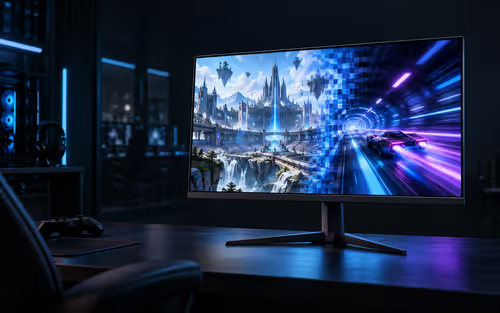
You’ve just dropped a stack of cash on a new graphics card, ready to crank Apex Legends to ultra settings. But instead of buttery-smooth visuals, you’re hit with jagged, distracting screen tearing. Eish. This frustrating disconnect between your GPU and monitor can ruin any game. Luckily, the solution is here, but it comes with a big question for South African gamers: in the FreeSync vs G-Sync battle, which adaptive sync tech is right for your setup? 🤔
First Off, What is Adaptive Sync?
Before diving into the FreeSync vs G-Sync debate, let's get the basics down. Your graphics card (GPU) produces frames at a variable rate, while your monitor refreshes its image at a fixed rate (e.g., 144Hz). When these two are out of sync, you get visual artifacts like screen tearing (where the monitor displays parts of multiple frames at once) or stuttering.
Adaptive sync technology forces your monitor to refresh only when the GPU sends a new frame, creating a perfectly synchronised, smooth experience. Both AMD's FreeSync and NVIDIA's G-Sync do this, but they go about it in very different ways.
Understanding AMD FreeSync: The People's Champion?
FreeSync is AMD's answer to adaptive sync. It's an open standard, which means any monitor manufacturer can implement it without paying licensing fees to AMD. This has one massive benefit for the SA market: lower prices and a huge selection.
Key Features of FreeSync:
- Open Standard: More choice and better pricing across a vast range of PC monitors.
- Tiers of Quality: Look out for different levels. 'FreeSync' is the base level, 'FreeSync Premium' adds mandatory low framerate compensation (LFC) and at least a 120Hz refresh rate, and 'FreeSync Premium Pro' adds HDR optimisations.
- Compatibility: Works with AMD Radeon GPUs and, more recently, NVIDIA GeForce GPUs (more on that below).
The main drawback? Performance can vary between monitors since the certification isn't as strict as G-Sync's.
Unpacking NVIDIA G-Sync: The Premium Experience 🏆
G-Sync is NVIDIA's proprietary solution, and it originally required a dedicated hardware module to be installed inside the monitor. This module handles the communication with the NVIDIA GPU, ensuring a flawless, rigorously tested experience.
Key Features of G-Sync:
- Hardware Module: A dedicated chip ensures rock-solid performance and consistency.
- Strict Certification: Every G-Sync monitor undergoes over 300 tests to guarantee quality, from colour accuracy to refresh rate stability. This is why you'll often see them on high-end, stunning 4K and 5K displays.
- Tiers of Quality: The ecosystem now includes 'G-Sync Compatible' (FreeSync monitors tested by NVIDIA), 'G-Sync' (with the dedicated hardware), and 'G-Sync Ultimate' (for the absolute best HDR gaming experience).
The catch? That hardware and testing costs money, making G-Sync monitors more expensive.
NVIDIA User Pro Tip ⚡
you have a GeForce GPU (10-series or newer), you're not locked into G-Sync! NVIDIA allows you to enable G-Sync on many FreeSync monitors. Check NVIDIA's official 'G-Sync Compatible' list online before you buy. This gives you the best of both worlds: the potential for a great price with verified smooth performance.
FreeSync vs G-Sync: The Head-to-Head for SA Gamers
So, which one should you choose for your rig? Let's break it down based on what matters most to gamers in South Africa.
Cost 💸
For most people, this is the decider. FreeSync monitors are almost always more affordable than their G-Sync counterparts. When you're trying to build a powerful rig without breaking the bank, saving a few thousand Rand on the monitor is a big win. You can often find some great monitor deals on FreeSync models.
Winner: FreeSync
Performance & Consistency
Historically, G-Sync's dedicated hardware gave it a clear edge, offering a perfectly smooth experience across the entire refresh rate range. However, modern FreeSync Premium and Premium Pro monitors have closed the gap significantly. For elite competitive gamers, the guaranteed consistency of a true G-Sync monitor might still be worth the premium. For everyone else, a good FreeSync Premium display is fantastic.
Winner: G-Sync (by a slight margin)
Choice & Flexibility
Because FreeSync is an open standard, the market is flooded with options. You can find FreeSync on everything from budget 1080p panels to massive, immersive curved monitors and even some niche portable monitors for LANs. G-Sync options are more limited and tend to focus on the mid-to-high end of the market.
Winner: FreeSync
The Final Verdict: Which Is Right for You?
The G-Sync vs FreeSync decision ultimately depends on your GPU and your budget.
- If you have an AMD Radeon GPU: The choice is simple. Get a FreeSync monitor. A FreeSync Premium model offers the best balance of price and performance.
- If you have an NVIDIA GeForce GPU and are on a tight budget: A 'G-Sync Compatible' FreeSync monitor is your best bet. You get smooth gameplay without the hefty price tag.
- If you have an NVIDIA GPU and want the absolute best, no-compromise experience: Go for a monitor with a dedicated G-Sync or G-Sync Ultimate module. The peace of mind and flawless performance are what you're paying for.
Before you finalise your choice, remember to grab the right DisplayPort or HDMI cable to support the high refresh rates, and check out other monitor accessories that might complete your setup.