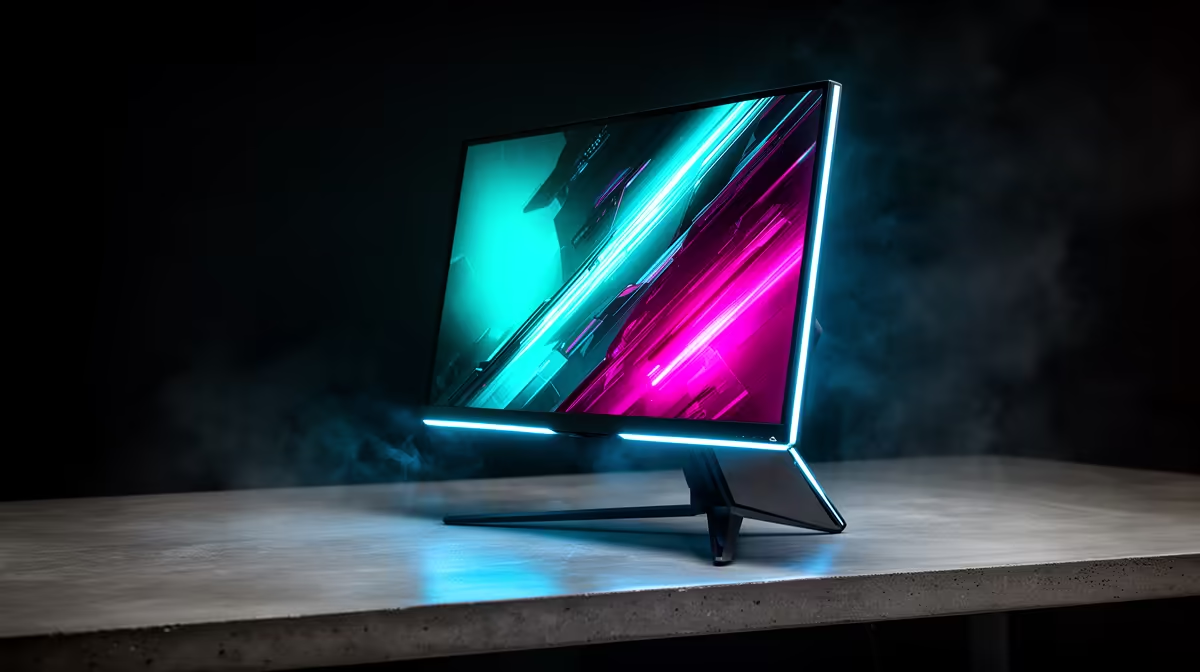
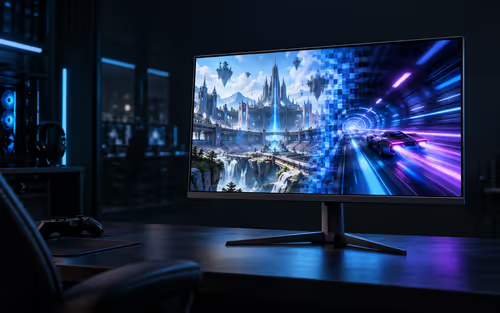
You’re in the final circle in Apex Legends, your aim is true, but just as you line up the winning shot… your screen jitters and tears. Frustrating, right? This visual glitch, known as screen tearing, happens when your graphics card and monitor are out of sync. Luckily, there’s a fix: adaptive sync technology.
In the battle for buttery-smooth gameplay, two champions dominate: NVIDIA’s G-Sync and AMD’s FreeSync. But when it comes to the G-Sync vs FreeSync South Africa debate, which one is right for your rig and your wallet? Let’s break it down.
What is Adaptive Sync and Why Do You Need It?
Imagine your graphics card (GPU) is drawing frames of your game at 90 frames per second (FPS), but your monitor can only refresh its picture 60 times a second (60Hz). When the monitor tries to display a new image while the old one is still on-screen, you get a jarring horizontal line—a screen tear.
Adaptive sync technology solves this by forcing your monitor to wait for the GPU. It dynamically adjusts the monitor's refresh rate to match the frame rate of your graphics card, frame by frame. The result? A perfectly smooth, tear-free visual experience. It's a foundational feature for modern PC monitors built for gaming.
Team Green: Understanding NVIDIA G-Sync
G-Sync is NVIDIA's proprietary adaptive sync solution. For a long time, the "best" G-Sync experience required a special hardware module built directly into the monitor. This chip communicates with your GeForce GPU to ensure flawless performance, strict quality control, and features like variable overdrive for pristine motion clarity.
The G-Sync Tiers
- G-Sync Ultimate: The absolute premium experience. These monitors have the dedicated hardware module and must pass rigorous NVIDIA testing for HDR, colour accuracy, and low latency. They are often found on incredible, high-resolution 4K monitors where visual fidelity is paramount.
- G-Sync: The original standard, also featuring the hardware module for a guaranteed high-quality, tear-free experience.
- G-Sync Compatible: This is the game-changer. NVIDIA now tests and certifies certain FreeSync monitors that meet their baseline performance standards. They don't have the special G-Sync chip, making them much more affordable, but they still deliver a great variable refresh rate experience for NVIDIA users.
The main takeaway? G-Sync, especially with the hardware module, offers a premium, plug-and-play experience with guaranteed quality… but it usually comes at a premium price.
Pro Tip: Enabling G-Sync on a Compatible Monitor ⚡
Got a 'G-Sync Compatible' FreeSync monitor and an NVIDIA card? Enabling it is easy. Open the NVIDIA Control Panel, go to 'Set up G-SYNC', check the 'Enable G-SYNC, G-SYNC Compatible' box, and select your monitor. Make sure to also enable it for full-screen mode. Voila! Smooth gameplay unlocked.
Team Red: Understanding AMD FreeSync
FreeSync is AMD's answer to G-Sync, and its biggest advantage is that it's an open standard. This means monitor manufacturers don't have to pay licensing fees or buy special hardware from AMD to include it. This saving is passed directly on to you, the consumer. 💰
This open approach has made FreeSync incredibly popular, especially on budget-to-mid-range displays, including many of the most popular curved monitors that offer amazing immersion for the price.
The FreeSync Tiers
- FreeSync: The basic tier, which guarantees tear-free gaming.
- FreeSync Premium: Adds a key requirement: support for at least a 120Hz refresh rate at 1080p resolution and Low Framerate Compensation (LFC). LFC prevents stuttering if your frame rate drops below the monitor's minimum refresh rate.
- FreeSync Premium Pro: Includes everything from Premium but adds specific optimizations for HDR (High Dynamic Range) gaming, ensuring brilliant colours and contrast without adding extra input lag.
The performance of FreeSync monitors can vary more than G-Sync ones because of the open standard, but the certification tiers (especially Premium and Premium Pro) help you choose a display with confidence.
The Showdown: G-Sync vs FreeSync in South Africa
So, which technology should you back? The choice in South Africa often boils down to two key factors: your current hardware and your budget.
Performance and Compatibility
If you have an NVIDIA RTX or GTX graphics card, you can use G-Sync or a G-Sync Compatible monitor. If you have an AMD Radeon GPU, FreeSync is your native choice.
The crucial point is crossover: you can now use many FreeSync monitors with an NVIDIA card thanks to the G-Sync Compatible program. However, you cannot use a G-Sync monitor (with the hardware module) with an AMD graphics card. This gives NVIDIA users far more flexibility in their monitor choice. The display market is more diverse than ever, with options ranging from massive ultrawides to compact, even portable monitors, and this compatibility is key.
Cost: The Deciding Factor?
This is where FreeSync lands its biggest punch. Because it’s an open standard, FreeSync monitors are almost always cheaper than their G-Sync counterparts with the hardware module. For South African gamers looking for the best bang-for-buck, a FreeSync Premium monitor that is also certified as G-Sync Compatible offers incredible value. You can often save hundreds, if not thousands, of Rands. If you're hunting for value, it's always smart to check out the best monitor deals in South Africa to see where the sweet spot is.
The Verdict: Which is Right for You? ✨
Deciding on G-Sync vs FreeSync in South Africa is simpler than it seems. Follow this logic:
- Check your GPU: This is your starting point. Are you Team Green (NVIDIA) or Team Red (AMD)?
- If you have an AMD GPU: Your choice is clear. Get a FreeSync monitor. Aim for a "FreeSync Premium" model for the best overall experience, especially with LFC.
- Item
Ultimately, both technologies do a fantastic job of eliminating screen tearing. The best choice is the one that fits your graphics card and your budget. Before you decide, be sure to browse our full range of gaming monitors to compare specs and prices.
Ready to Banish Screen Tearing for Good?
The G-Sync vs FreeSync debate comes down to your GPU and your budget. But no matter which team you're on, a smooth, tear-free experience is waiting. Explore our massive range of gaming monitors and find the perfect screen to conquer your world.