Your screen goes black mid-clutch. The silence is deafening, broken only by your own frustrated sigh. For South African gamers, this is a painful reality. But what if you could conquer the darkness? The secret isn't just a powerful PC; it's understanding your gaming monitor power consumption. This knowledge is your first step towards building a setup that never lets you down, letting you game on through any outage. ⚡
Understanding Your Gaming Monitor's Power Consumption
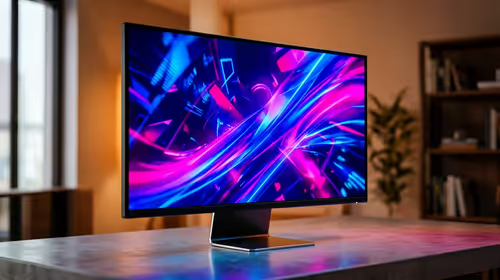
Before you can plan your backup strategy, you need to know what you're up against. A monitor isn't just a screen; it's a complex piece of tech where every feature impacts its energy use. The gaming monitor power consumption of your specific model is the most critical number you need to find.
Here’s what influences that number:
- Screen Size & Resolution: A massive 49-inch 4K beast will naturally draw more power than a compact 24-inch 1080p display. More pixels and more surface area require more energy to light up.
- Refresh Rate & Brightness: Running at 240Hz uses more electricity than 60Hz. Likewise, cranking the brightness to maximum for those vibrant colours will increase the watts pulled from the wall.
- Panel Technology: Modern OLED screens are often more efficient than older LCDs because they can turn individual pixels completely off to display true black.
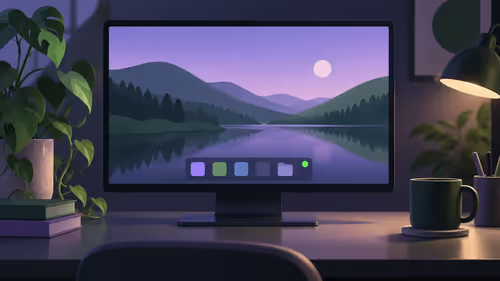
You can usually find the power rating (in Watts) on the manufacturer's website or on the sticker at the back of your monitor. This figure is your baseline for planning. A tidy setup on a dedicated gaming desk can make it easier to access and manage these power connections.
Reliable Everyday Performance
Okay, you’ve found your monitor’s power rating. Now what? It's time for some simple maths to figure out exactly what size backup you need. You'll need to know the power draw of your entire core setup—your PC and your monitor.
The Basic Formula
A simple way to estimate your need is:
(PC Power Supply Wattage * 0.6) + Monitor Wattage = Your Total Load
We multiply the PC's power supply unit (PSU) wattage by 0.6 (or 60%) because a PC rarely uses its maximum power constantly. This gives you a realistic average load during a gaming session.
Example:
- Your PC has a 750W PSU:
750W * 0.6 = 450W - Your 1440p gaming monitor uses 45W.
- Total Load:
450W + 45W = 495W
This means you need a backup solution that can handle at least 495W continuously. If a UPS is required, size it for a controlled shutdown against the measured load of the complete display. Many complete Arrozi gaming setups are designed with balanced components, making this calculation even more straightforward.
Power-Saving Pro Tip 🔧
Most gaming monitors have an 'Eco Mode' or power-saving setting in their on-screen display (OSD) menu. Activating this can instantly reduce brightness and lower power consumption by 10-20%. It's a quick fix to stretch your battery life when the power goes out unexpectedly.
Choosing the Right Backup Solution for Your Rig
With your total load calculated, you can choose the right hardware to keep your game alive. Your choice boils down to two main options: a UPS or an Inverter.
Uninterruptible Power Supply (UPS)
A UPS is the simplest solution. It's essentially a big battery that kicks in the instant the power cuts.
- Best for: Short outages or providing enough time to save your game and shut down your PC safely, protecting it from power surges.
- Limitation: Most consumer-grade UPS units won't last a full 2-hour gaming session with a high-end rig.
Inverter & Battery System
- How it works: An inverter converts DC power from a deep-cycle battery (or a bank of them) into the AC power your gear needs.
- Key Consideration: Ensure you get a Pure Sine Wave inverter. It delivers clean, stable power that sensitive electronics (like your PC and monitor) require. Cheaper modified sine wave inverters can damage your components over time.
When planning your power budget, don't forget the small things. All those flashy peripherals, from speakers to NZXT case lighting, add to the total load. While a few LEDs won't break the bank, it all adds up. The goal is a seamless experience, where you can stay comfortable in your favourite gaming chair and forget the power is even out. ✨
Ready to Build a More Reliable Display?
Don't let power cuts dictate your K/D ratio. Understanding your gaming monitor's power consumption is the first step. The next is getting the right gear. Explore our range of UPS and power solutions and keep the game going, no matter what stage it is.