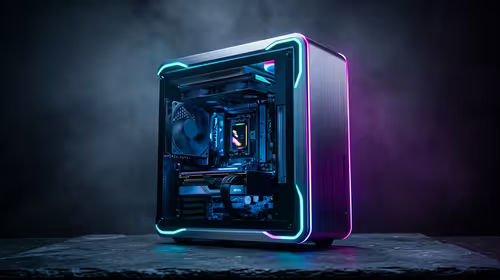
Staring at a list of PC specs and feeling like you're decoding a secret language? We get it. You just want to frag your mates, not get a degree in electrical engineering. This beginner's guide will demystify the core parts of a gaming rig. We'll break down the jargon and explain the key gaming PC components in plain English, so you can understand what makes a PC truly powerful. Let’s get you ready to build or buy with confidence. 🚀
The Brain: Your CPU (Central Processing Unit)
Think of the CPU as the PC’s brain. It handles all the instructions and calculations that make your games run… from enemy AI to physics simulations. A faster CPU means the game’s logic runs smoother, which is vital for high frame rates, especially in competitive titles.
For years, the debate has been between Intel (Core i5, i7, i9) and AMD (Ryzen 5, 7, 9). Both offer fantastic performance, so your choice often comes down to budget and what’s on special. For lightning-fast reflexes in competitive titles where every millisecond counts, a powerful CPU is key, which you'll find in our Counter-Strike 2 gaming PCs.
The Artist: Your GPU (Graphics Processing Unit)
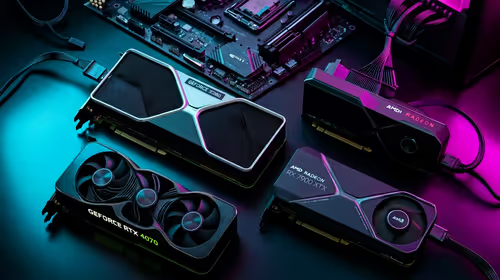
This is the single most important component for gaming performance. The GPU, or graphics card, is responsible for drawing everything you see on screen. It’s what determines whether you can run a game at 1080p, 1440p, or glorious 4K, and how many frames per second (FPS) you get. Higher FPS means smoother gameplay.
The main players here are NVIDIA (GeForce RTX series) and AMD (Radeon RX series). To see Night City in all its neon glory with ray tracing enabled, you'll need a beastly GPU like those in our custom Cyberpunk 2077 PCs. Likewise, for breathtakingly realistic skies, a top-tier graphics card is non-negotiable for anyone serious about Microsoft Flight Simulator gaming rigs.
The Workspace: Your RAM (Random Access Memory)
RAM is your PC's short-term memory. It holds all the data your computer is actively using, like the game map, character models, and textures. Having enough RAM ensures your PC can juggle the game, Discord, and your web browser without slowing down.
For modern gaming, 16GB is the sweet spot, offering plenty of headroom for most titles. 32GB is becoming more common for future-proofing and for players who love heavily modded games. When you're dropping into Al Mazrah, having enough RAM is crucial for smooth performance, a standard feature on our Call of Duty: Warzone 2.0 PCs. Even a game like Minecraft can demand a lot of memory with mods, so our Minecraft gaming PCs are built to handle it.
The Library: Your Storage (SSD vs. HDD)
This is where your games, operating system, and files are stored permanently. There are two main types:
- HDD (Hard Disk Drive): Older, mechanical drives. They offer huge amounts of storage for a low price but are very slow. Best for storing photos, videos, or older games you don't play often.
- SSD (Solid-State Drive): Modern, flash-based storage with no moving parts. They are incredibly fast, meaning your PC boots in seconds and game loading screens are drastically shorter.
Today, an NVMe M.2 SSD is the gold standard for your operating system and favourite games. Quickly loading into the next match is vital in fast-paced shooters, which is why our PUBG gaming PCs prioritise speedy SSDs. You don't want to be stuck on a loading screen while your mates are causing chaos in Los Santos; check out the storage options on our GTA V gaming PCs.
Storage Pro Tip 🔧
For a budget-friendly setup, use a smaller, faster NVMe SSD (like 1TB) for your Windows installation and most-played games. Then, add a larger, cheaper SATA SSD or even an HDD (2TB or more) for your massive game library, media, and backups. It's the best of both worlds!
The Foundation: Motherboard & Power Supply
These are the unsung heroes of any gaming PC component list.
Motherboard
The motherboard is the central circuit board that connects everything. The CPU, GPU, RAM, and storage all plug into it. Your choice of motherboard depends on the CPU you pick (e.g., an AMD CPU needs a motherboard with an AM5 socket) and what features you need, like Wi-Fi or extra USB ports. A stable foundation ensures you can play for hours, whether you're building and battling in Fortnite on a custom PC or coordinating team pushes in our Overwatch 2 ready systems.
Power Supply Unit (PSU)
The PSU takes power from your wall outlet and converts it into the correct voltages for all your components. Never cheap out on a PSU! A poor-quality one can be inefficient, unreliable, and even damage your expensive parts. Get a reputable brand (like Corsair, Seasonic, or Cooler Master) with enough wattage for your system, plus a little extra for future upgrades. ✨
Ready to Build Your Dream Rig?
Understanding these gaming PC components is the first step. The next is bringing your ultimate setup to life. Whether you're upgrading a single part or building from scratch, we've got the hardware and expertise you need. Explore our massive range of PC components and start building the machine that will conquer your world.