Quick Answer
Bi-directional cables transmit signals in either direction depending on which end is connected to the source, meaning you can flip the cable without losing functionality. For DisplayPort and Thunderbolt connections, this eliminates the frustration of plugging in a cable the wrong way and getting no signal.
What Bi-Directional Support Actually Means 📡
In older unidirectional video cables, the source end and the display end are electrically distinct; swapping them results in no signal or device damage. Modern DisplayPort cables meeting the DP 1.4 specification are inherently bi-directional at the signal level: the connected devices negotiate source and sink roles during the handshake, so either end can be the transmitter. USB-C cables carrying DisplayPort Alt Mode are similarly bi-directional, which is why a USB-C to USB-C cable can carry video from a laptop to a monitor regardless of which port you start from. Thunderbolt 3 and 4 cables take this further by supporting simultaneous bidirectional data transfer at up to 40 Gbps, enabling daisy-chaining of multiple peripherals on a single cable run.
Practical Benefits for Daily Workflows 🔄
For a South African home office user with a USB-C dock connecting a monitor, storage, and keyboard, bi-directional cable support means the dock can power the laptop while simultaneously receiving display output over the same cable. Thunderbolt 4 docks support up to 96W power delivery and 40 Gbps data plus display signal over a single cable. Reversible USB-C connectors add a physical layer: the connector inserts either way up, reducing fumbling at the start of a workday. For users who regularly move between home and office (common in Johannesburg's hybrid-work culture), bi-directional support reduces the chance of grabbing the wrong cable end.
Choosing the Right Bi-Directional Cable for Your Setup 🔧
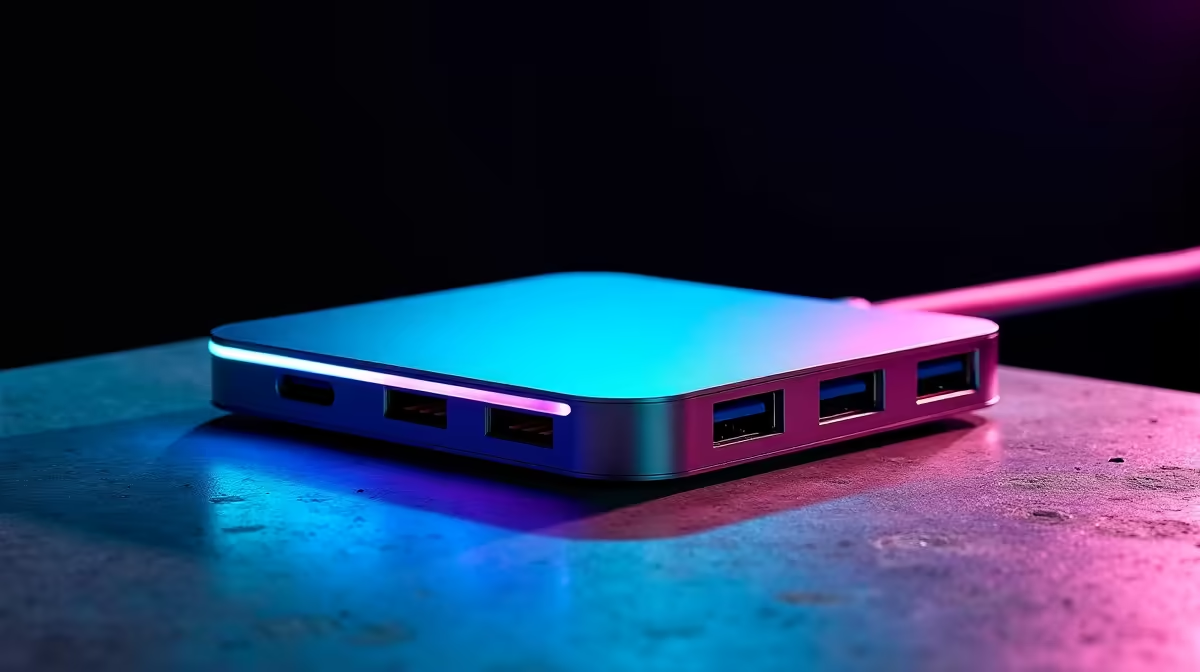
Not all USB-C cables support bi-directional video. A USB-C charging cable without the Thunderbolt or DisplayPort Alt Mode logo carries power only and will not pass video in either direction. When buying a bi-directional cable for display use, look for the Thunderbolt logo (a lightning bolt) or DP Alt Mode specification on packaging. Certified Thunderbolt 4 cables handle all use cases and retail between R350 and R900 at Evetech depending on length. For pure DisplayPort bi-directional use on a desktop with standard DP ports, a standard DP 1.4 cable works correctly in either orientation and costs R120 to R280 for 1m to 2m lengths.
Check the Logo Before You Buy ⚡
A USB-C cable without a Thunderbolt or DisplayPort Alt Mode certification marking will not carry video signals in either direction. Always look for the Thunderbolt lightning bolt symbol or explicit DP Alt Mode labelling on the cable packaging before purchasing.
FAQ
Can I use a bi-directional cable to connect two laptops for file transfer?
Not directly via DisplayPort. Bi-directional DisplayPort cables are for source-to-display connections. For laptop-to-laptop file transfer, you need a Thunderbolt cable and specific software, or a standard USB-C cable with the appropriate transfer application.
Do bi-directional cables cost more than standard cables?
Thunderbolt-certified bi-directional cables cost more than basic DisplayPort cables due to the certification and higher-spec construction, typically R350 to R900 versus R120 to R280. Standard DP 1.4 cables are inherently bi-directional at no premium.
Is bi-directional support important for gaming monitors?
For most gaming monitor connections using full-size DisplayPort, the bi-directional property is transparent and not a buying factor. It matters more in laptop-to-dock or USB-C-to-monitor scenarios common in hybrid work setups.
Setting up a flexible home or office workstation?
Evetech carries Thunderbolt and DisplayPort cables with bi-directional support to simplify multi-device setups. Browse the cable and accessory section to find the right fit.