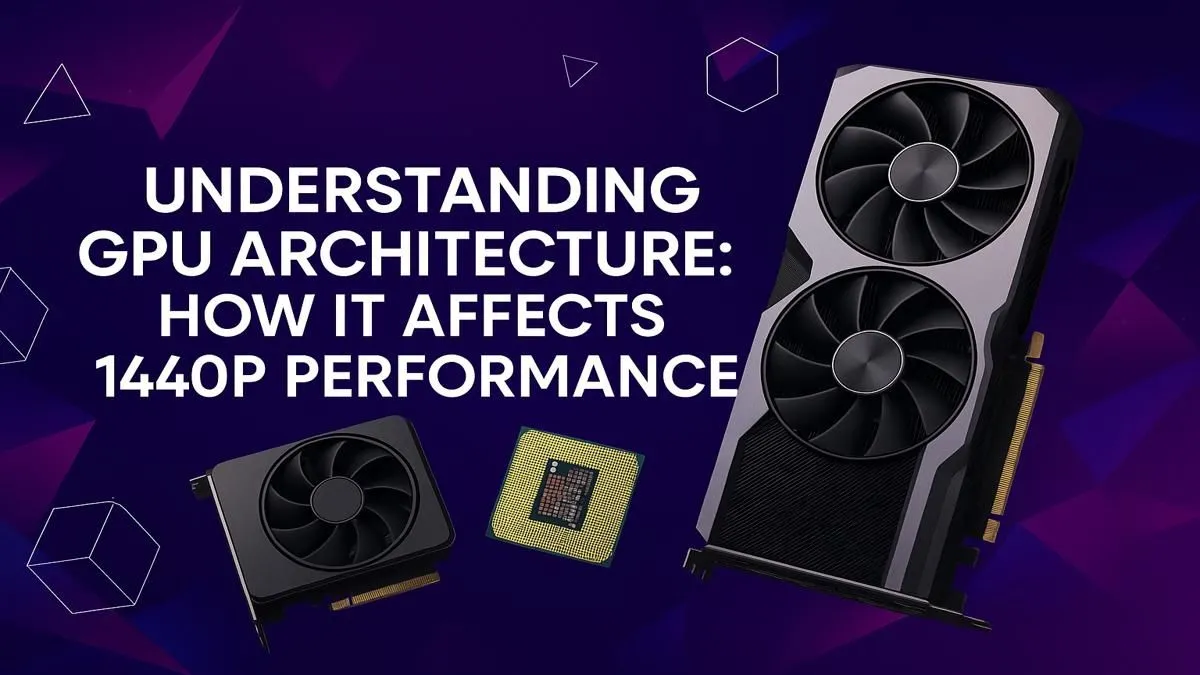
So, you're building a rig to conquer the 1440p sweet spot? Smart move. It's the perfect balance of sharp visuals and high frame rates. But if you’re just comparing VRAM and clock speeds, you're missing the most important piece of the puzzle: the GPU architecture. This hidden blueprint is what truly dictates your performance, turning a good gaming experience into an incredible one. It’s the difference between stuttering through a boss fight and landing every shot flawlessly.
What Exactly is GPU Architecture?
Think of GPU architecture as the design of a car's engine. You could have two 5.0-litre engines, but if one is a 1990s V8 and the other is a modern, twin-turbo hybrid, which one performs better? It’s the same with graphics cards. The GPU architecture for 1440p is the underlying design that determines how efficiently the card processes information.
Each generation, manufacturers like NVIDIA (Ada Lovelace), AMD (RDNA), and Intel (Alchemist) release a new architectural blueprint. This design dictates how the different parts of the GPU—like the cores, cache, and memory controllers—work together. A newer, more refined architecture can do more work with less power, unlocking features and performance that older cards simply can't match, even if their raw specs look similar on paper.
Core Components Affecting 1440p Gaming
A modern graphics card architecture is a complex beast, but a few key elements have a massive impact on your performance at 1440p resolutions. Understanding these will help you see beyond the marketing hype.
Shader Cores: The Raw Muscle 🦾
These are the fundamental workhorses of any GPU. NVIDIA calls them CUDA Cores, while AMD calls them Stream Processors. They handle the vast majority of graphical calculations. While more is generally better within the same family, you can't directly compare the core count of an AMD card to an NVIDIA one. The efficiency of the GPU architecture for 1440p determines how much work each core can do per cycle. This is why a newer card with fewer cores can often outperform an older card with more. For example, the latest RDNA architecture in AMD Radeon graphics cards is designed for incredible efficiency in modern gaming workloads.
Ray Tracing & AI Cores: The Specialist Brains
This is where modern architectures truly shine. Dedicated hardware like NVIDIA's RT Cores (for light simulation) and Tensor Cores (for AI and machine learning) are crucial for 1440p. They handle demanding tasks like real-time ray tracing and AI-powered upscaling (DLSS) without crippling your main shader cores.
Want to play Cyberpunk 2077 at 1440p with all the stunning visual effects turned on? You need an architecture built for it. The latest NVIDIA GeForce graphics cards leverage these specialist cores to deliver smooth, high-fidelity experiences that were once impossible.
Check Your Card's DNA 🧬
Download a free tool like GPU-Z. It goes beyond the basics and tells you exactly which architecture your GPU is based on (e.g., 'Ada Lovelace' or 'RDNA 3'), its memory type, and bus width. This is the best way to understand the technology you actually have, rather than just the product name on the box.
How Architecture Translates to Real-World Performance
So, how does all this tech talk affect your frame rate in Helldivers 2? Drastically.
A GPU with a modern architecture provides access to exclusive features that boost performance. NVIDIA's DLSS 3 with Frame Generation, for instance, is an architectural feature of the RTX 40 series. It uses AI to generate entire new frames, massively increasing FPS at demanding 1440p settings. Similarly, AMD's FSR and HYPR-RX technologies are baked into their architecture to give you a competitive edge.
Even newer players are making waves with fresh designs. The architecture behind Intel Arc graphics cards includes advanced features like XeSS upscaling and robust media encoding capabilities, offering fantastic value. It's also important to note that gaming architecture is highly specialised. While incredibly powerful, the design of workstation graphics cards is optimised for tasks like CAD and 3D rendering, not the high-speed demands of 1440p gaming.
Choosing Your 1440p Champion ✨
When you're ready to upgrade, look beyond the gigabytes of VRAM. Ask yourself: what generation is this card from? What features does its architecture support? A card with a superior GPU architecture for 1440p is a smarter, more future-proof investment. It will give you better performance, access to new technologies, and a far more enjoyable gaming experience for years to come.
Whether you're looking at Team Red, Green, or Blue, the right architecture is your key to victory. You can find all the latest and greatest NVIDIA & ATI graphics cards right here at Evetech, ready to power your next-gen setup.