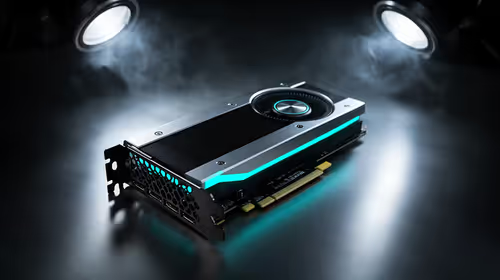
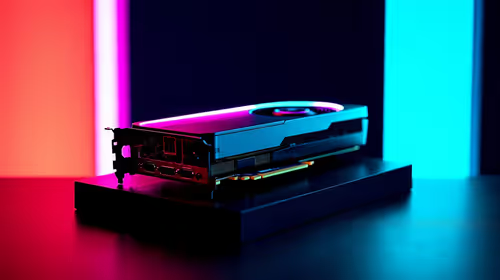
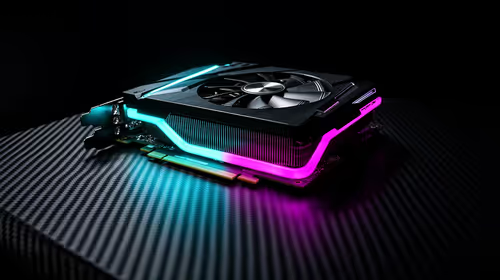
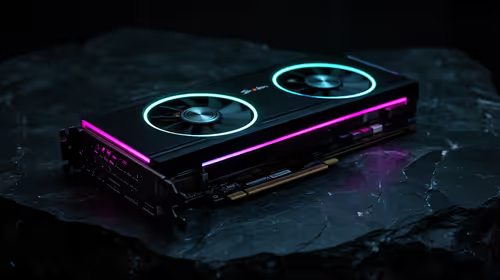
Are you Team Green or Team Red? For years, the NVIDIA vs AMD showdown has dominated local forums, LAN parties, and every PC build discussion. It's a classic South African tech rivalry. This deep dive explores the current state of GPU brand loyalty in South Africa, helping you decide whether your next upgrade should be based on habit or hard facts. 🚀
The Roots of the NVIDIA vs AMD Rivalry
For many seasoned gamers, brand loyalty was forged in the fires of iconic product generations. You might remember the sheer power of NVIDIA's 8800 GT, or how AMD (then ATI) often delivered incredible performance-per-Rand with their Radeon cards.
This history created powerful brand identities:
- NVIDIA (Team Green): Often seen as the premium, feature-rich option with dominant performance at the high end and pioneering tech like real-time ray tracing.
- AMD (Team Red): Championed as the scrappy underdog, pushing open standards and offering competitive pricing that appealed to budget-conscious builders.
This long-standing competition has been fantastic for consumers, pushing innovation and forcing prices down. But the landscape is more complex today.
Team Green: The NVIDIA Advantage
NVIDIA's biggest drawcard is its mature and feature-rich ecosystem. Their DLSS (Deep Learning Super Sampling) technology is a standout, using AI to boost frame rates with impressive image quality. For gamers chasing the highest possible performance in titles with ray tracing, the current lineup of NVIDIA GeForce graphics cards is often the top choice.
Beyond gaming, NVIDIA's CUDA cores give them a significant edge in creative and scientific workloads. Video editors, 3D artists, and data scientists often choose NVIDIA for faster rendering and processing, making their powerful workstation graphics cards the industry standard for productivity.
Team Red: The AMD Counter-Punch
AMD has made massive strides, closing the performance gap and, in some cases, beating NVIDIA in traditional rasterization (gaming without ray tracing). Their main weapon against DLSS is FSR (FidelityFX Super Resolution), an open-source upscaling technology that works on a wider range of GPUs, including older NVIDIA and AMD models.
This commitment to open standards is a core part of AMD's appeal. For many South African gamers, the raw price-to-performance value offered by AMD Radeon GPUs is simply too good to ignore, especially in the mid-range where every Rand makes a difference. They deliver a phenomenal gaming experience without demanding a premium price.
Check Your Power Supply! ⚡
you upgrade your GPU, double-check your Power Supply Unit (PSU). Newer cards can be power-hungry. A good rule of thumb is to check the manufacturer's recommended PSU wattage for your chosen card. An underpowered PSU can cause instability and crashes, especially during intense gaming sessions. Don't forget to budget for a potential PSU upgrade and other [essential graphics card accessories](https: www.evetech.co.za PC-Components buy-graphics-card-accessories-367) if needed.
A New Challenger Enters the Arena 🤔
The NVIDIA vs AMD duel is no longer a two-horse race. A third player has officially entered the market: Intel. While still new, Intel's Arc graphics cards are targeting the entry-level and mid-range segments with competitive pricing and promising features like XeSS upscaling. While driver maturity is still a work in progress, more competition is always great news for buyers.
The South African Reality: Does Brand Loyalty Make Sense?
Here’s the bottom line: for most South African gamers, blind brand loyalty is a luxury we can't afford. Factors like the Rand-Dollar exchange rate, fluctuating stock levels, and local pricing mean the "best value" brand can change from month to month.
The smartest approach is to focus on your specific needs:
- Your Budget: What is the absolute maximum you can spend?
- Your Games: Which titles do you play most? Check benchmarks for those specific games.
- Your Resolution: Are you gaming at 1080p, 1440p, or 4K?
Instead of being loyal to a brand, be loyal to your wallet. The wisest move is always to compare the current performance benchmarks and start by finding the best graphics card deals available right now. Often, a great deal on a slightly less powerful card is a better financial decision than paying a premium for the absolute top-tier model. Ultimately, exploring our complete range of graphics cards will give you the clearest picture of what your money can buy today.