A firm ceiling is useful only when every shortlisted card actually fits beneath it. Graphics-card features to prioritise under R50,000 should come from the games, applications, screens and supporting PC - not from a flagship reference that already exceeds the budget.
Quick Answer
The ASUS TUF RTX 5090 costs R73,599, which is R23,599 above a R50,000 graphics-card limit. Use its 32GB memory, 3352 AI TOPs, five outputs and cooling design as comparison points, but choose an eligible card whose most-used features fit inside the ceiling.
🎯 Define the outcome before the feature list
Begin with the job. A gaming buyer should name the titles, display resolution, target frame experience and settings priorities. A creator should specify the application, project scale and output deadline. An AI user needs the model, tool and acceleration support.
These details determine which evidence matters. A competitive player may value consistent frame delivery at a chosen refresh target. Someone working with large scenes may prioritise graphics-memory capacity. A multi-screen editor can place output connections ahead of a feature that never appears in the daily workflow.
Write a "must, useful, optional" list. Must-have items should be few and testable. Useful features can break a tie. Optional specifications receive budget only after the complete system is covered.
The under-R50,000 rule applies to the card price, but the buying decision should recognise any related expense. A chassis change, suitable power supply or required display cable can move the total build beyond the comfortable limit even when the GPU itself qualifies.
Compare candidates within Evetech's ASUS graphics-card collection only after writing the target and maximum spend at the top of the page.
🧠 Rank memory, compute and interface separately
The RTX 5090 illustrates why features need independent rows. Its 32GB GDDR7 is a memory configuration; 3352 AI TOPs describes theoretical supported AI operations; PCIe 5.0 identifies the host interface. They do not combine into a single universal performance score.
For graphics memory, look for workload evidence. Observe VRAM use and behaviour in the intended game or creator project. Allocated memory is not always the same as capacity that changes the outcome, so note stutter, failed jobs, reduced settings or other repeatable pressure.
For AI processing, check the precise software feature. A large TOPs figure has little value when the application does not direct compatible work to the GPU. Keep model, precision and output settings constant when comparing measured results.
For PCIe, confirm the motherboard slot generation and lane arrangement. PCIe 5.0 may offer newer interface headroom, but it need not be mandatory when a workload is comfortable on another supported link. Platform compatibility, fit and power remain distinct checks.
Under a hard ceiling, reject specifications that cannot be connected to a real need. That discipline protects the budget from "future-proof" guesses that have no credible use case.
Add a rejection note beside every removed card. "Exceeds R50,000", "does not fit the current enclosure" or "fails the required display map" is more useful than leaving a vague impression that it was nearly chosen. The next buying review can then revisit facts rather than reconstructing memory.
Keep the date and source beside each observed price. A budget comparison is a snapshot, and the shortlist may change when prices move. The hard ceiling itself should remain fixed unless the complete financial decision is deliberately reopened.
Browse Evetech's broader NVIDIA graphics-card category with separate memory, AI and interface columns.
🌬️ Give cooling and displays practical weight
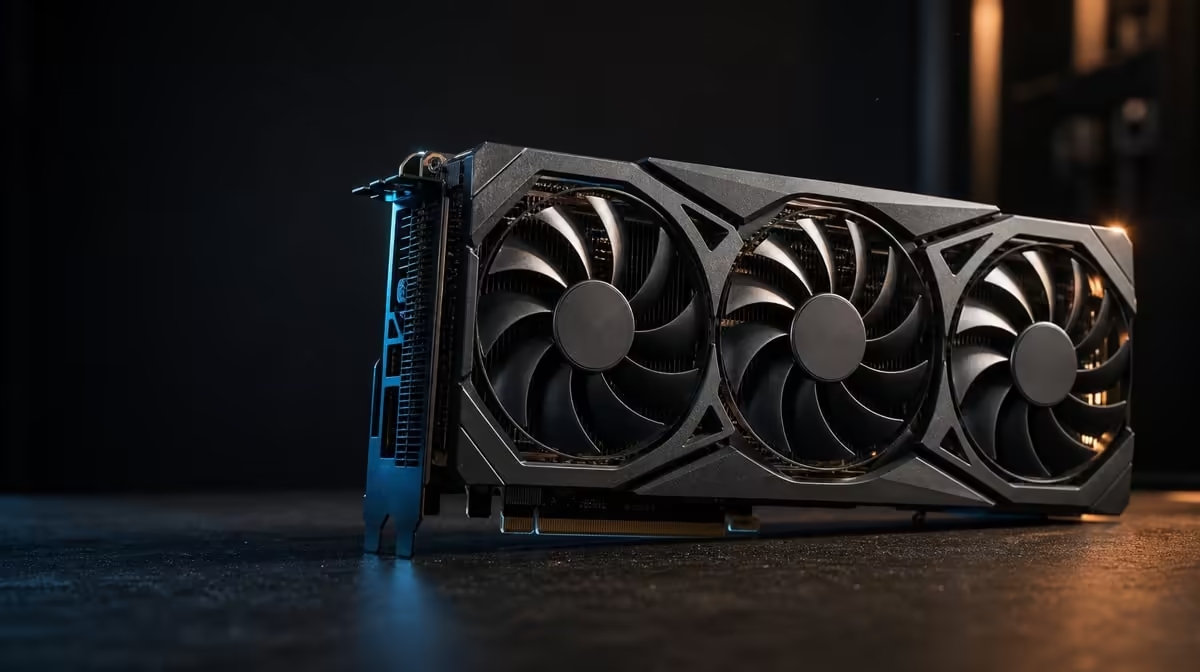
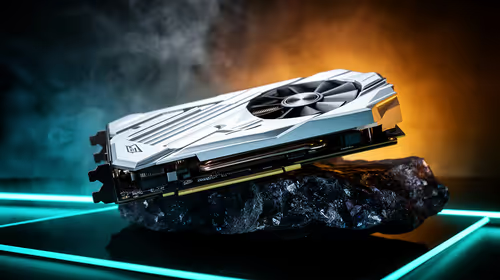
Cooling is not a decorative specification. The ASUS TUF RTX 5090 names the TUF card's vapor chamber and axial fans. Those parts spread heat and move air through the card, while the case must supply and exhaust air around it.
For any sub-R50,000 option, assess the same complete path. Confirm dimensions from the product information, check the chassis clearance, review intake and exhaust routes and make sure cables do not obstruct fans. Do not infer exact temperature or noise from a cooler name.
Display needs can be counted more directly. This reference card offers five display links: three over DP 2.1b and two through HDMI 2.1b connections. A buyer with one screen may gain little from five sockets; a creator with several panels should map inputs and modes before deciding how many outputs are useful.
Physical socket count does not guarantee every simultaneous arrangement. Monitor, cable, output and selected resolution or refresh must form a compatible path. An adapter adds another item to verify.
Cooling and outputs often reveal better value than a headline benchmark because they affect whether the card fits and connects to the intended environment. Still, they should not displace game or application performance evidence.
Consider the support burden of the final arrangement. A build that needs frequent cable swaps, aggressive compromises or a difficult chassis conversion may cost more time than a straightforward alternative. Simplicity can be a legitimate feature when two cards meet the workload similarly.
💰 Keep the shortlist below the line
Create a table containing candidate price, complete-PC cost, measured workload result and must-have checks. Remove the RTX 5090 from an under-R50,000 shortlist immediately: at R73,599, it is R23,599 above the boundary.
Keeping it as a feature reference is acceptable. Its specifications can help ask whether 32GB, five outputs or dedicated AI capability would change your work. The answer may be "yes, but not at this budget," which is more useful than quietly breaking the cap.
Do not spend the entire ceiling by default. If a less expensive card meets the defined target, the difference can support storage, system memory, cooling, display quality or simply remain unspent. Total experience depends on the complete machine.
Use workload tests from the exact applications and games wherever possible. Match settings and note the host system. A result from an unrelated processor or resolution should be treated as context, not a guarantee.
Give uncertainty its own column. If simultaneous display support, software acceleration or case clearance has not been established, mark it unresolved and obtain the missing answer. Never convert an unknown into a silent assumption to keep a favoured model on the list.
Finish with a one-sentence justification: "This card fits below R50,000 and meets these three measured requirements without forcing these platform replacements." If the sentence depends mainly on status or an unused specification, revisit the shortlist.
Review Evetech's GPU best-seller page for another comparison set and check current availability once every remaining card respects the cap.
Frequently Asked Questions
Does the ASUS TUF RTX 5090 fit below R50,000?
No. Its R73,599 price is R23,599 above that ceiling.
Which feature should a budget buyer define first?
Define the outcome in the main game or application, because that determines which hardware feature can create value.
How should cooling influence a sub-R50,000 choice?
The cooler and case airflow must support the intended session length without forcing an unplanned chassis change.
How many display outputs might a multi-screen buyer need?
Only enough compatible outputs for the screens and modes in the actual desk plan; more sockets are not automatically more valuable.
Should PCIe 5.0 be mandatory within this budget?
Not unless platform compatibility or an interface-sensitive workload creates a clear reason for it.
What can the RTX 5090 illustrate without fitting the cap?
It provides a reference for 32GB GDDR7, 3352 AI TOPs, five modern outputs and a named cooling design.
How can a buyer avoid overspending on unused GPU features?
Assign every paid feature to a frequent, measurable workload and remove anything supported only by vague future possibilities.
Holding the graphics-card line at R50,000?
Compare Evetech options against a written must-have list, keep every candidate below the cap and spend only where your measured workload benefits.