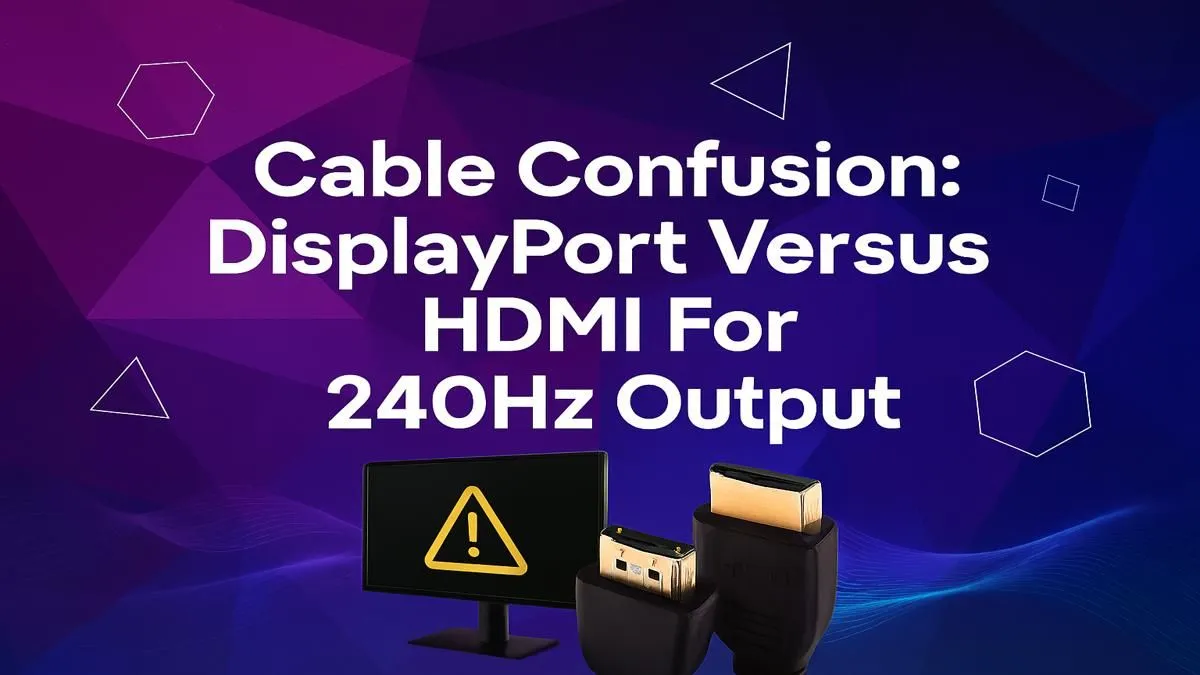
So, you've just dropped some serious ZAR on a lightning-fast 240Hz monitor, ready to dominate in Apex Legends or Valorant. But your gameplay still feels… off. Before you blame your GPU, look at that little cable connecting them. Getting the HDMI vs DisplayPort 240Hz choice right is crucial for unlocking the buttery-smooth performance you paid for. Let's plug in and find the clear winner for your South African gaming setup. 🚀
The Core Difference: HDMI vs DisplayPort
At a glance, these two cables look pretty similar, but they were built for different worlds. HDMI (High-Definition Multimedia Interface) was designed for home theatre systems—TVs, Blu-ray players, and consoles. DisplayPort, on the other hand, was created from the ground up for computers, with a focus on high resolutions and refresh rates.
While modern versions of both can handle intense gaming demands, their PC-centric roots give DisplayPort an inherent advantage that we'll explore. The key isn't just the cable, but the version number on it.
The 240Hz Showdown: Which Cable Delivers?
When you're pushing 240 frames per second, you're sending a massive amount of data from your graphics card to your monitor. The real question in the HDMI vs DisplayPort 240Hz debate is about bandwidth—which connection can handle that firehose of information without compromise?
HDMI for High Refresh Rates
For years, HDMI lagged behind for high-refresh PC gaming.
- HDMI 2.0: Can achieve 240Hz, but typically only at 1080p resolution. To hit 1440p at high refresh rates, it often relies on a technology called Display Stream Compression (DSC), which slightly compresses the image. It works, but it’s not ideal.
- HDMI 2.1: This is the new powerhouse. It has massive bandwidth, comfortably handling 4K at 120Hz and easily managing 1440p or 1080p at 240Hz without breaking a sweat. It's the standard for PlayStation 5 and Xbox Series X, and many of the best PC monitor deals now feature at least one HDMI 2.1 port.
DisplayPort: The PC Gamer's Choice ⚡
DisplayPort has long been the go-to for PC enthusiasts, and for good reason.
- DisplayPort 1.4: This is the current king and the most common port on gaming monitors and graphics cards. It has more than enough bandwidth for 1440p at 240Hz and even 4K at 120Hz, often without needing DSC. This clean, uncompressed signal is why most pros stick with it.
- DisplayPort 2.0/2.1: This is the future. It offers almost triple the bandwidth of DP 1.4, making it ready for next-gen 4K 240Hz and even 8K displays. While not common yet, choosing a monitor with it ensures you're future-proof.
You'll find DisplayPort 1.4 across our entire range of gaming monitors, making it the safest bet for immediate performance.
Pro Tip: Check Your Ports! 🔧
Before buying a new cable, physically check the ports on your graphics card and monitor. Most GPUs have more DisplayPort outputs (usually 3) than HDMI (usually 1). Your monitor might also only support its maximum 240Hz refresh rate over a specific input. A quick 10-second check can save you a lot of frustration.
Beyond Refresh Rate: Other Factors to Consider
The debate isn't just about raw speed. A few other features can influence your decision.
- Variable Refresh Rate (VRR): Both standards support VRR tech like NVIDIA G-Sync and AMD FreeSync, which eliminates screen tearing. However, G-Sync has historically favoured DisplayPort for the best compatibility, though this is changing.
- Connectors: DisplayPort cables often feature a handy locking mechanism to prevent them from being accidentally unplugged—a small but appreciated feature, especially with immersive curved monitors where you might be moving around.
- Multiple Displays: DisplayPort supports Multi-Stream Transport (MST), allowing you to daisy-chain multiple monitors from a single port on your graphics card. HDMI can't do this.
The Verdict: So, Which Cable for 240Hz Gaming? ✅
For the vast majority of South African PC gamers today, the answer is clear: DisplayPort 1.4 is the winner for 240Hz gaming.
It offers the most reliable, uncompressed performance on the widest range of hardware available right now. If you're building a new rig or upgrading, ensuring your components have DisplayPort 1.4 is your ticket to silky-smooth frames.
HDMI 2.1 is an excellent, future-proof alternative, and it's absolutely essential if you're also a console gamer. But for a dedicated PC setup, DisplayPort still holds the crown. To find the perfect screen with the right ports, check out our full selection of PC monitors and match it to your graphics card.
Ready to Unleash True 240Hz?
The right cable makes all the difference between winning and watching a replay. Explore our massive range of high-refresh-rate gaming monitors and get the performance that leaves lag in the dust.