Quick Answer
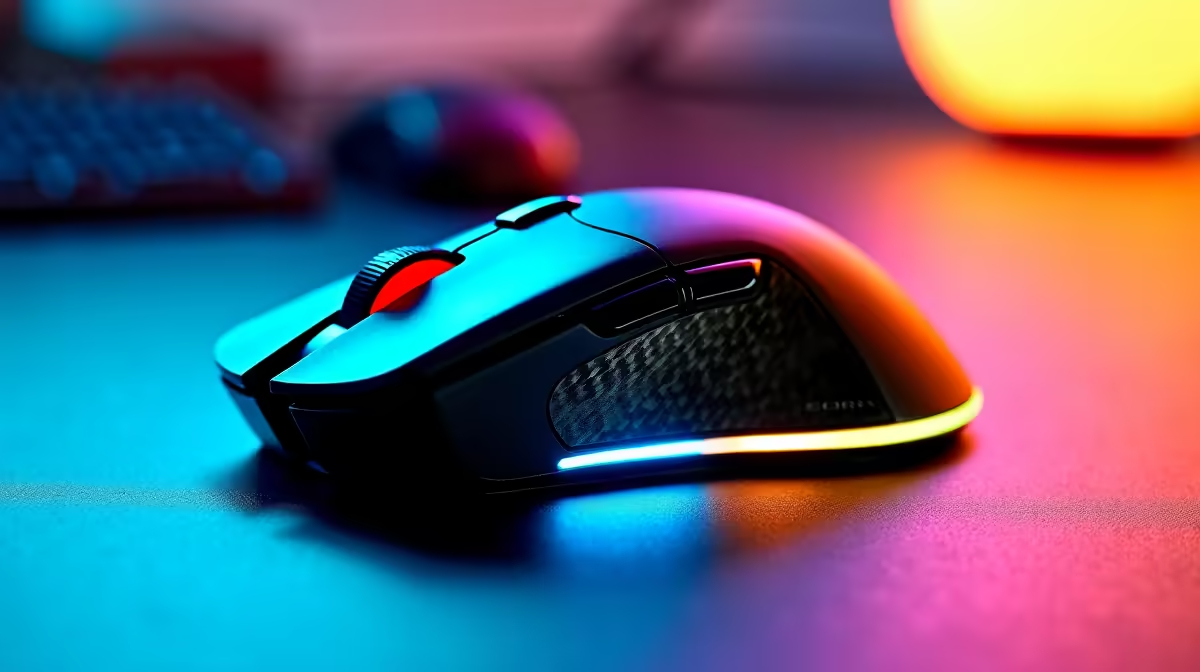
For precision gaming, sensor quality at low to mid DPI matters far more than the maximum DPI rating. A high-end optical sensor like the Razer Focus Pro 30K or Logitech HERO 25K delivers zero acceleration, accurate tracking at high speeds, and consistent 1:1 cursor movement. A basic sensor may have an 8,000 DPI ceiling but suffers from acceleration artifacts and spin-out at fast swipe speeds.
The Specs That Actually Determine Precision 🔬
Four sensor specifications predict real-world tracking quality better than DPI ceiling: maximum tracking speed in IPS, maximum acceleration in G, lift-off distance, and angle snapping behaviour. A sensor rated for 400 IPS handles fast swipes without losing positional data, while a basic sensor rated for 60 to 80 IPS will spin out during aggressive crosshair flicks. Acceleration should be near-zero: any added acceleration means faster movements are scaled differently from slower ones, destroying consistent muscle memory. The Razer Focus Pro 30K and HERO 25K achieve near-zero acceleration across their DPI range, while basic sensors in budget mice apply correction algorithms that introduce detectable acceleration artifacts above 800 DPI.
Where Basic Sensors Fall Short Under Real Conditions 🎮
Basic optical sensors perform adequately at low DPI on smooth surfaces, but two failure modes appear in competitive gaming. First, inconsistent lift-off distance: a basic sensor may re-register movement when the mouse is lifted more than 2 mm from the pad, causing phantom cursor movement when repositioning. Second, surface tracking limitations: basic sensors often require specific mousepad textures and struggle on glass, textured surfaces, or uneven desk finishes. In SA gaming setups where budget mousepads with rough stitched edges are common, a high-end sensor's broader surface compatibility produces consistently more reliable tracking.
Why DPI Ceiling Is the Least Important Spec 📊
Marketing materials for budget mice lead with high DPI ceiling numbers to create the appearance of performance. In practice, competitive FPS players use 400 to 1,600 DPI and casual players rarely exceed 3,200 DPI. The DPI ceiling is irrelevant unless you run a multi-monitor 4K setup. What matters is how accurately the sensor performs within the 400 to 1,600 DPI range where nearly all actual gaming occurs. A basic sensor rated to 16,000 DPI with 80 IPS max tracking speed is far less capable than a premium sensor rated to 12,000 DPI with 400 IPS and zero acceleration.
Test Your Sensor on Your Actual Mousepad ⚡
Even high-end optical sensors can produce inconsistent results on certain surfaces. Before committing to a DPI setting, move the mouse rapidly across your specific mousepad while watching for cursor jitter. If you see irregular movement at fast speeds, try adjusting the lift-off distance in the mouse software before assuming a sensor hardware fault.
FAQ
Can a budget mouse sensor keep up in casual gaming?
For casual single-player and low-stakes multiplayer gaming, a basic sensor with up to 80 IPS is acceptable. The limitations become apparent in fast-paced competitive FPS where precision tracking at high movement speeds is critical.
Does a better sensor make me a better player?
A better sensor removes technical limitations so physical movements translate more accurately. It eliminates the ceiling imposed by sensor artifacts but does not improve fundamental aiming technique.
What is a good entry-level gaming mouse with a quality sensor for SA buyers?
The Razer DeathAdder Essential and Logitech G203 are both stocked at Evetech under R600 and use optical sensors with reliable low-acceleration tracking, making them strong entry-level choices for SA gamers.
Want a mouse with a genuinely precise sensor?
Browse gaming mice at Evetech that feature high-end optical sensors, from entry-level to flagship, and find the tracking quality your setup deserves.