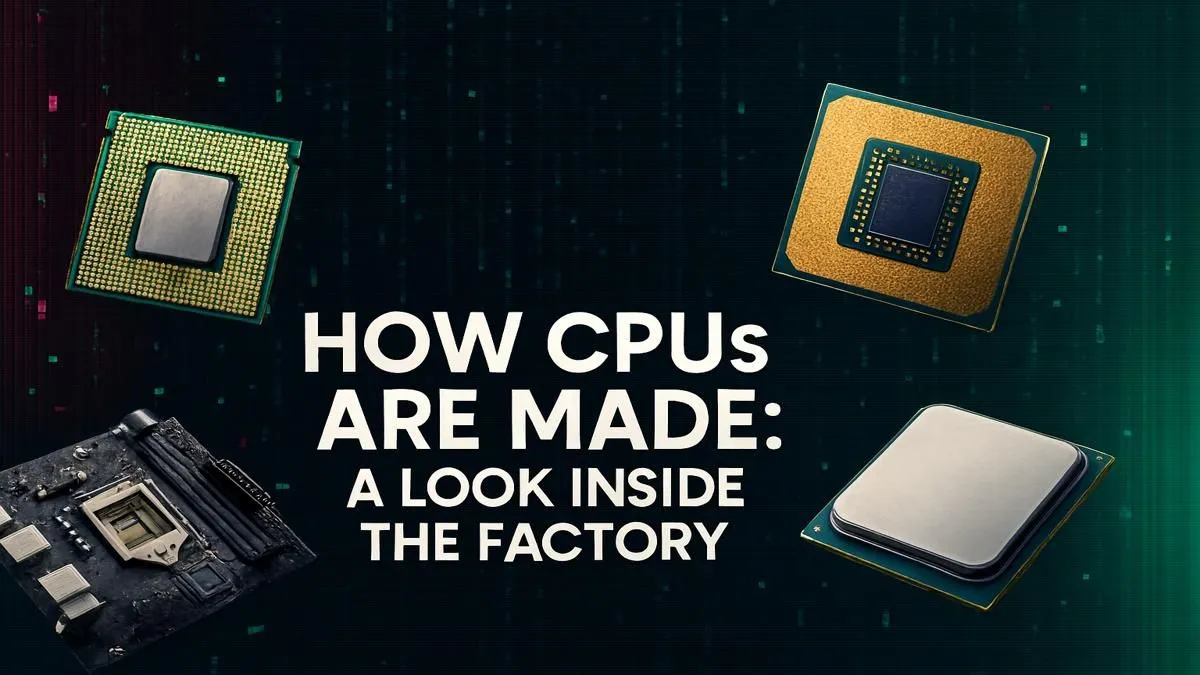
Ever wondered what the "brain" of your PC is actually made of? It’s not magic, but it’s close. The powerful CPU running your favourite games started its life as… sand. Seriously. From a simple grain of sand to a complex silicon marvel capable of billions of calculations per second, the process is one of the most precise and fascinating feats of modern engineering. Let's take a deep dive into how CPUs are made. 🚀
The First Step: From Sand to Pure Silicon
It all begins with quartz sand, which is rich in silicon dioxide (SiO₂). But you can't just shovel sand from the beach into a factory. To create the foundation for a processor, this raw material must be purified to an incredible degree—we're talking 99.9999999% purity, a standard known as "nine-nines."
This ultra-pure silicon is melted in a crucible at over 1,400°C. A seed crystal is dipped into the molten silicon and slowly pulled upwards while rotating. As it cools, the molten silicon solidifies around the seed, forming a massive, single-crystal cylinder called an ingot. This ingot can weigh over 100 kilograms and is the bedrock of every CPU.
The Wafer: Creating the Silicon Canvas ⚙️
Once the ingot is grown, it's a flawless, cylindrical crystal of pure silicon. It's then sliced into incredibly thin discs called wafers using a diamond-tipped saw. These wafers are typically 300mm in diameter but less than a millimetre thick.
Each wafer is polished to a mirror-smooth, defect-free finish. Why? Because the circuits that will be built on its surface are measured in nanometres—thousands of times thinner than a human hair. Any imperfection, no matter how small, could ruin the hundreds of CPU processors we rely on that will eventually be etched onto this single canvas.
Photolithography: Drawing with Light
This is where the real magic of CPU manufacturing happens. Photolithography is the process of printing the CPU's complex circuit design onto the silicon wafer. It works a bit like developing a photograph.
- Coating: The wafer is coated with a light-sensitive material called a photoresist.
- Exposure: A "mask," which acts like a stencil of the CPU's circuitry, is placed between the wafer and a UV light source. The light passes through the mask's clear parts, hardening the photoresist below it.
- Etching: The wafer is washed in a chemical solvent that dissolves the unhardened photoresist, revealing the underlying silicon.
- Doping: The exposed silicon is then bombarded with ions (a process called doping) to alter its electrical properties, creating the transistors.
This entire cycle—coating, exposing, etching, and doping—is repeated dozens of times, meticulously building up the intricate, multi-layered network of billions of transistors that form the CPU's architecture. It’s a painstaking process that has been perfected by tech giants like Intel for decades.
Cooling is Critical ❄️
All those billions of transistors switching on and off generate a massive amount of heat in a tiny space. That's why a high-quality CPU cooler isn't just a nice-to-have; it's essential. Without proper cooling, your CPU will throttle (slow down) to prevent damage, killing your gaming performance. Always invest in a decent cooler to unlock your processor's true potential.
Testing and Dicing: Finding the Best of the Best
Before the wafer is cut up, every individual processor-in-the-making (called a "die") is tested right there on the wafer. Probes send signals through each die to check for functionality and performance. Defective dies are marked and discarded.
This testing phase is also where "binning" occurs. Not all dies are created equal. Some, located near the centre of the wafer, might perform better and be able to hit higher clock speeds. These become the high-end models (like a Core i9 or Ryzen 9). Slower but still perfectly functional dies are binned as lower-tier models (like a Core i5 or Ryzen 5). This is a key reason why competition between rivals like AMD drives innovation and gives consumers more choice.
Once testing is complete, the wafer is sliced with a diamond saw, separating the hundreds of individual dies.
Packaging: The Final Assembly ✨
The raw silicon die is incredibly fragile. To become the CPU you buy off the shelf, it needs to be packaged. The die is mounted onto a substrate, which provides the electrical connections (the pins or pads) that interface with your motherboard.
A protective heat spreader is then attached on top. This is the metal lid you see on a finished CPU. It serves two crucial purposes: it protects the delicate die from being crushed by the CPU cooler and it helps transfer heat away from the silicon to the cooler more efficiently.
After a final round of testing to ensure the packaged processor works perfectly, it's ready to be boxed up and shipped out. From a humble grain of sand to a powerhouse of computation, the journey is complete.
Ready to Harness the Power of Silicon?
From a grain of sand to the heart of your rig, the journey is complete. Now it's time to choose the right one. A new CPU is the single biggest performance upgrade you can make for gaming, streaming, and creating.
Browse our wide range of powerful CPUs and find the perfect brain for your build.