Quick Answer
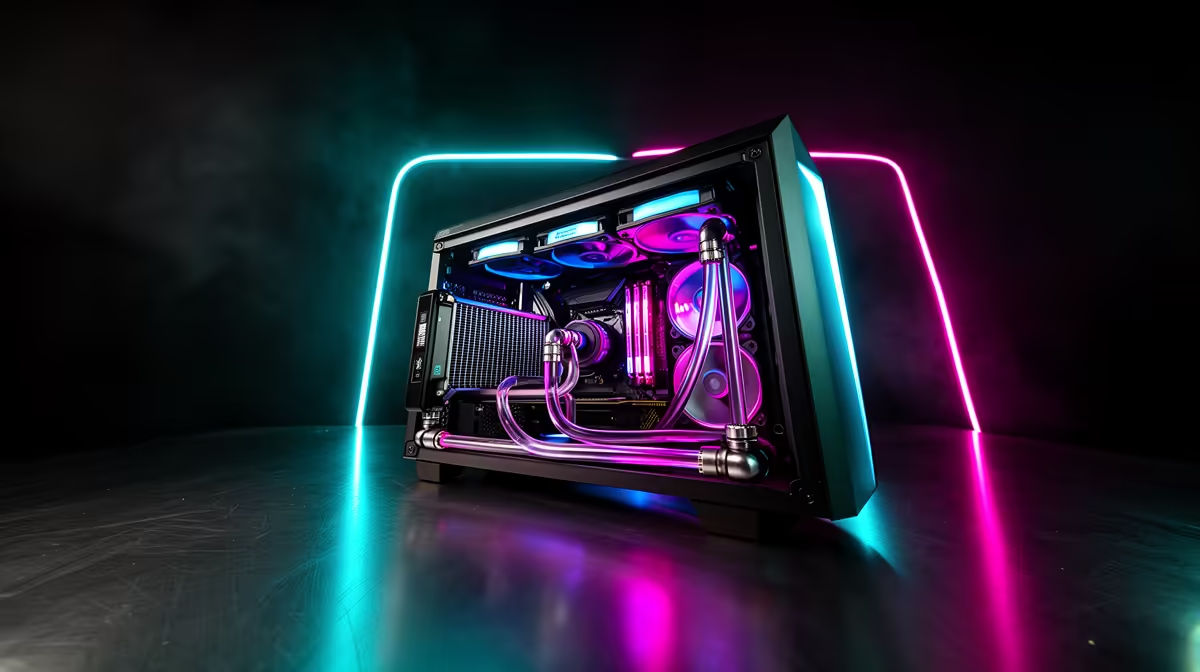
An 8-core Ryzen CPU paired with a quality 360mm AIO has substantially more cooling capacity than it needs for gaming. These CPUs peak at 65W to 142W TDP and a 360mm AIO holds them at 65 to 78 degrees Celsius during sustained all-core loads. During gaming specifically, where load is rarely all-core, temperatures run 10 to 15 degrees lower than that.
What an 8-Core Ryzen Generates Under Gaming Load 🌡️
Modern 8-core Ryzen gaming CPUs are efficient by design. The Ryzen 7 7800X3D maintains package power below 65W during gameplay because 3D V-Cache reduces the need for high clock speeds to achieve maximum gaming performance. The Ryzen 7 9700X runs similarly lean at 65W in eco mode or up to 105W in performance mode. A 360mm AIO's thermal capacity of 250W to 300W continuous dissipation is massively overspecified for either CPU in a gaming workload. What this means practically is that the AIO runs its fans at very low RPM during gaming, often below 700 RPM, making the system extremely quiet.
When the Extra Headroom Actually Helps 💪
The headroom from a 360mm AIO on an 8-core Ryzen becomes useful outside of gaming. If you use the same PC for video rendering, 3D modelling, or compilation, all-core loads push the Ryzen 7 7700X or 9700X to their maximum TDP for extended periods. A 360mm AIO handles this without throttling, while a 240mm AIO may briefly throttle a 7700X during sustained Blender or Cinebench runs. For South African creators using their gaming PC as a dual-purpose workstation, the 360mm AIO justifies its R500 to R1,000 premium over a 240mm unit. For a pure gaming-only build, a 240mm AIO or a premium single-tower air cooler like the DeepCool AK620 is objectively sufficient.
South African Summer and Fan Speed Settings 🌤️
At 35 degrees ambient in Johannesburg, a 360mm AIO with fans set to a flat 800 RPM may allow coolant to rise slowly during a three-hour gaming session. Set a mild temperature-responsive fan curve rather than a static low-RPM setting: ramp from 700 RPM at 30 degrees coolant temperature to 1,100 RPM at 45 degrees. This keeps the system quiet in winter and automatically adds cooling capacity in summer without manual intervention. Most AIO software including iCUE, Armoury Crate, and DeepCool Control supports coolant-temperature-referenced fan curves.
Connect Pump to CPU_OPT for Better Control ⚡
Connect the AIO pump to the CPU_OPT header on the motherboard rather than a case fan header. CPU_OPT is designed for constant-speed pump operation and gives the BIOS thermal monitoring direct control over pump speed. This ensures the pump never underspins during high ambient temperature events.
FAQ
Is a 360mm AIO necessary for the Ryzen 7 7800X3D?
No. The 7800X3D's power ceiling is 120W and it typically runs well below that during gaming. A quality 240mm AIO is fully sufficient. Choose a 360mm only if you want whisper-quiet operation or if your case has better front 360mm mounting than top 240mm clearance.
Does pump speed significantly affect cooling performance?
At standard pump speeds (2,000 to 3,000 RPM), pump speed has minimal effect on thermal performance for desktop gaming CPUs. Radiator size and fan speed are the dominant variables. Pump speed only matters at heat loads above 250W.
Can a 360mm AIO handle the Ryzen 9 9950X if I upgrade later?
Yes. The 9950X at up to 170W TDP is within the sustained capacity of a quality 360mm AIO. Choosing a 360mm AIO with an 8-core Ryzen today is a smart forward-compatible decision if you plan to step up to a 16-core chip later.
Cooling your Ryzen gaming build right?
Shop 240mm and 360mm AIOs at Evetech, stocked for the South African market with local warranty and compatibility support for AMD AM5 platforms.