Quick Answer
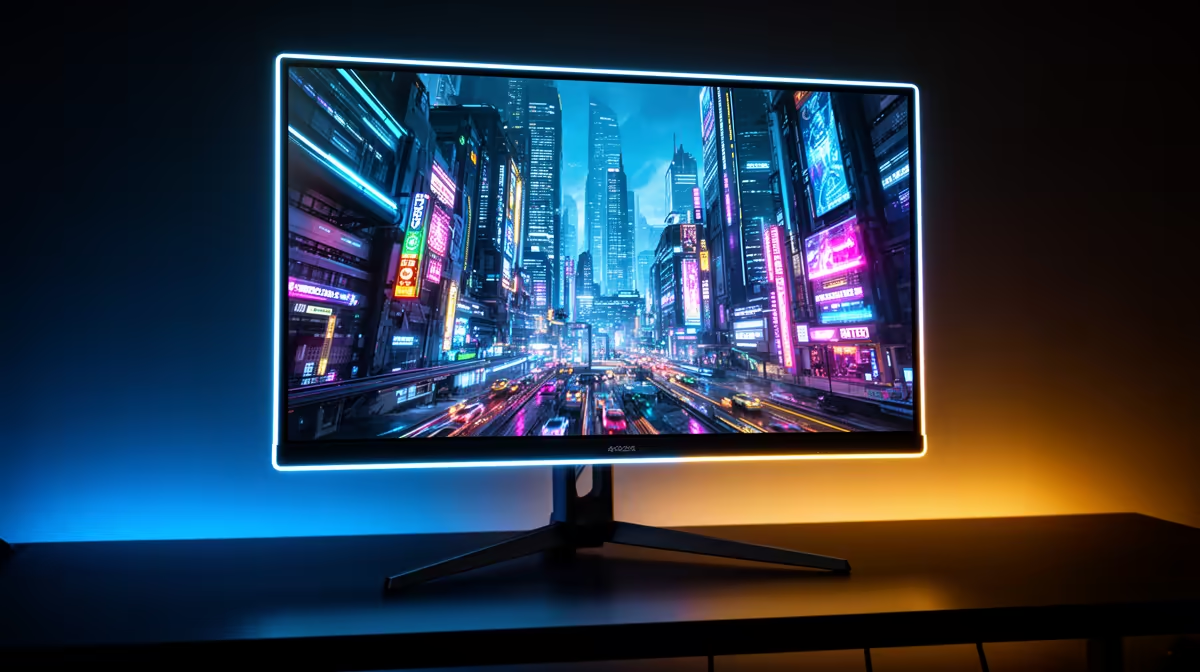
For a 32-inch 4K gaming monitor in South Africa, budget between R8,000 and R13,000 for a solid IPS or VA panel at 144Hz, or R16,000 to R28,000 for a premium QD-OLED or Mini-LED model at 240Hz. Spending below R8,000 at 32 inches usually means 60Hz or TN panels that are not ideal for gaming.
What R8,000 to R13,000 Gets You at 32 Inches 💰
In this price tier you can expect a 4K IPS panel at 144Hz with G-Sync Compatible or FreeSync Premium Pro support, HDR400 certification, and good sRGB colour accuracy. Brands commonly stocked in SA at this range include LG, Samsung, and ASUS TUF Gaming. Response times sit at 1ms GtG or better, and most panels in this bracket include two HDMI 2.1 ports and one DisplayPort 1.4, which supports 4K at 144Hz without compression. These monitors pair well with an RTX 5070 or RX 9070 XT, which can sustain 60 to 100 fps at 4K in demanding titles.
The R16,000 to R28,000 Premium Bracket 🖥️
Spending above R16,000 moves you into QD-OLED territory with panels offering infinite contrast, 240Hz refresh rates, and DisplayHDR True Black 400 certification. The LG 32GS95UE and ASUS ROG Swift OLED PG32UCDM exemplify this bracket. At 32 inches the QD-OLED subpixel density at 4K is high enough that text fringing, a concern on smaller OLED panels, is largely eliminated. Mini-LED options in this range from ASUS ROG and Samsung Odyssey offer 1,000 to 2,000 local dimming zones and sustained brightness above 800 nits, which is better suited to brightly lit SA lounge gaming environments where OLED panels can look dimmer.
Is a 32-Inch 4K Monitor Worth It for Your GPU? 🎮
At 32 inches, 4K pixel density reaches approximately 138 pixels per inch. At typical gaming distances of 60 to 80 cm, individual pixels are not visible, so the sharpness benefit over 1440p is real but not dramatic. The main argument for 4K at 32 inches is future-proofing: as GPU performance scales with each generation, the same monitor will extract more resolution detail from more powerful cards. If your current GPU is an RTX 4070 or RTX 5070, expect to run 4K at medium to high settings. An RTX 5080 or above is needed for consistent high-fps 4K at maximum settings.
HDMI 2.1 vs DisplayPort at 4K ⚡
For 4K at 144Hz you need DisplayPort 1.4 with DSC or a native DisplayPort 2.1 connection. HDMI 2.1 also supports 4K at 144Hz and is useful for connecting a PS5 alongside your PC without swapping cables. Check that your monitor has at least one of each port to cover both use cases.
FAQ
Can I use a 32-inch 4K monitor for console gaming too?
Yes. A 32-inch 4K monitor with HDMI 2.1 works well with a PlayStation 5 at 4K 120Hz. The smaller screen size compared to a TV means you will sit closer, which suits the more immediate input response of a monitor versus a large-screen TV.
How much do warranties differ at these price points in SA?
Most monitors in the R8,000 to R13,000 range carry a one-year to two-year local warranty through the SA distributor. Premium panels in the R16,000-plus bracket often include two to three years, and some ASUS ROG models include a pixel-warranty policy covering dead pixels from day one.
Is it better to get a 32-inch 4K or a 27-inch QD-OLED at the same price?
A 27-inch QD-OLED at the same budget as a 32-inch IPS offers significantly better contrast and motion clarity but at a smaller screen size. Choose 27-inch QD-OLED for pure image quality and gaming; choose 32-inch IPS for a larger workspace that doubles as a productivity display.
Ready to invest in a 32-inch 4K display?
Evetech carries 32-inch 4K gaming monitors across entry and premium price tiers. Visit the Evetech monitor section to compare panel types, refresh rates, and features side by side.