Quick Answer
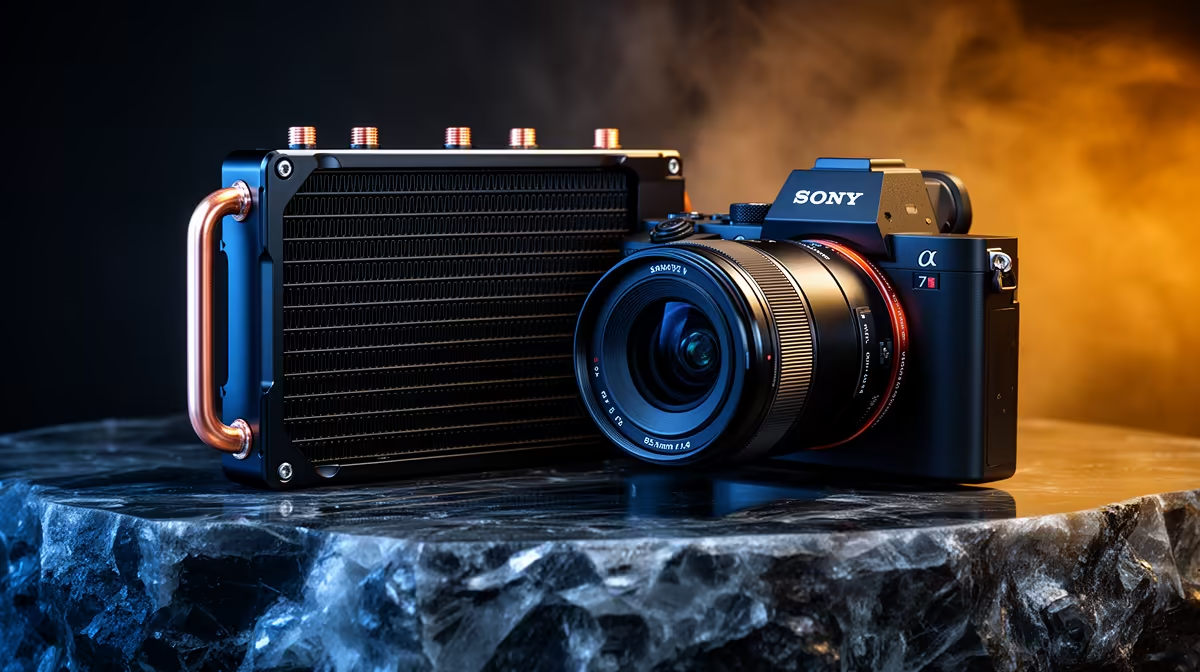
SA gaming rooms at 26 to 34 degrees Celsius ambient during summer directly raise CPU temperatures by the same margin, since liquid cooler heat dissipation depends on the temperature difference between coolant and room air. A CPU that sits at 72 degrees Celsius in a 20-degree room hits 84 to 86 degrees Celsius in a 32-degree room under identical load, making radiator size and fan speed choices significantly more consequential for SA gamers than for those in cooler climates.
How Ambient Temperature Affects the Radiator's Cooling Capacity 🌡️
A liquid cooler transfers heat from coolant to air through a temperature gradient: the greater the difference between hot coolant and cool air, the more heat dissipates per unit of time. At 20 degrees Celsius ambient, coolant at 40 degrees has a 20-degree delta T for heat transfer. At 30 degrees Celsius ambient, the same coolant temperature leaves only a 10-degree delta T, halving the effective cooling rate. To compensate, the fan must spin faster, or the radiator must be larger.
Fan Speed Increases and Their Consequences in Warm Rooms 🔊
When ambient temperature rises, a well-configured PWM curve automatically increases fan speed to compensate. A curve that keeps fans at 1,000 RPM in a 20-degree room may push them to 1,400 to 1,600 RPM in a 30-degree room for the same CPU temperature target, increasing noise from near-silent to clearly audible. For SA gamers in rooms without air conditioning, this seasonal noise increase is a real quality-of-life issue. Two solutions: choose a 360mm AIO over a 240mm unit (the larger radiator compensates for warm ambient temperatures at lower fan speeds), or accept a slightly higher CPU temperature target in summer, say 80 degrees Celsius instead of 72, to keep fans quieter.
Radiator Sizing Strategy for SA Gaming Rooms 💡
For Gauteng or Western Cape setups where summer ambient temperatures regularly hit 28 to 32 degrees Celsius, oversizing your radiator by one step is sound strategy. If a 240mm AIO is technically sufficient for your CPU's TDP in ideal conditions, choosing a 360mm unit provides the thermal buffer SA summer demands without fans ramping to uncomfortable speeds. The cost difference is R600 to R1,200 locally at Evetech. Additionally, improving room ventilation with a pedestal fan or opening a window during gaming sessions can reduce ambient temperature by 4 to 8 degrees Celsius, meaningfully improving the effectiveness of any liquid cooler.
Set Summer and Winter Fan Profiles in Your BIOS ⚡
Many modern motherboards allow storing multiple fan curve profiles in BIOS. Save a conservative curve for winter (SA ambient 14 to 18 degrees Celsius) and a more aggressive curve for summer. Switching profiles takes 30 seconds in BIOS and keeps your build thermally safe year-round without permanent fan noise compromises.
FAQ
How much hotter does a gaming PC run in a South African summer compared to winter?
With identical CPU loads, temperatures are typically 8 to 14 degrees Celsius higher in summer (28 to 32 degrees ambient) compared to winter (14 to 18 degrees ambient) in most of South Africa. This seasonal swing can push a borderline cooling solution into throttling territory during the hottest months.
Should I set a higher temperature target on my CPU AIO for summer to reduce fan noise?
Yes. Allowing the CPU to run at 80 to 82 degrees Celsius during gaming instead of targeting 70 degrees reduces fan speed meaningfully. Most modern CPUs do not throttle below 90 to 95 degrees Celsius, so 80 degrees under gaming load is entirely safe with comfortable noise levels.
Does SA coastal humidity affect liquid cooler performance compared to dry Highveld conditions?
Humidity has minimal direct effect on AIO performance since the sealed loop is not moisture-dependent. Condensation forming on cold components is extremely unlikely in practice with a normally operating AIO.
Gaming in a warm SA room and need a cooler that handles summer ambient temperatures?
Evetech stocks 360mm and 240mm AIO coolers suited for South Africa's warm gaming conditions. Browse the cooling section on the Evetech site for current pricing and stock.