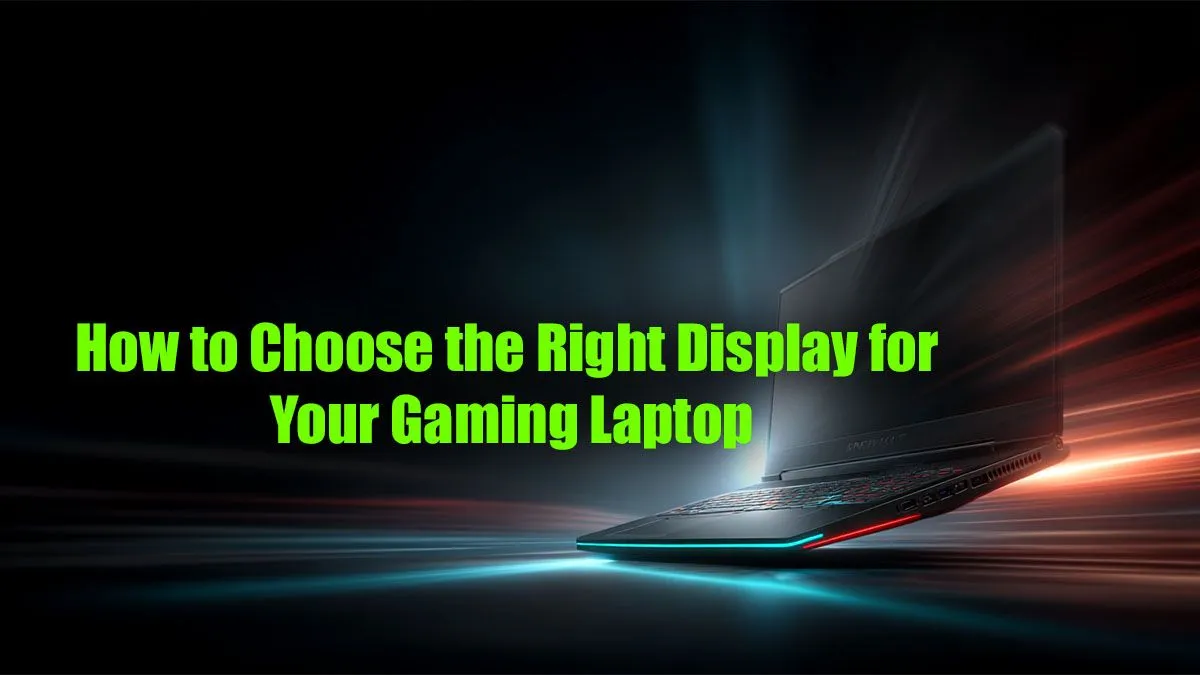
You've just dropped a serious amount of ZAR on a laptop with a beastly GPU and a lightning-fast CPU. But what’s the point if the action looks blurry, washed out, or stutters? The gaming laptop display is your window to the virtual world, and choosing the wrong one is like buying a supercar and fitting it with retreads. Let’s make sure you get the immersive, crystal-clear experience you paid for. 🚀
The Core Specs: What Really Matters in a Gaming Laptop Display
Forget the marketing jargon for a second. To choose the perfect screen, you need to understand four key pillars: Resolution, Refresh Rate, Response Time, and Panel Type. Getting the balance right for your needs is everything.
Resolution: The Sweet Spot Between Sharpness and Speed
Resolution is simply the number of pixels on your screen. More pixels mean a sharper, more detailed image.
- 1080p (Full HD): The long-standing champion. It’s easy for most GPUs to run, meaning you get high frame rates. It's a great choice for competitive gamers who prioritise speed over everything else.
- 1440p (QHD): This is the new sweet spot for many South African gamers. It offers a significant jump in visual clarity over 1080p without demanding the insane power of a 4K display.
- 4K (UHD): The pinnacle of detail. It looks absolutely stunning in story-driven games but requires a top-tier (and pricey) GPU to run smoothly at high settings.
For most people, a QHD screen offers the best balance of performance and visual fidelity, making it a fantastic feature to look for in current laptop specials for sale in South Africa.
Refresh Rate (Hz): The Secret to Silky-Smooth Motion 🎯
Your refresh rate, measured in Hertz (Hz), is how many times your screen updates per second. A higher number means smoother motion, which is critical in fast-paced games.
- 60Hz: The old standard. It's fine for slower games but can look choppy in FPS titles like Valorant or Warzone.
- 120Hz/144Hz: A huge improvement. This is the baseline for a modern gaming laptop display, making gameplay feel fluid and responsive.
- 240Hz+: The competitive edge. For serious esports players, these ultra-high refresh rates provide the clearest possible picture of the action, reducing motion blur and helping you track targets more effectively.
If you're chasing wins, a high-refresh-rate panel is non-negotiable. You’ll find them on many of the best gaming laptop deals designed for performance.
Frame Rate vs. Refresh Rate 💡
Your GPU produces frames (FPS), and your display shows them (Hz). For the smoothest experience, you want your FPS to match or exceed your display's Hz. There's no point having a 240Hz screen if your GPU can only push 70 FPS in your favourite game!
Panel Technology: The Soul of the Screen
The type of panel determines colour, contrast, and viewing angles. The two main players are IPS and OLED.
- IPS (In-Plane Switching): The reliable all-rounder. IPS panels are famous for their excellent colour accuracy and wide viewing angles. They offer a fantastic experience for both gaming and content creation, striking a great balance between speed and beauty.
- OLED (Organic Light Emitting Diode): The visual superstar. OLED panels have pixels that produce their own light, allowing for perfect blacks, infinite contrast, and incredibly vibrant colours. They make cinematic games look breathtaking.
Beyond the Basics: Brightness and Colour Gamut
Once you've nailed the core specs, these final touches help you find the perfect gaming screen.
Colour Gamut: How Much of the Rainbow Can You See?
Colour gamut refers to the range of colours a display can reproduce. A wider gamut means more vibrant and lifelike images. For gamers, a screen covering close to 100% of the sRGB colour space is excellent. For those who also do creative work like video editing or graphic design, look for high coverage of the DCI-P3 space. These premium panels are often found in powerful workstation laptops that double as gaming rigs. ✨
Brightness (Nits): Beating the Glare
Brightness is measured in "nits." For comfortable indoor use, 300 nits is a solid baseline. If you often game in brightly lit rooms or near a window, aiming for 400 nits or more will help the screen stay clear and visible.
So, How Do You Choose the Perfect Screen?
The perfect gaming laptop display comes down to you.
- For the FPS Competitor: Prioritise a 165Hz+ refresh rate and a low response time. A 1080p or 1440p resolution is ideal to keep frame rates high.
- For the RPG Explorer: Go for visual quality. An OLED or a high-gamut IPS panel at 1440p or 4K will make your adventures unforgettable.
- For the All-Rounder: A 1440p QHD IPS display with a 144Hz-165Hz refresh rate is the undisputed champion, offering a brilliant mix of speed, clarity, and colour for any task.
Your screen is the final, crucial step in your gaming setup. Choose wisely, and you'll never look back.
Ready to See the Difference?
Choosing the perfect gaming laptop display transforms your experience from just playing to truly living the game. Armed with this knowledge, you're ready to pick a winner. Explore our massive range of gaming laptops and find the perfect screen to conquer your world.