Quick Answer
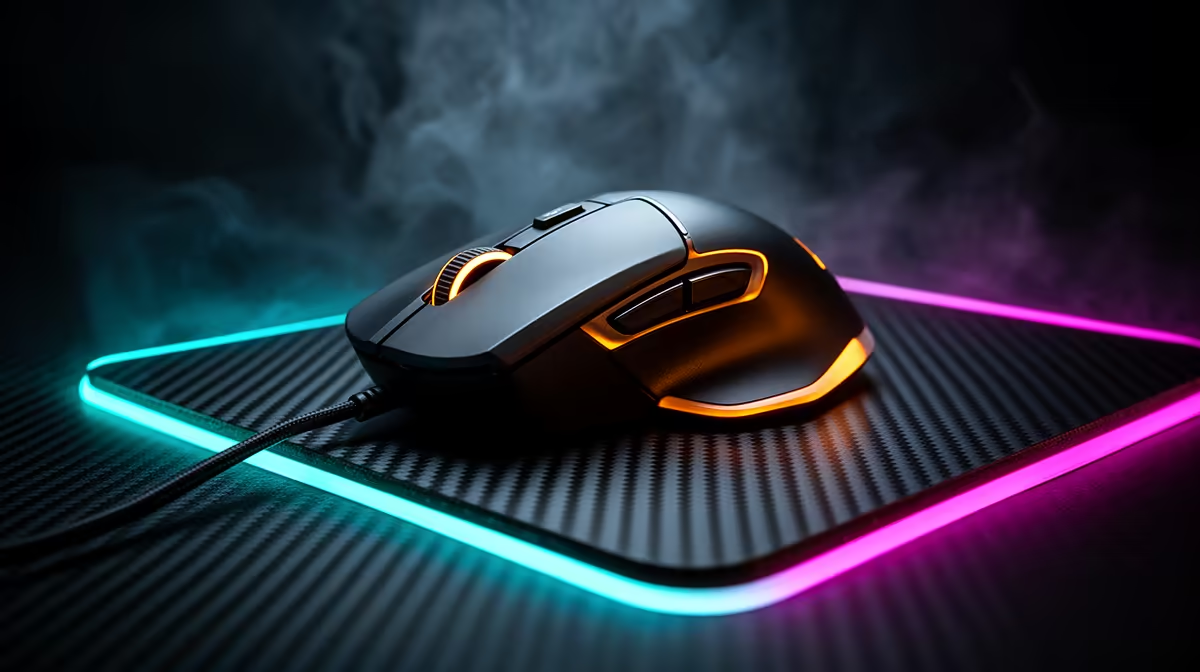
Choose a wireless gaming mouse by first confirming a native optical sensor (PixArt PAW3395 or equivalent), an effective DPI range of 400 to 3,200 for competitive play, and either optical or quality mechanical switches rated at 60 million clicks or more. These three specs together define whether a mouse performs consistently, not the marketing headline on the box.
Decoding Sensor Specifications 🔬
The sensor is the most important component in any gaming mouse. When evaluating a wireless mouse, look for the sensor model name rather than just the peak DPI number. A PixArt PAW3395 or PAW3950, Razer Focus Pro, or Logitech HERO 25K all offer native tracking at the advertised resolution, zero acceleration, and consistent performance across cloth, hard, and hybrid mousepad surfaces. Mice that list only a maximum DPI without naming the sensor model often use interpolation above their native ceiling, meaning cursor jitter increases at high DPI rather than resolution improving.
For practical play you will likely run between 400 and 1,600 DPI regardless of the sensor ceiling. What matters is sensor linearity within that range.
Understanding Switch Types for Wireless Mice 🖱️
Mechanical switches use physical contacts in varying actuation forces. Omron D2FC-F-7N switches are the benchmark at 50 million clicks, while Kailh GM 8.0 reaches 80 million. Both introduce a small debounce delay (typically 2 to 4 ms) to suppress contact bounce, imperceptible in normal use but measurable under lab conditions.
Optical switches replace the contact mechanism with a light gate. Razer Gen-4 optical switches carry a 90 million click rating, zero debounce delay, and no risk of double-click failure from contact oxidation. The trade-off is a slightly different click feel that some users find less tactile than a crisp mechanical switch.
Matching DPI Range to Your Game and Sensitivity 🎯
Your effective DPI should be chosen based on mousepad size and preferred arm movement style. South African competitive players commonly use 400 or 800 DPI with a large mousepad (at minimum 900 x 400 mm). If your desk space is limited, 1,600 DPI gives usable precision on a standard 350 x 280 mm mat without forcing extreme in-game sensitivity.
For wireless mice specifically, confirm that the DPI you intend to use is a native step rather than interpolated. Wireless models from Razer (Viper V3 HyperSpeed, DeathAdder V3 HyperSpeed) and Logitech (G Pro X Superlight 2) are available in South Africa in the R1,500 to R2,800 range.
Check the Wireless Protocol Before You Buy ⚡
Only 2.4 GHz proprietary wireless (Razer HyperSpeed, Logitech Lightspeed) delivers sub-1 ms latency for competitive gaming. Bluetooth 5.0 adds variable delay and is not suitable for ranked play. Always confirm the connection type before purchasing.
FAQ
How do I know if a mouse sensor is truly native at a given DPI?
Check independent reviews that test for sensor linearity and jitter at multiple DPI steps. If jitter increases significantly above a certain DPI, the sensor is interpolating above that point.
Does the wireless connection affect sensor accuracy?
No. The sensor reports to onboard firmware first; the wireless protocol then transmits the processed data. Sensor accuracy is unaffected by connection type, though a weak wireless signal can cause cursor stuttering via packet loss.
What wireless gaming mice are currently stocked in South Africa?
Evetech stocks wireless gaming mice from Razer, Logitech, SteelSeries, and HyperX from around R800 for entry-level wireless options up to R3,000 for flagship models.
Find your ideal wireless gaming mouse.
Evetech stocks the full range of performance wireless mice with verified sensor specs and local warranty support. Visit Evetech to compare models by sensor, switch type, and price.