Quick Answer
Optimise high-wattage power delivery for overclocked hardware by using an ATX 3.1 compliant PSU with 20 to 30 percent headroom above your peak measured draw, ensuring the 12V rail stays within plus or minus 1 percent under load, using native cables rather than adapters, and validating stability with sustained stress tests at South African ambient temperatures before committing to final overclock settings.
Selecting PSU Wattage for an Overclocked System 🔧
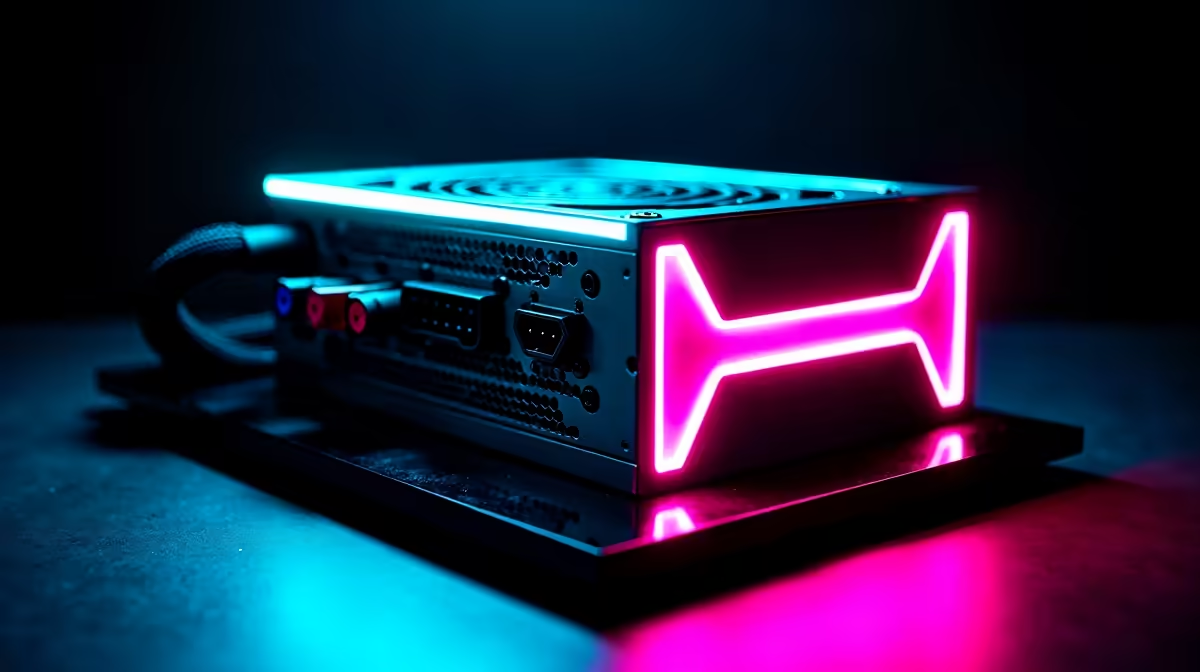
Overclocking changes the power delivery equation significantly. A Ryzen 9 9950X at stock draws around 170 to 200W under full multi-core load. With an aggressive PBO profile and manual voltage tuning, the same chip draws 220 to 260W. An RTX 5090 at stock draws approximately 575W peak; a power limit increase to 120 percent raises this to 690W. Combined with DDR5, NVMe storage, and case fans, a fully overclocked flagship build sustains 900 to 950W and produces transient spikes above 1,200W during scene transitions. For this configuration, a 1200W ATX 3.1 Gold or Platinum unit is the minimum recommendation. Locally, 1200W ATX 3.1 Gold units are stocked at Evetech from approximately R4,200 to R6,000.
Monitoring Voltage Rails and Cable Quality 🖥️
Voltage stability is the critical metric for overclocked power delivery. A PSU that delivers 12.0V at idle but drops to 11.6V under full gaming load is outside the 3 percent tolerance and will cause instability before any temperature limit is reached. Use a hardware monitor reading voltages from the motherboard's super I/O chip in real time, or choose a PSU with a built-in OLED display. Target 12V rail stability within plus or minus 1 percent, meaning 11.88V to 12.12V under maximum overclocked load. A dip below 11.8V during stress testing means the PSU is undersized or has poor voltage regulation. At high current, use native cables from the PSU manufacturer: they are tested for the unit's output characteristics. A single native 12V-2x6 cable is preferable to an adapter from two 8-pin connectors, which adds connector resistance that increases voltage drop under high current.
Stress Test in SA Summer Temperatures ⚡
Run your overclock stability test during a warm afternoon when room temperature is at its daily peak, not at midnight when the room is cool. A stable overclock at 22 degrees Celsius ambient may crash at 33 degrees if PSU voltage regulation is marginal under heat. Testing in real local conditions catches stability issues that international benchmarks in climate-controlled labs may not reveal.
FAQ
Does overclocking RAM affect PSU requirements significantly?
DDR5 memory overclocked to 7,200 MT/s draws marginally more power than at JEDEC speeds, typically 5 to 15W more for a 32GB dual-channel kit. This is small relative to CPU and GPU increases but should be included in wattage calculations for a fully overclocked system.
Should I disable PSU overcurrent protection for overclocking?
Leave overcurrent protection enabled. Modern ATX 3.1 PSUs set OCP thresholds above rated current with sufficient margin to avoid false trips during normal transients. Disabling OCP removes a critical hardware safeguard and can allow a failing component to draw uncontrolled current, potentially damaging the GPU, motherboard, and PSU simultaneously.
How long should I stress test to confirm overclocked stability?
A minimum of 30 minutes of simultaneous CPU and GPU stress is a practical baseline: run a CPU stress tool and GPU benchmark concurrently. For a mission-critical workstation, extend this to four hours to catch thermal-related instability that only emerges after the system reaches fully saturated temperatures.
Building an overclocked powerhouse?
Evetech stocks high-wattage ATX 3.1 power supplies from 1000W to 1600W suited to overclocked CPU and GPU combinations. Browse the power supply section to find the right unit for your performance build.